




author avatar
Mark Chandik

Feb 13, 2023

Housing Thaw

Weekly Market Commentary

Rising interest rates are the result of the Federal Reserve’s campaign to snuff out inflation. The pain of rising rates has been felt in the financial sector. It has also been felt in housing.

Housing sales tumbled since the beginning of 2022, as the jump in mortgage rates forced many buyers to the sidelines. Existing home sales fell a whopping 38% last year, according to the National Association of Realtors.

The decline was foreshadowed by a leading index for home sales called the Purchase Index from the Mortgage Bankers Association.
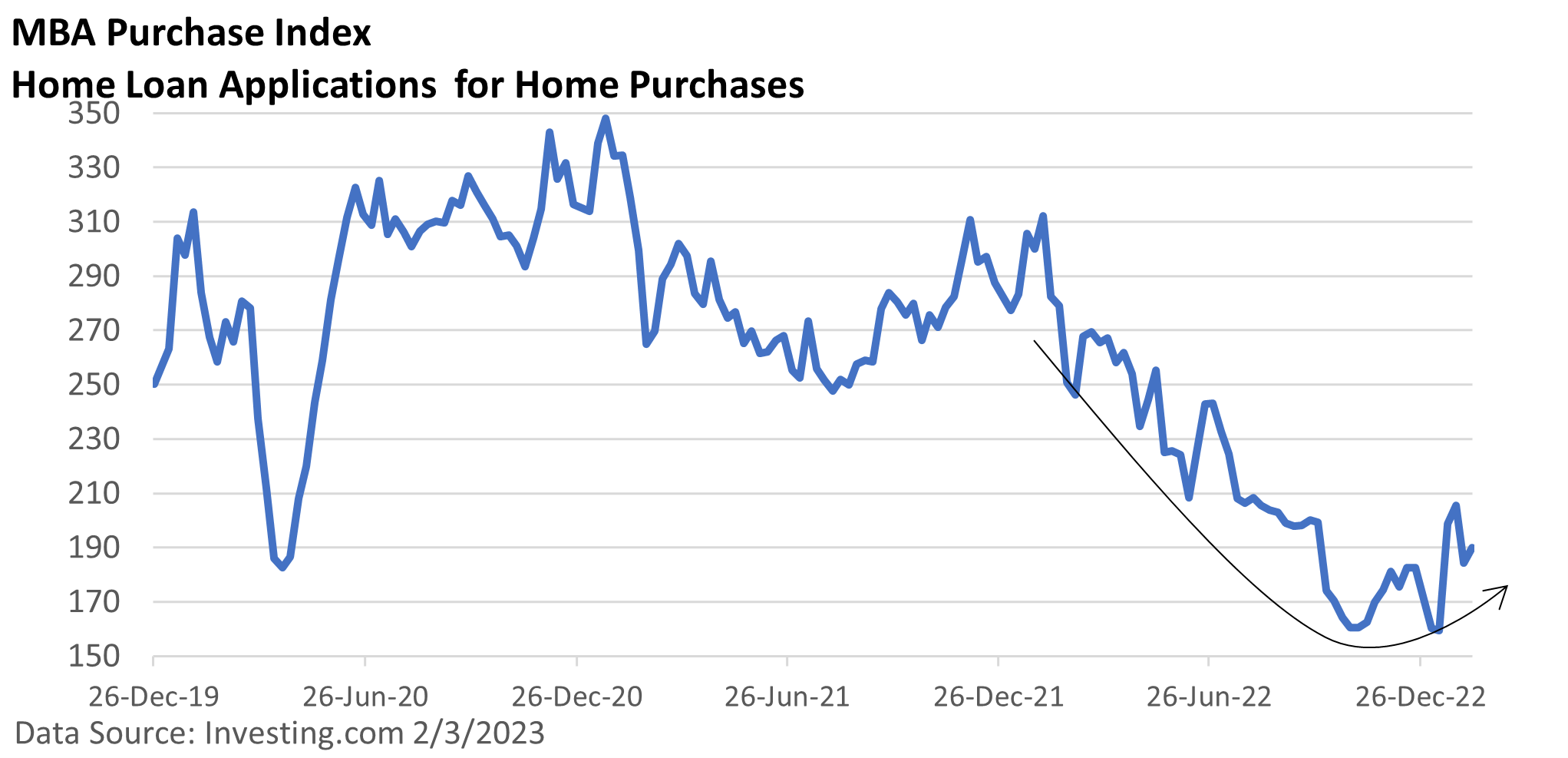
The Purchase Index is a weekly measure of home loan applications for home purchases, so it provides a reasonably accurate sneak peek of upcoming sales.

Tied to the spike in mortgage rates, the sharp decline in sales last year led to a modest dip in home prices in many locations.

So far, homeowners have been spared the pain of 2008 thanks to more realistic lending standards. No longer are buyers jumping into mortgage products they neither understand nor can afford.

Additionally, the spike in rates discouraged some from listing their homes, as they’d be trading in a very low rate for one that is much higher. That helped restrict supply on the market.

The Power of Rates

Freddie Mac’s weekly mortgage survey put the 30-year fixed mortgage rate at 3.11% as of the week ending December 30, 2021. The benchmark rate peaked at 7.08% in early November.

The 30-year fixed rate declined to 6.12% as of the week ending February 9.

Housing is rate sensitive. While rates are nowhere near the levels that sparked the buying frenzy in 2020 and 2021, the recent drop has sparked renewed interest in homes, according to data from the Purchase Index.

As the year unfolds, much will depend on the direction of mortgage rates.

author avatar
Mark Chandik

Reproduction Prohibited without Express Permission. Copyright FDP Wealth Management. All rights reserved. Advisory Services offered through FDP Wealth Management, LLC, a state Registered Investment Adviser and Valmark Advisers, Inc. a SEC Registered Investment Advisor. Securities offered through ValMark Securities, Inc., Member FINRA/SIPC. 130 Springside Drive, Suite 300, Akron, OH 44333-2431 800.765.5201 Prosperity Partners and FDP Wealth Management, LLC are separate entities from ValMark Securities, Inc. and Valmark Advisers, Inc. Prosperity Partners, FDP Wealth Management, LLC, ValMark Securities, Inc., Valmark Advisers Inc., and their representatives do not offer tax advice. You should consult your tax professional regarding your individual circumstances. Indices are unmanaged and cannot be invested directly in. Past performance is not a guarantee of future results.

Indices are unmanaged and do not incur fees, one cannot directly invest in an index. You should consult your tax professional regarding your individual circumstances. This information is provided by Financial Jumble, LLC. Financial Jumble, LLC is a separate entity from ValMark Securities, Inc. and ValMark Advisers, Inc.

RELATED POSTS

Retail Sales Surge on Higher Gasoline Prices

The Nasdaq hit fresh record highs on Wednesday, Thursday, and Friday, capping off a strong week for tech stocks. On Wednesday, the S&P 500 also made history, closing above 7,000 for the first time. It kept building on those gains through the end of the week.

Stocks Rise to New Highs

The Nasdaq hit fresh record highs on Wednesday, Thursday, and Friday, capping off a strong week for tech stocks. On Wednesday, the S&P 500 also made history, closing above 7,000 for the first time. It kept building on those gains through the end of the week.

Inflation Heats Up as Gasoline Prices Surge

Led by a 10.9% rise in energy, including a 21% rise in gasoline, the US Bureau of Labor Statistics reported that the Consumer Price Index (CPI) rose 0.9% in March, the highest in almost four years. On an annual basis, prices rose 3.3%.

It’s Not Just Oil – Key Commodities That May Soon Be in Short Supply

Oil has captured much of the attention amid the conflict in the Middle East. While a limited number of tankers are transiting the region, the Strait of Hormuz is largely blocked, disrupting nearly one-fifth of the world’s oil supply.

California’s Delicate Energy Situation

How long the war might last is not clear, but its effects are being felt in global energy markets. Oil moves easily across borders, which means supply disruptions quickly lead to higher gasoline prices.