





author avatar
Mark Chandik

Jul 10, 2023

Cracks Appear in the Labor Market

Weekly Market Commentary

It has been a surprising year for the labor market, as job growth has been much more resilient than anticipated.

According to CNBC, the U.S. Bureau of Labor Statistics’ monthly nonfarm payrolls report has surpassed analyst expectations for 14-straight months, that is, until June’s report came up short.

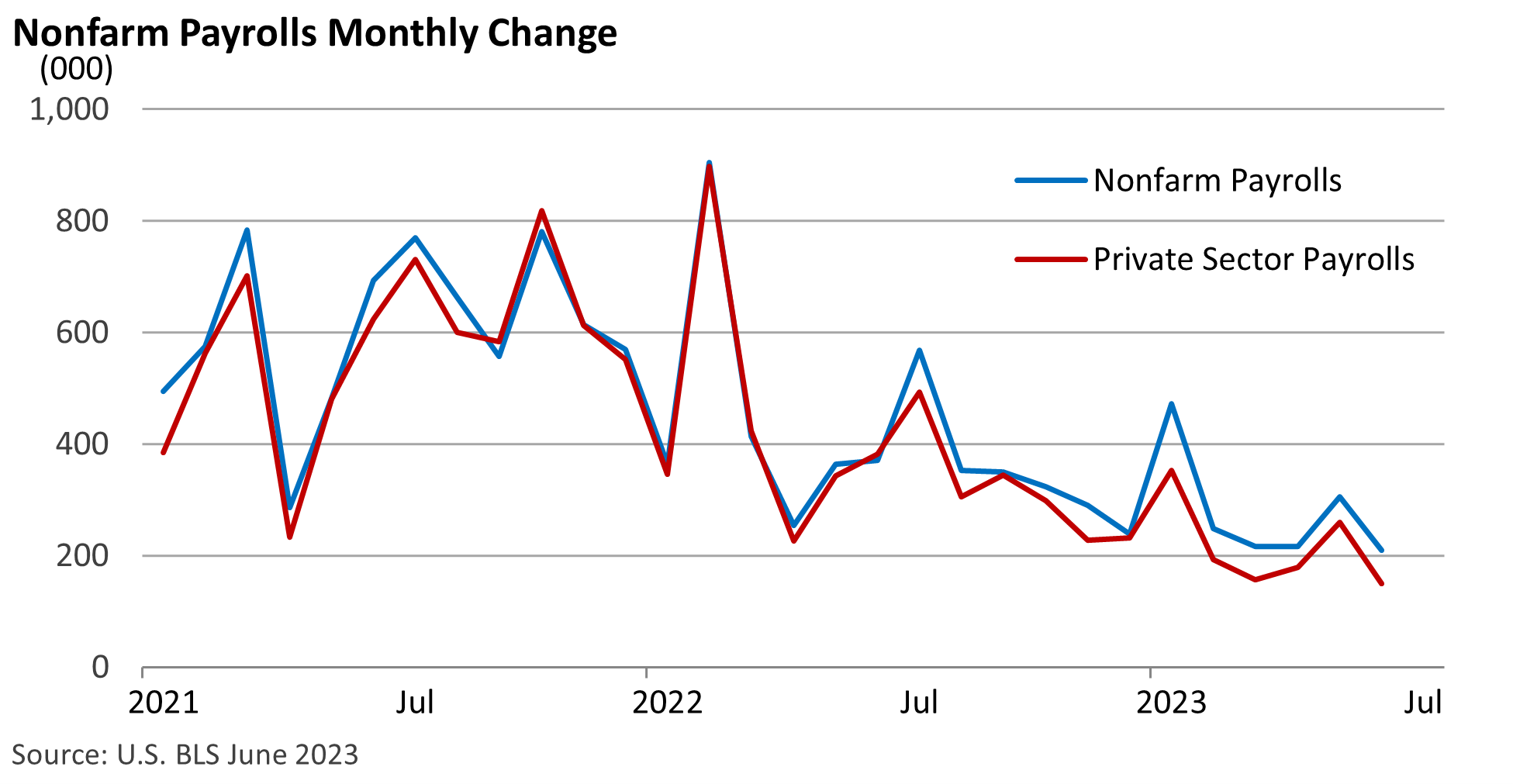
Nonfarm payrolls in June increased by 209,000, which was lower than the forecast of 240,000 (CNBC). Additionally, the figures for April and May were revised down by 110,000.

Although the figure of 209,000 was shy of expectations, the overall headline number is respectable. Further analysis shows that growth was aided by government employment (federal, state, local, and education), which increased by 60,000 in June.

That translates into 149,000 new private-sector jobs, marking the weakest reading since a 268,000 pandemic-influenced drop in December 2020.

It’s worth providing some context for June’s private-sector number. The 149,000 increase was the lowest monthly reading since December 2019 (excluding the shutdown in early 2020 and the decline in December of the same year), which saw a rise of 93,000.

With the revisions, private sector jobs have been below 200,000 in four of the last five months. At no time during 2021 and 2022 did private-sector payroll growth slip below 200,000.
It is not recessionary, nor does it signal that the economy is on the cusp of a recession, but job growth is finally slowing down.

Despite economic uncertainty, the economy has managed to avoid a downturn. However, it seems that the Fed could be approaching a peak in rates as payroll growth begins to slow down.

A more rapid decrease in the rate of inflation would further support this notion. However, it may require a recession or significant economic slowdown to prompt rate cuts.

author avatar
Mark Chandik

Reproduction Prohibited without Express Permission. Copyright FDP Wealth Management. All rights reserved. Advisory Services offered through FDP Wealth Management, LLC, a state Registered Investment Adviser and Valmark Advisers, Inc. a SEC Registered Investment Advisor. Securities offered through ValMark Securities, Inc., Member FINRA/SIPC. 130 Springside Drive, Suite 300, Akron, OH 44333-2431 800.765.5201 Prosperity Partners and FDP Wealth Management, LLC are separate entities from ValMark Securities, Inc. and Valmark Advisers, Inc. Prosperity Partners, FDP Wealth Management, LLC, ValMark Securities, Inc., Valmark Advisers Inc., and their representatives do not offer tax advice. You should consult your tax professional regarding your individual circumstances. Indices are unmanaged and cannot be invested directly in. Past performance is not a guarantee of future results.

Indices are unmanaged and do not incur fees, one cannot directly invest in an index. You should consult your tax professional regarding your individual circumstances. This information is provided by Financial Jumble, LLC. Financial Jumble, LLC is a separate entity from ValMark Securities, Inc. and ValMark Advisers, Inc.

RELATED POSTS

Retail Sales Surge on Higher Gasoline Prices

The Nasdaq hit fresh record highs on Wednesday, Thursday, and Friday, capping off a strong week for tech stocks. On Wednesday, the S&P 500 also made history, closing above 7,000 for the first time. It kept building on those gains through the end of the week.

Stocks Rise to New Highs

The Nasdaq hit fresh record highs on Wednesday, Thursday, and Friday, capping off a strong week for tech stocks. On Wednesday, the S&P 500 also made history, closing above 7,000 for the first time. It kept building on those gains through the end of the week.

Inflation Heats Up as Gasoline Prices Surge

Led by a 10.9% rise in energy, including a 21% rise in gasoline, the US Bureau of Labor Statistics reported that the Consumer Price Index (CPI) rose 0.9% in March, the highest in almost four years. On an annual basis, prices rose 3.3%.

It’s Not Just Oil – Key Commodities That May Soon Be in Short Supply

Oil has captured much of the attention amid the conflict in the Middle East. While a limited number of tankers are transiting the region, the Strait of Hormuz is largely blocked, disrupting nearly one-fifth of the world’s oil supply.

California’s Delicate Energy Situation

How long the war might last is not clear, but its effects are being felt in global energy markets. Oil moves easily across borders, which means supply disruptions quickly lead to higher gasoline prices.