





Dec 28, 2023

Home Prices Defy Conventional Wisdom

Weekly Market Commentary

Mortgage rates have soared, and home sales are down sharply. Conventional wisdom would suggest that prices should be down. But housing prices have defied expectations, rising to record heights and locking first-time buyers out of the market.

First of all, real estate is local. What’s happening in one market may not mirror what’s occurring in another market.

For example, a recent story on CNBC cites a big drop in prices in Austin, Texas. But that is the exception, not the rule.

Why have prices defied gravity? During the financial crisis, home prices fell sharply, as sales dried up and buyers defaulted on mortgages, flooding the market with unsold homes.

Sales of existing homes (homes that are owned and occupied before being put on the market) are down close to 40% from the peak, according to the National Association of Realtors.

They account for roughly 90% of all housing sales. New builds account for the rest.

During the 2000s, builders threw caution to the wind and churned out new homes at a torrid pace. Once bitten twice shy, builders turned cautious after the crisis, limiting supply. Moreover, much tougher lending standards reduce the risk of default.

But paradoxically, the rise in mortgage rates has also discouraged those who want to move simply because they are reluctant to trade a low mortgage rate for a much higher one.

That has reduced the supply of homes available for sale, forcing buyers to compete for the limited supply that remains.
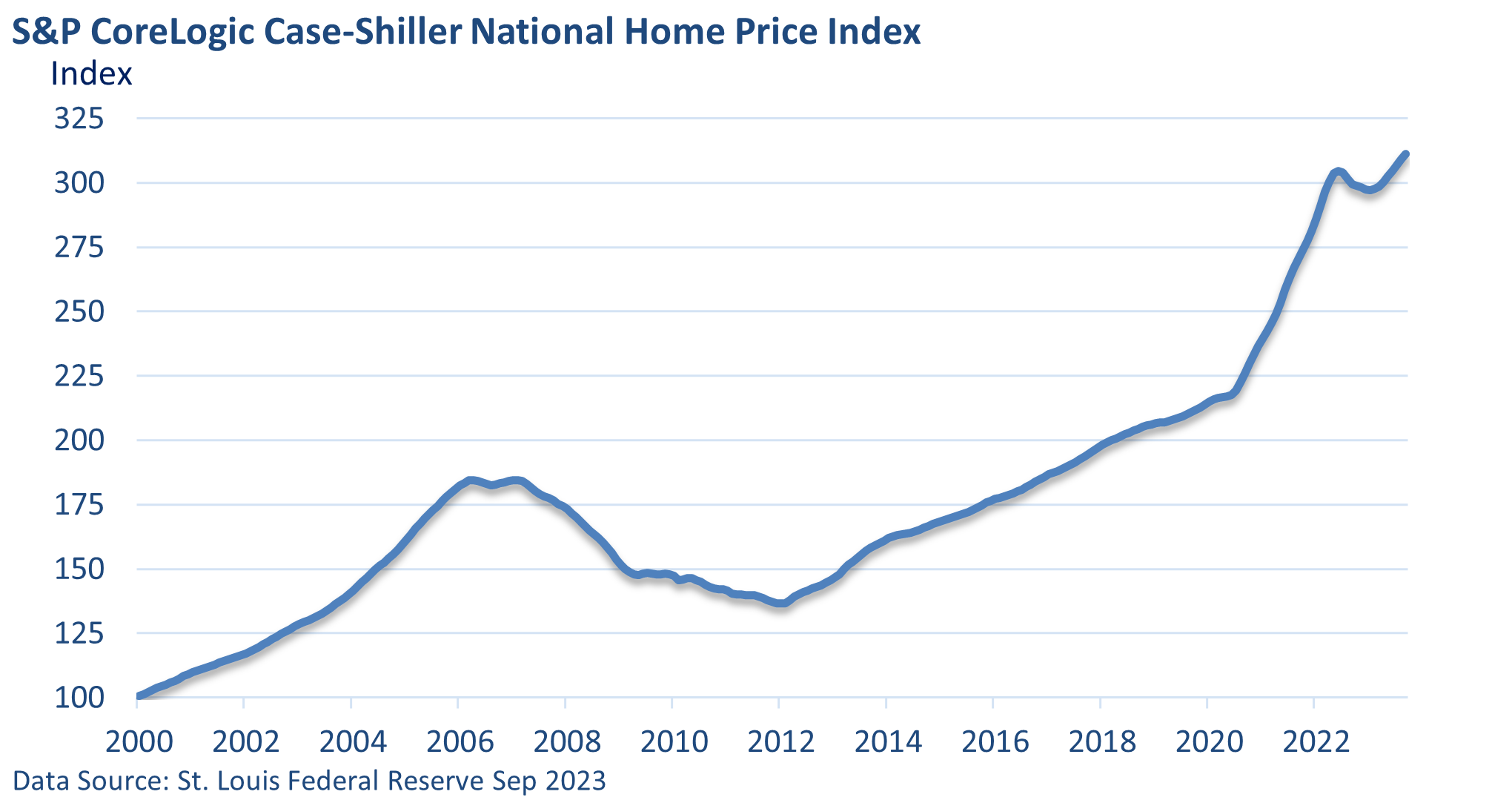
The graphic below illustrates that the National Home Price Index is at a record high.

Notably, rock-bottom mortgage rates during 2020 and most of 2021 boosted demand and accelerated price gains. However, the recent increase in rates had only a short-lived and limited negative impact on prices.
The 30-the fixed mortgage rate averaged 6.67% in the week ending December 21, down from the peak two months ago of 7.79%. As expectations reset, that may bring some new buyers into the market. It could also slowly encourage reluctant sellers to list their homes.

Reproduction Prohibited without Express Permission. Copyright FDP Wealth Management. All rights reserved. Advisory Services offered through FDP Wealth Management, LLC, a state Registered Investment Adviser and Valmark Advisers, Inc. a SEC Registered Investment Advisor. Securities offered through ValMark Securities, Inc., Member FINRA/SIPC. 130 Springside Drive, Suite 300, Akron, OH 44333-2431 800.765.5201 Prosperity Partners and FDP Wealth Management, LLC are separate entities from ValMark Securities, Inc. and Valmark Advisers, Inc. Prosperity Partners, FDP Wealth Management, LLC, ValMark Securities, Inc., Valmark Advisers Inc., and their representatives do not offer tax advice. You should consult your tax professional regarding your individual circumstances. Indices are unmanaged and cannot be invested directly in. Past performance is not a guarantee of future results.

Indices are unmanaged and do not incur fees, one cannot directly invest in an index. You should consult your tax professional regarding your individual circumstances. This information is provided by Financial Jumble, LLC. Financial Jumble, LLC is a separate entity from ValMark Securities, Inc. and ValMark Advisers, Inc.

RELATED POSTS

Q4 Government Shutdown Drags on GDP; Supreme Court Blocks Tariff Plan

The government shutdown proved to be a far greater drag on the economy than earlier estimates indicated. On Friday, the U.S. BEA reported that fourth-quarter Gross Domestic Product (GDP), the largest measure of economic output, grew at a 1.4% annualized pace. This compares with a 4.4% annualized pace in Q3.

Revisiting 2025 Employment

The US Bureau of Labor Statistics published its final benchmark revisions covering employment during the 12‑month period between April 2024 and March 2025. The revisions showed that payrolls were revised lower by 898,000 jobs compared with the originally reported figures.

Markets Rotate: What’s Driving the Shift; Plus, the Dow Crosses a Milestone

After leading markets for much of the past two years, AI, tech stocks, and software specifically, are losing leadership in early 2026, as investors rotate capital toward other sectors, including energy, industrials, and defensive sectors.

January Barometer Flashes Green, a Sleepy Fed Gathering

The so-called January Barometer holds that the market’s performance in January—measured by the S&P 500 Index—tends to foreshadow how stocks will perform during the year. Since 1970, January finished higher 33 times and fell 23 times, excluding this month’s increase of 1.37% (MarketWatch data, excludes reinvested dividends).

It’s Hard to Say Good-bye: What Persistently Low Layoffs Say About the Economy

Much has been made of the sluggish hiring environment, but less attention has been paid to an important counterpoint: the persistently low level of layoffs. Figure 1 highlights the number of individuals who go online or head to their respective state’s unemployment office and file for benefits following a layoff.