





author avatar
Mark Chandik

Mar 5, 2024

Waiting… and Waiting for the Other Shoe to Drop

Weekly Market Commentary

What is consumer spending? Loosely defined, consumer spending is the ‘stuff’ we buy. It is the goods and services we purchase. It is groceries, clothes, entertainment, health care, auto repair, insurance, appliances, utilities, wireless service, and much more.

Why is consumer spending important to the economy? Well, spending by consumers accounts for almost 70% of total economic activity in the U.S., according to the U.S. Bureau of Economic Analysis (BEA).

The monthly release of consumer spending is much broader than the monthly retail sales report. Retail sales, as the name suggests, tallies the amount of goods purchased at retailers. You know, the stuff you’d buy at the store or online.

Consumer spending includes goods and services. According to the U.S. BEA, the dollar amount spent on services tops goods. Therefore, it is a comprehensive report.

Unlike monthly retail sales, consumer spending is adjusted for inflation. To clarify, if a business sells ten items for $10 in one month, its sales are $100. If it raises the price next month to $11 and sells ten items, its sales will be $110. However, when we adjust for inflation, sales are unchanged, as we exclude the price hike.

This is a very high-level explanation. The straightforward example helps explain how the data are adjusted for inflation. You see, economists aim to capture changes in volume/quantity.

That said, let’s review what’s been happening over the past couple of years. As the graphic illustrates, spending has been rising.

We occasionally get pullbacks, as in January, but pullbacks have been minor. Spending has been up in eight of the last ten months. A similar pattern existed in 2022.
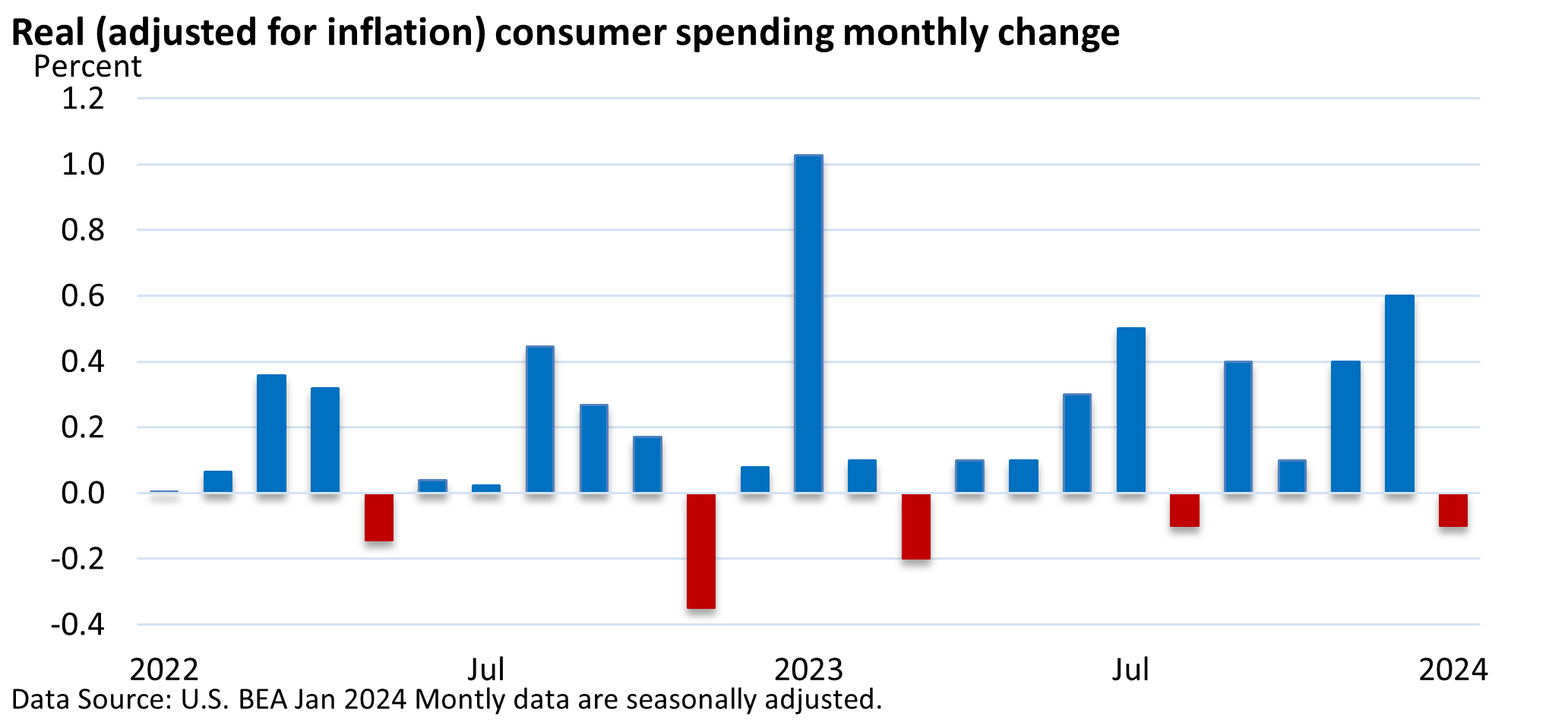
The widely expected recession in 2023 never materialized, as illustrated above. It’s been four steps forward and a small step back over the last year.

A recession will eventually occur. It’s inevitable. However, the consumer has been resilient in the face of higher prices and interest rates.

Those waiting for the other shoe to drop, well, are still waiting.

author avatar
Mark Chandik

Reproduction Prohibited without Express Permission. Copyright FDP Wealth Management. All rights reserved. Advisory Services offered through FDP Wealth Management, LLC, a state Registered Investment Adviser and Valmark Advisers, Inc. a SEC Registered Investment Advisor. Securities offered through ValMark Securities, Inc., Member FINRA/SIPC. 130 Springside Drive, Suite 300, Akron, OH 44333-2431 800.765.5201 Prosperity Partners and FDP Wealth Management, LLC are separate entities from ValMark Securities, Inc. and Valmark Advisers, Inc. Prosperity Partners, FDP Wealth Management, LLC, ValMark Securities, Inc., Valmark Advisers Inc., and their representatives do not offer tax advice. You should consult your tax professional regarding your individual circumstances. Indices are unmanaged and cannot be invested directly in. Past performance is not a guarantee of future results.

Indices are unmanaged and do not incur fees, one cannot directly invest in an index. You should consult your tax professional regarding your individual circumstances. This information is provided by Financial Jumble, LLC. Financial Jumble, LLC is a separate entity from ValMark Securities, Inc. and ValMark Advisers, Inc.

RELATED POSTS

A Hotter August CPI Builds Rate Hike Momentum

First, let’s clarify that any attempt to predict the Federal Reserve’s actions this week is, at best, an educated guess. Fed Chair Kevin Warsh has struck a hawkish tone, and the odds of a quarter-point increase in the fed funds rate are 87%, according to the CME Group. It was 59% on September 4.

Behind the Jobs Report

On Friday, the US Bureau of Labor Statistics (BLS) reported that nonfarm payrolls rose by a much greater-than-expected 162,000 jobs in August. The unemployment rate held steady at 4.1%.

Location Location Location

The graphic below compares the change in home prices, adjusted for inflation, for various US cities. For example, the average USA home price has topped inflation by 238% since 1948. Why has there been such a wide trajectory in prices, and why have they proven so persistent?

Rising Yields Faily to Derail Stocks

This year, the stock market has risen significantly. Lingering worries about oil prices, inflation, the war with Iran, and the possibility of an AI bubble haven’t subsided. But the economy is expanding, corporate profits have been strong, and the S&P 500 Index set a new high last week, according to the Wall Street Journal.

All Gas, No Brakes: Profits Soar in Q2

In a solid earnings season, we’d generally expect S&P 500 companies to deliver double-digit profit growth, meaning earnings growth of at least 10% versus a year ago (20% tops). That’s not a hard-and-fast rule, but it provides a useful benchmark for evaluating the strength of a quarter.