





author avatar
Mark Chandik

Jan 12, 2026

Soft December Hiring Underscores Tepid Year

On Friday, the U.S. Bureau of Labor Statistics reported that nonfarm payrolls increased by 50,000 in December, underscoring a year of persistently sluggish job growth.

The unemployment rate offered a glimmer of optimism, edging down to 4.4%. November’s 4.6% rate was revised to 4.5%.

Despite upbeat economic growth, businesses have scaled back hiring after rapidly adding employees in 2022, as the economy reopened.

The unemployment rate is low, suggesting some equilibrium between the demand and supply of workers. Layoffs measured by first-time claims for unemployment insurance signal that layoffs are low, but firms aren’t adding many new jobs.

It’s what many economists are calling a “low hire, low fire” economy. Note the number of long-term unemployed (jobless for 27 weeks or more) is up by 397,000 versus one year ago (US BLS).

The graphic below sheds some light on job creation in 2025.
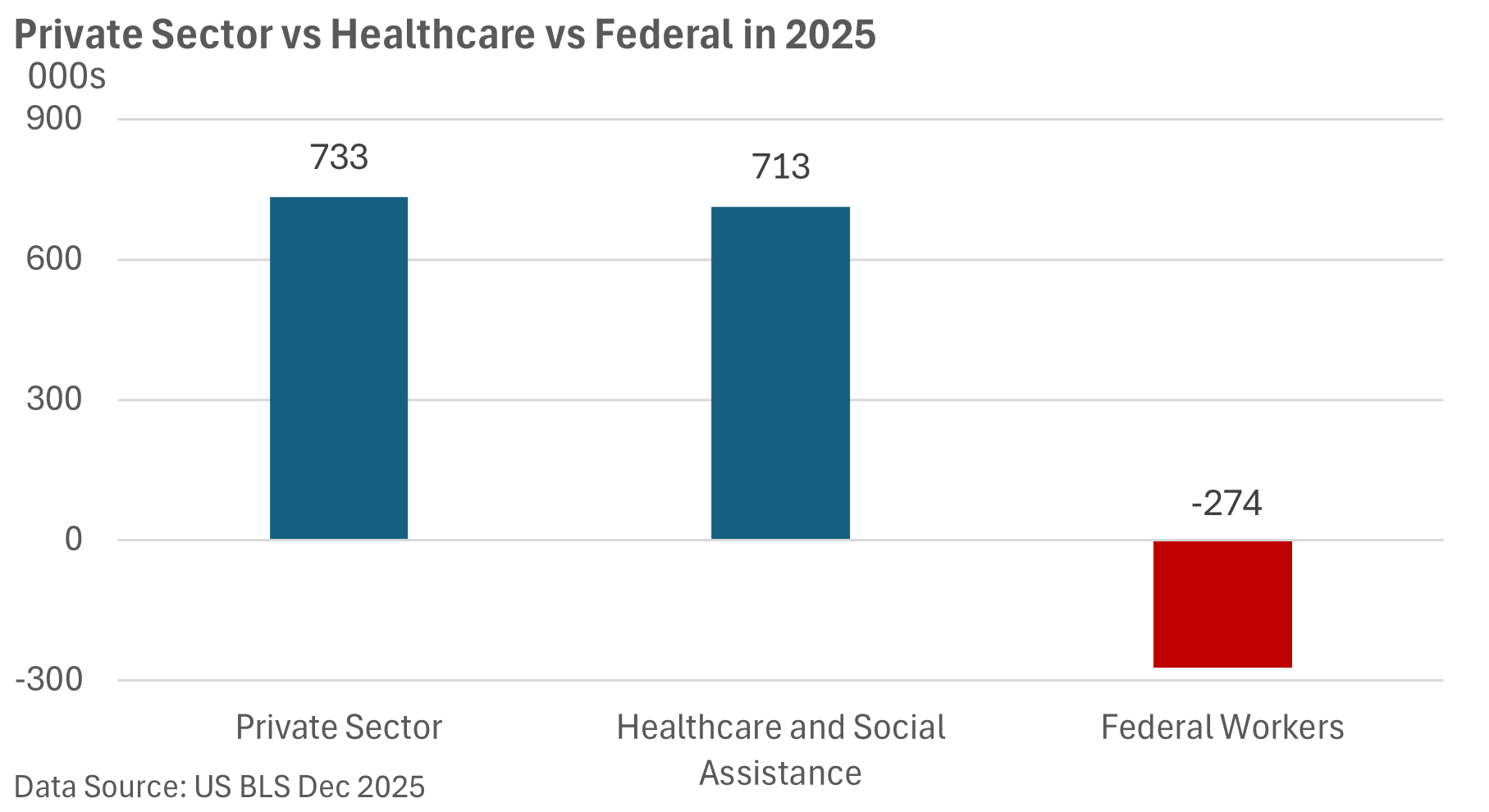
During 2025, private-sector payrolls rose by 733,000, with nearly all the gains occurring in one sector—healthcare. Meanwhile, the federal workforce was down by 274,000 last year. Manufacturing shed 68,000 positions.

For investors, economic growth equates to earnings growth at the nation’s largest companies. But there has been a disconnect between solid economic growth and subdued job gains.

While the drop in the jobless rate lowers already low odds of a January rate cut per a closely followed gauge from the CME Group, there’s little to suggest the Fed will abandon its accommodative stance anytime soon.

On Friday, the Dow and the S&P 500 Index both closed at record highs.

author avatar
Mark Chandik

Reproduction Prohibited without Express Permission. Copyright FDP Wealth Management. All rights reserved. Advisory Services offered through FDP Wealth Management, LLC, a state Registered Investment Adviser and Valmark Advisers, Inc. a SEC Registered Investment Advisor. Securities offered through ValMark Securities, Inc., Member FINRA/SIPC. 130 Springside Drive, Suite 300, Akron, OH 44333-2431 800.765.5201 Prosperity Partners and FDP Wealth Management, LLC are separate entities from ValMark Securities, Inc. and Valmark Advisers, Inc. Prosperity Partners, FDP Wealth Management, LLC, ValMark Securities, Inc., Valmark Advisers Inc., and their representatives do not offer tax advice. You should consult your tax professional regarding your individual circumstances. Indices are unmanaged and cannot be invested directly in. Past performance is not a guarantee of future results.

Indices are unmanaged and do not incur fees, one cannot directly invest in an index. You should consult your tax professional regarding your individual circumstances. This information is provided by Financial Jumble, LLC. Financial Jumble, LLC is a separate entity from ValMark Securities, Inc. and ValMark Advisers, Inc.

RELATED POSTS

Rising Mortgage Rates: A Consequence of Higher Treasury Yields

Mortgage rates have moved sharply higher in recent months, creating a noticeable headwind for homebuyers and homeowners looking to refinance.

When Bad News Is Good News

Released by the US Bureau of Labor Statistics (BLS), September’s nonfarm payroll report came in lighter than expected, and the unemployment rate unexpectedly inched higher.

Rising Bond Yields and the Stock Market

“Bond Selloff Deepens After 30-Year Yield Hits Highest Level Since 2004,” declared Bloomberg News last week. CNBC echoed the sentiment with “10-Year Treasury Yield Rockets to 19-Year High.”

The Fed Hikes Rates: What Investors Should Know

In his opening remarks in a speech last month at the Federal Reserve Bank of Kansas City’s Economic Symposium, Fed Chief Kevin Warsh said, “(Event) planners have some recreation options lined up for later today.

A Hotter August CPI Builds Rate Hike Momentum

First, let’s clarify that any attempt to predict the Federal Reserve’s actions this week is, at best, an educated guess. Fed Chair Kevin Warsh has struck a hawkish tone, and the odds of a quarter-point increase in the fed funds rate are 87%, according to the CME Group. It was 59% on September 4.