




Why 2%? That particular number evolved over a number of years and is a research paper in its own right.
But briefly, it leaves a buffer that helps prevent a destructive slide into deflation (falling prices and falling wages), while small price increases typically don’t factor into buying or financial decisions of businesses and consumers.
Think of it like a typical 1970s, high-inflation conversation. “Bob, I’m thinking of buying a _____.” Bob’s typical response: “You’d better buy today because it will rise in price next month.”
For perspective, let’s take it one step further:
- 2% annual inflation ⇒ prices double in about 36 years
- 3% inflation ⇒ doubles in about 24 years
- 4% inflation ⇒ about 18 years
- 5% inflation ⇒ about 14 years
- 7% inflation ⇒ about 10 years
Using the Rule of 72 as a guide
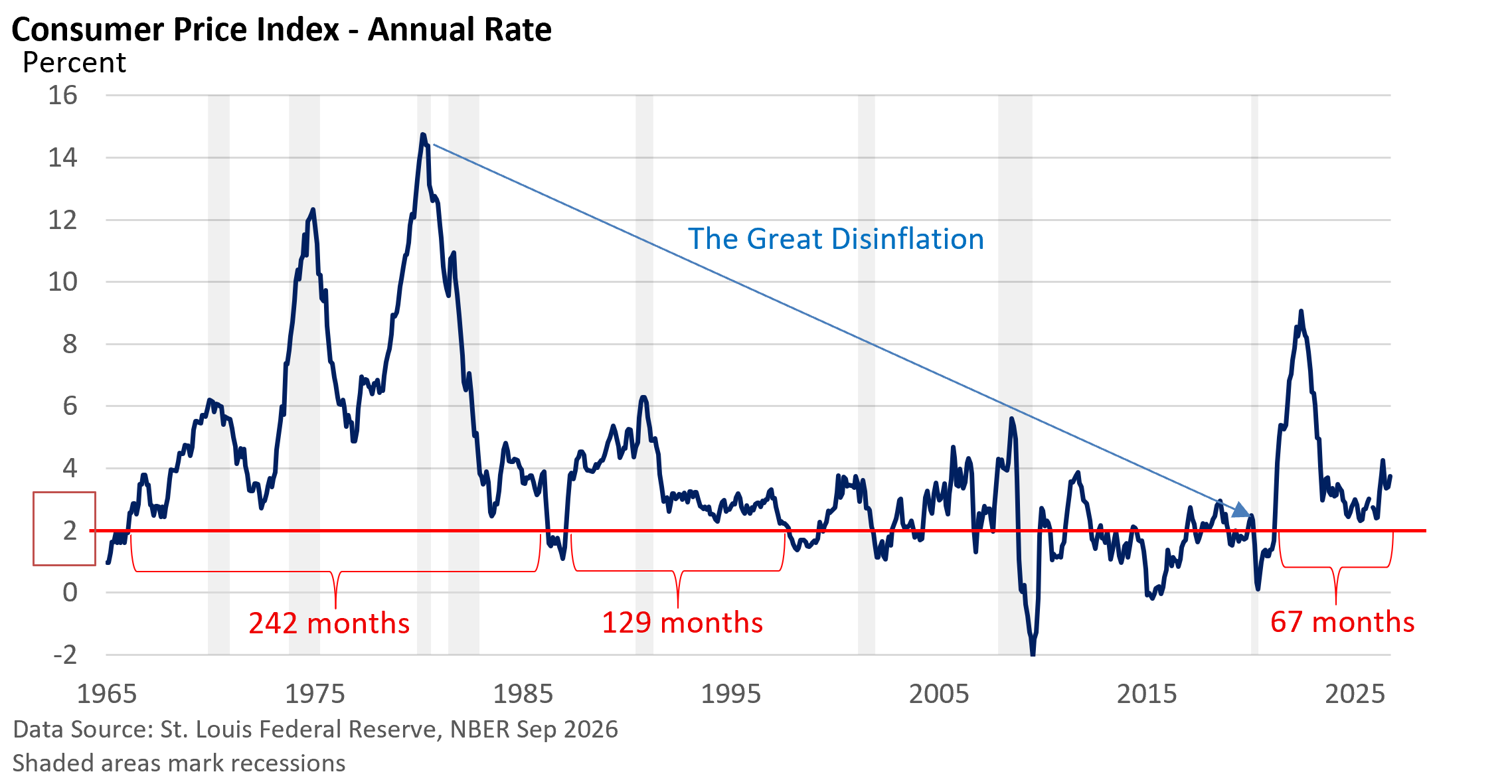
In September, the Consumer Price Index rose at an annual rate of 3.7%, per the US BLS.
Inflation is ultimately a byproduct of Federal Reserve monetary policy, according to many economists. If so, how has inflation stacked up against the 2% target?
Using the CPI as a yardstick, the Fed has exceeded its target for 67 months. It’s the third longest period since 1965. Inflation wasn’t a major issue in the 1950s and early 1960s.
Meanwhile, workers across various industries demand larger wage increases to keep pace with rising living costs, putting additional upward pressure on prices.
Once inflation expectations become entrenched, restoring price stability becomes far more difficult, requiring a more restrictive monetary policy that greatly raises the risk of recession.
The 1981-82 downturn provides a stark example: only after interest rates reached exceptionally high levels did inflation begin a sustained retreat.
For investors, higher rates are a double-edged sword. If interest rates rise, earnings on savings increase, while higher rates and higher bond yields usually increase headwinds for stocks.
Higher bond yields put downward pressure on bond prices (yields and bond prices move in the opposite direction). This is particularly true for longer-term bonds.
Besides, a rising cost of living places added pressure on those who rely on a fixed income.
Today’s inflation is far from the levels last seen in the 1970s. But attaining the Fed’s 2% target has been elusive.
