




Oct 26, 2026

The End of an Era – The Disappearance of Cheap Stuff

To better understand what’s been happening to inflation, let’s take a long-term look at two major inflation categories: the price of services and consumer goods.
Categories defined

Services include items such as utilities, travel, recreation, hotels, sporting events, insurance, doctor visits, concerts, Internet, and rent. Of course, it excludes consumer goods.

Consumer goods excluding food and energy include household items like soap, toilet paper, and toothpaste. It would also include cleaning products, clothing, toys, and various items you buy online that aren’t meant to last long term. Durable goods are also included in this category.

Durable goods are goods designed to last over three years, such as appliances, furniture, electronics, and autos. They are a subset of consumer goods.

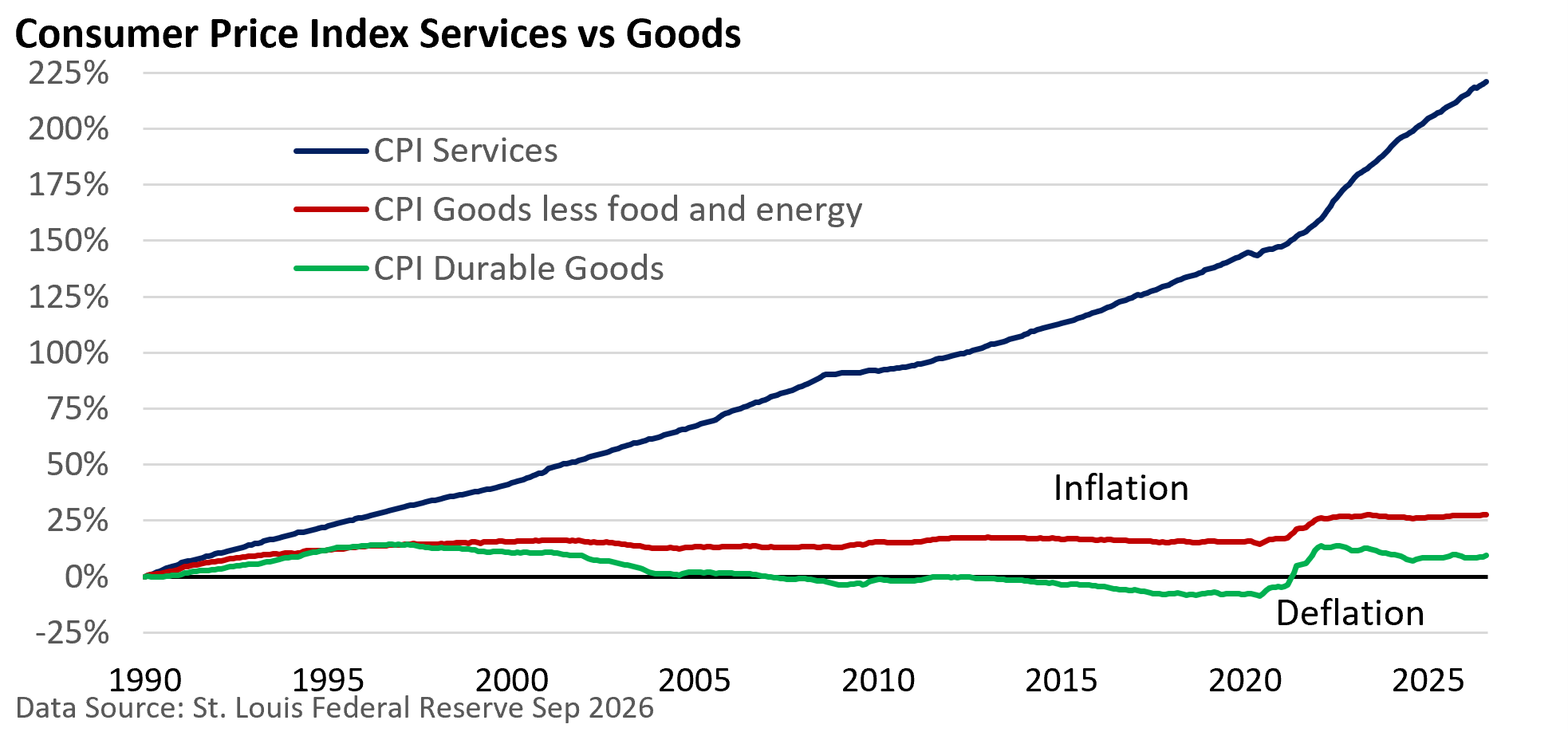
So, what stands out in the chart? The price of services has steadily marched higher over the last 35 years and has far outpaced the cost of everyday household items.

Consumer goods, however, were very stable between the early 2000s and the pandemic. The most striking trend was durable goods, which actually fell in price during the 2000s and 2010s.

Why were consumer goods so stable during the 20-year period prior to severe supply chain disruptions tied to the pandemic?

  1. Foreign competition, globalization, and the rise of goods imported cheaply from China.
  2. Technological improvements that increase efficiency in manufacturing.
  3. Excess global capacity exacerbates intense foreign competition.
  4. Periods of strength in the dollar (lowers the cost of imports).

All in all, globalization and foreign competition helped keep a lid on goods prices for much of the past two decades.

But services tell a different story. You can buy a television from a manufacturer halfway around the world, but you cannot rent a local apartment from a foreign competitor or attend a hometown concert, theater
performance, or sporting event supplied from overseas.

Today, consumer goods inflation remains below services inflation, but prices are edging higher in a sector that was once accustomed to outright price declines—deflation.

Reasons include the AI buildout, which is raising prices for some components amid strong demand, a reconfiguration of supply chains, tariffs, and higher transportation and raw material costs.

As the Federal Reserve gathers this week to decide on interest rates, various policy goals and economic complexities that help support the economy also complicate the path back to price stability.

author avatar
Mark Chandik

Reproduction Prohibited without Express Permission. Copyright FDP Wealth Management. All rights reserved. Advisory Services offered through FDP Wealth Management, LLC, a state Registered Investment Adviser and Valmark Advisers, Inc. a SEC Registered Investment Advisor. Securities offered through ValMark Securities, Inc., Member FINRA/SIPC. 130 Springside Drive, Suite 300, Akron, OH 44333-2431 800.765.5201 Prosperity Partners and FDP Wealth Management, LLC are separate entities from ValMark Securities, Inc. and Valmark Advisers, Inc. Prosperity Partners, FDP Wealth Management, LLC, ValMark Securities, Inc., Valmark Advisers Inc., and their representatives do not offer tax advice. You should consult your tax professional regarding your individual circumstances. Indices are unmanaged and cannot be invested directly in. Past performance is not a guarantee of future results.

Indices are unmanaged and do not incur fees, one cannot directly invest in an index. You should consult your tax professional regarding your individual circumstances. This information is provided by Financial Jumble, LLC. Financial Jumble, LLC is a separate entity from ValMark Securities, Inc. and ValMark Advisers, Inc.

RELATED POSTS

The New Railroads: Deconding the AI Boom

The AI boom has introduced an entirely new vocabulary. Just a few years ago, terms like OpenAI, Anthropic, hyperscalers, GPUs, and compute were mostly confined to niche tech circles. Today, they dominate headlines and boardroom conversations.

Stocks and Elections

Stocks surged in a broad-based rally on Wednesday. But sentiment shifted abruptly on Thursday as investors assessed the outcome and its potential implications for the dominant technology and AI trade. That reassessment triggered a sharp pullback, sending shares much lower.

The American Economic Boom

You’d never know it from sluggish job growth or consumer surveys showing confidence near rock bottom levels, but economic indicators that measure actual activity tell a much different story, with many indicators reflecting a surprising degree of strength.

Is Inflation Becoming Entrenched in the Economic Fabric?

Congress has long tasked the Federal Reserve with pursuing two core objectives: price stability and maximum employment, commonly known as the Fed’s dual mandate.

Rising Mortgage Rates: A Consequence of Higher Treasury Yields

Mortgage rates have moved sharply higher in recent months, creating a noticeable headwind for homebuyers and homeowners looking to refinance.