





author avatar
Mark Chandik

Apr 13, 2026

Inflation Heats Up as Gasoline Prices Surge

Led by a 10.9% rise in energy, including a 21% rise in gasoline, the US Bureau of Labor Statistics reported that the Consumer Price Index (CPI) rose 0.9% in March, the highest in almost four years. On an annual basis, prices rose 3.3%.

If food, which was unchanged, and energy are excluded, the core CPI rose 0.2%. It was up 2.6% from one year ago. Economists closely watch this so-called core measure in an effort to better capture inflation’s underlying trend.
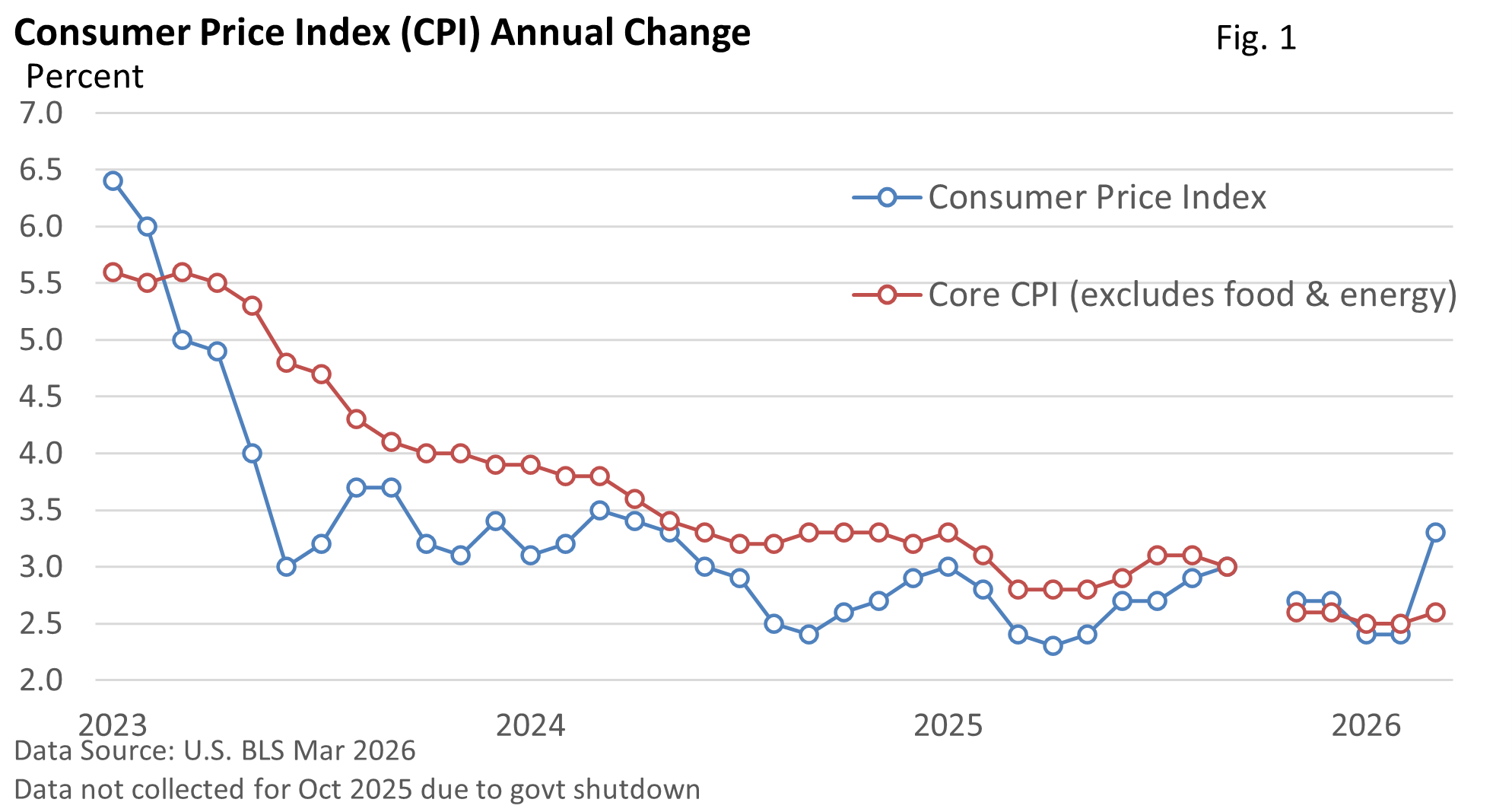
It comes as no surprise that the CPI surged last month amid the sharp rise in gasoline prices.
Otherwise, outside of energy, the CPI was less discouraging.

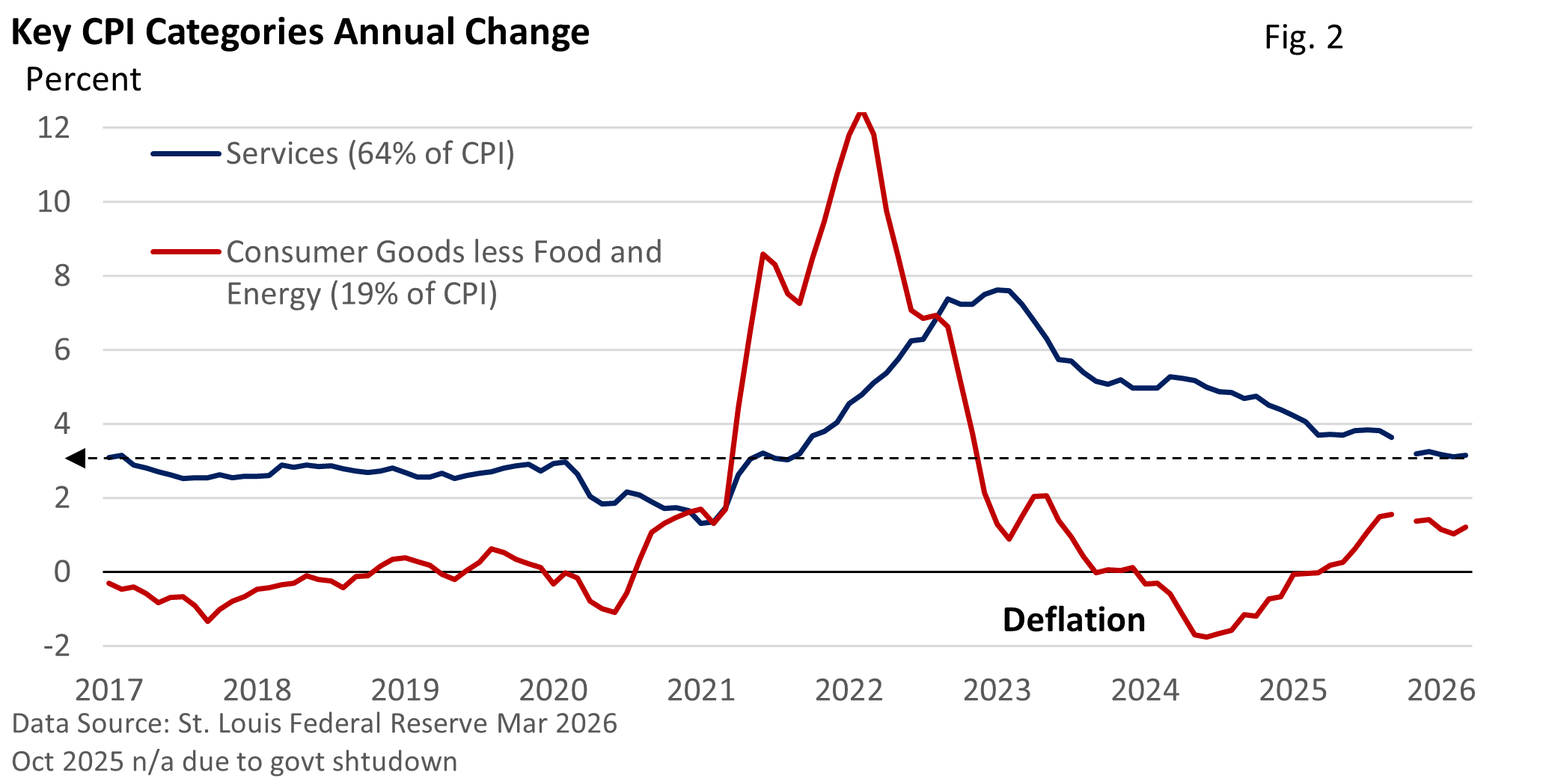
Let’s review Figure 2, which breaks the CPI into two key categories: services and consumer goods.

As supply chains normalized in the wake of the pandemic, inflation in consumer goods slowed sharply and briefly slipped into deflationary territory. Services inflation proved to be more persistent, but it has since eased back toward pre-pandemic levels.

More recently, however, inflation in consumer goods has re‑accelerated.
Oil has captured much of the attention amid the conflict in the Middle East. While a limited number of tankers are transiting the region, the Strait of Hormuz is largely blocked, disrupting nearly one-fifth of the world’s oil supply.

But it’s not simply oil. Let’s look at three other key commodities that originate from the region.

  1. About one-third of the world’s helium comes from Qatar and flows through the Strait of Hormuz, according to the United States Geological Survey (USGS). It’s not simply party balloons that are affected. Helium is essential in the production of computer chips.

“Currently in our own domestic economy, helium is more valuable than foreign oil because it’s used to cool the processing of semiconductors and there is no substitute for it,” said Todd Schoenberger, CIO at CrossCheck Management.

A prolonged shortage could have a significant impact on semiconductor manufacturing.
Where does the world’s helium come from?

  • 44% United States
  • 34% Qatar
  • 10% Russia
  • 6% Algeria
  • 6% Other

Source: USGS, Reuters, 2025

  1. The world’s supply of fertilizer is being impacted by the war. Countries exposed to disruptions account for nearly 50% of global exports of urea—a widely used nitrogen fertilizer—and about 30% of global ammonia exports, according to the US Farm Bureau.

Though the US does not directly import large quantities of fertilizer from the Middle East, fertilizer markets, like oil, respond to price movements in the region. Lower global crop yields would likely lift food prices if the Strait remains blocked for an extended period.

  1. Persian Gulf Coast countries produced about 6 million metric tons of aluminum in 2025, representing about 9% of global aluminum output, according to the International Aluminum Institute.

The damage from last week’s attack on Emirates Global Aluminum and Aluminum Bahrain’s facilities is still being assessed, according to the companies and S&P Global.

The US relies on imports for about 60% of aluminum, USGS data shows (Reuters). Gulf nations accounted for 22% of US aluminum imports last year. Because aluminum is used early and repeatedly in production chains, price increases can propagate quickly.

Key point: Aluminum is not a niche metal. It is a cost base for large parts of the economy, including autos, packaging, construction, machinery, electronics, and power transmission.

Clearly, the world is interconnected, and what happens in one region can ripple through global supply chains. But we are also mindful that we may not be having this conversation in a few months. Most observers, including the president, believe the war will end shortly.

author avatar
Mark Chandik

Reproduction Prohibited without Express Permission. Copyright FDP Wealth Management. All rights reserved. Advisory Services offered through FDP Wealth Management, LLC, a state Registered Investment Adviser and Valmark Advisers, Inc. a SEC Registered Investment Advisor. Securities offered through ValMark Securities, Inc., Member FINRA/SIPC. 130 Springside Drive, Suite 300, Akron, OH 44333-2431 800.765.5201 Prosperity Partners and FDP Wealth Management, LLC are separate entities from ValMark Securities, Inc. and Valmark Advisers, Inc. Prosperity Partners, FDP Wealth Management, LLC, ValMark Securities, Inc., Valmark Advisers Inc., and their representatives do not offer tax advice. You should consult your tax professional regarding your individual circumstances. Indices are unmanaged and cannot be invested directly in. Past performance is not a guarantee of future results.

Indices are unmanaged and do not incur fees, one cannot directly invest in an index. You should consult your tax professional regarding your individual circumstances. This information is provided by Financial Jumble, LLC. Financial Jumble, LLC is a separate entity from ValMark Securities, Inc. and ValMark Advisers, Inc.

RELATED POSTS

It’s Not Just Oil – Key Commodities That May Soon Be in Short Supply

Oil has captured much of the attention amid the conflict in the Middle East. While a limited number of tankers are transiting the region, the Strait of Hormuz is largely blocked, disrupting nearly one-fifth of the world’s oil supply.

California’s Delicate Energy Situation

How long the war might last is not clear, but its effects are being felt in global energy markets. Oil moves easily across borders, which means supply disruptions quickly lead to higher gasoline prices.

Decoding the Fed: Impact on Investors

Against the backdrop of the war, the Federal Reserve met last week and decided to hold its key rate—the fed funds rate—unchanged at 3.50–3.75%. The decision was completely expected.

Looking Past the Pump: A Granular Look at Gasoline Prices

There are fears that higher prices will exacerbate inflation and hurt the economy, as cash that might have gone to other items will be diverted to the gas tank.

The War and Its Impact – So Far

What is the efficient market theory? Textbooks have been written to fully explain the theory. But if we can sum it up in one sentence: Assets, such as stocks, reflect all publicly available information. It is a foundational principle of finance.