





Nov 21, 2022

A Big Pile of Cash on the Sidelines

Weekly Market Commentary

Recession fears are rampant. Interest rates are up, which discourages spending, and housing, a leading economic indicator, has fallen into a steep recession.

Reported on Friday, the Conference Board’s Leading Economic Index (LEI), which is designed to detect trends in advance, is down 8-straight months, including a sharp 0.8% decline in October.

Let’s back up for a moment. Congress’ response to the pandemic was to flood the economy with cash, including generous jobless benefits, tax credits, and stimulus checks. The extra cash boosted spending, but not all has been spent.

The Federal Reserve estimates that households still hold $1.7 trillion in government largesse, down from a peak of $2.3 trillion. It is excess savings over and above what households might otherwise have held if pre-pandemic trends had continued.
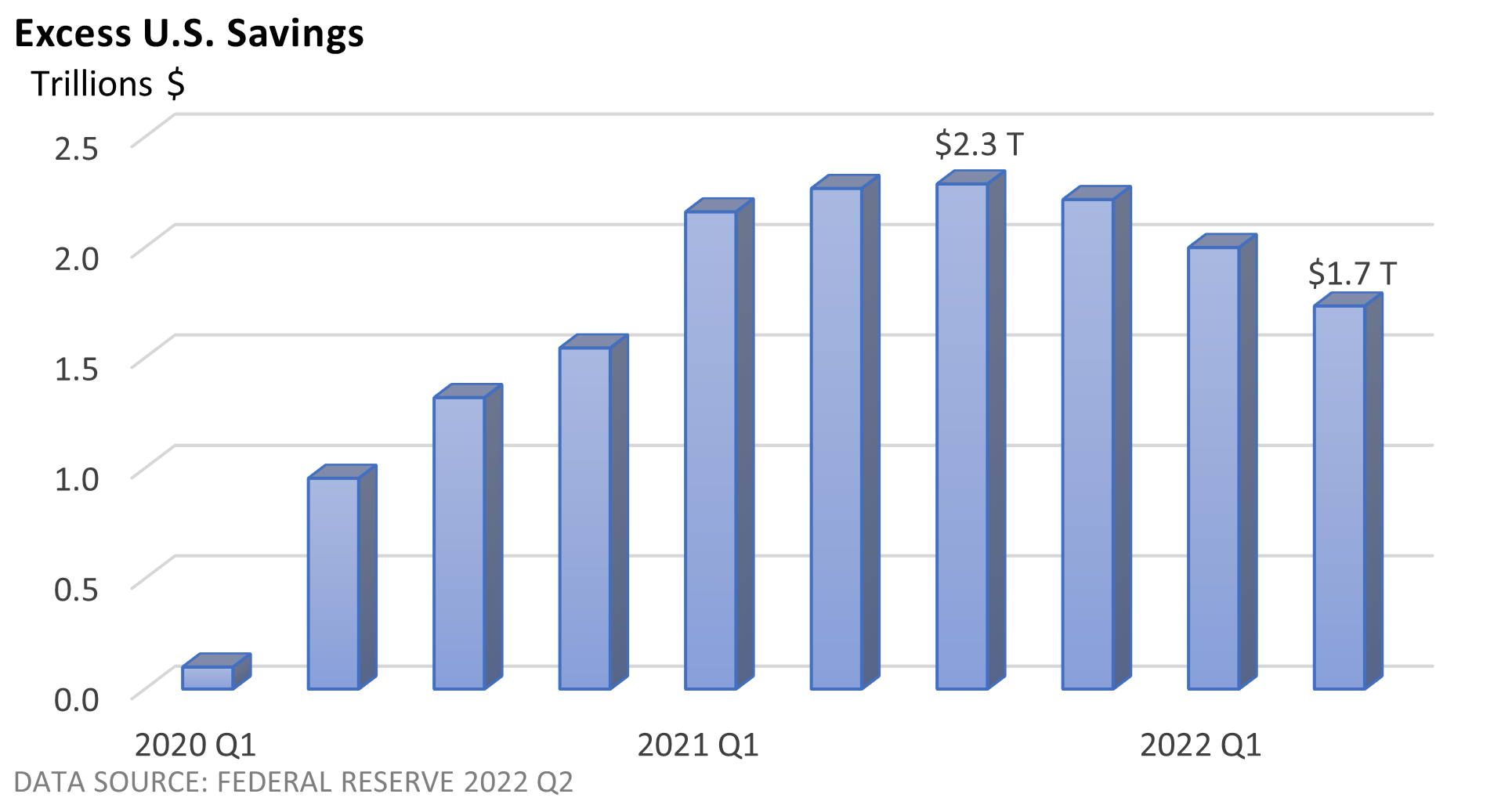
Why is this significant? Consumer spending accounts for 70% of the total economy, according to the U.S. Bureau of Economic Analysis.

Excess cash in the bank is aiding consumer spending, helping to bridge the gap of wage hikes that haven’t kept up with inflation.

A $1.7 trillion war chest is significant and could help mitigate some headwinds from Fed rate hikes and higher inflation.

But it could also complicate the Fed’s job, as it hopes to combat high inflation by slowing down the economy, bringing demand back in line with supply.

The Conference Board believes “a recession is likely to start around year-end and last through mid-2023.” However, economic forecasts are dicey, and the LEI does not make allowances for the mountain of cash that sits in savings.

Reproduction Prohibited without Express Permission. Copyright FDP Wealth Management. All rights reserved. Advisory Services offered through FDP Wealth Management, LLC, a state Registered Investment Adviser and Valmark Advisers, Inc. a SEC Registered Investment Advisor. Securities offered through ValMark Securities, Inc., Member FINRA/SIPC. 130 Springside Drive, Suite 300, Akron, OH 44333-2431 800.765.5201 Prosperity Partners and FDP Wealth Management, LLC are separate entities from ValMark Securities, Inc. and Valmark Advisers, Inc. Prosperity Partners, FDP Wealth Management, LLC, ValMark Securities, Inc., Valmark Advisers Inc., and their representatives do not offer tax advice. You should consult your tax professional regarding your individual circumstances. Indices are unmanaged and cannot be invested directly in. Past performance is not a guarantee of future results.

Indices are unmanaged and do not incur fees, one cannot directly invest in an index. You should consult your tax professional regarding your individual circumstances. This information is provided by Financial Jumble, LLC. Financial Jumble, LLC is a separate entity from ValMark Securities, Inc. and ValMark Advisers, Inc.

RELATED POSTS

The Job Market’s Missing Pulse

The government shutdown has been and will always be prominently featured in the 24-hour news cycle. Travelers are feeling it, furloughed federal employees wonder when they will receive their next paycheck, and even the housing market is affected as some buyers are left in limbo.

One Cut, Two Cut: The Fed’s Delicate Balancing Act

The Federal Reserve delivered a widely expected 25-basis-point rate cut (bp, 1 bp = 0.01%), but Fed Chief Jay Powell tempered market enthusiasm by signaling that a December cut is far from certain.

All That Glitters is Gold

On October 12, 2022, the S&P 500 Index hit a cyclical low. In hindsight, that marked the end of the 2022 bear market. Fast forward three years, and the current bull market has now been running for three years.

A Three-Year Anniversary

On October 12, 2022, the S&P 500 Index hit a cyclical low. In hindsight, that marked the end of the 2022 bear market. Fast forward three years, and the current bull market has now been running for three years.

Government Shutdowns: Why Investors Rarely Care

Historically, US government shutdowns have had minimal impact on the stock market. Let’s review the graphic below. Since 1976, government shutdowns of varying lengths have had little effect on stocks, as measured by the S&P 500 Index.