




Feb 24, 2025

Earnings Impress

On January 13th, the Wall Street Journal published an article entitled “Investors Hope Earnings Season Can Revive Faltering Stock Rally—With the Fed unlikely to cut interest rates as quickly as hoped, corporate earnings growth becomes even more critical.”

It’s not unusual to see a financial website write a story expressing concerns about the upcoming earnings season—in this case, Q4 2024.

As the season unfolds, we typically see firms top conservative profit estimates, and Q4 was no exception, per LSEG.

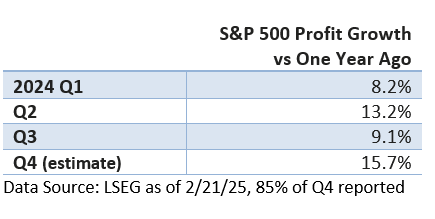
As the new year began, LSEG expected S&P 500 companies to report a 9.6% rise in profits compared to one year ago (estimate published by LSEG as of January 1).

With 85% of companies having reported Q4 results, LSEG’s survey pegs Q4 profit growth at 15.7%, the best showing in three years. That’s well ahead of the early forecast.

In part, strength in profits among some of the large tech firms is helping drive earnings growth. In part, the economy is expanding, and the public is spending money, which also supports corporate profits.
Stronger profits contributed to rising stocks during the current earnings season, and the S&P 500 Index achieved record closes last Tuesday and Wednesday, according to MarketWatch.

These records occurred before a selloff at the end of the week.

Other factors also influence the direction of equities, such as interest rates and the economic outlook.

Furthermore, developments related to tariffs may affect the economic outlook. Anxieties about tariffs have been an on-again, off-again headwind over the last month.

While the movement in stocks doesn’t have an immediate one-to-one correlation to corporate earnings, over a longer period, earnings have a significant impact on stocks.

Reproduction Prohibited without Express Permission. Copyright FDP Wealth Management. All rights reserved. Advisory Services offered through FDP Wealth Management, LLC, a state Registered Investment Adviser and Valmark Advisers, Inc. a SEC Registered Investment Advisor. Securities offered through ValMark Securities, Inc., Member FINRA/SIPC. 130 Springside Drive, Suite 300, Akron, OH 44333-2431 800.765.5201 Prosperity Partners and FDP Wealth Management, LLC are separate entities from ValMark Securities, Inc. and Valmark Advisers, Inc. Prosperity Partners, FDP Wealth Management, LLC, ValMark Securities, Inc., Valmark Advisers Inc., and their representatives do not offer tax advice. You should consult your tax professional regarding your individual circumstances. Indices are unmanaged and cannot be invested directly in. Past performance is not a guarantee of future results.

Indices are unmanaged and do not incur fees, one cannot directly invest in an index. You should consult your tax professional regarding your individual circumstances. This information is provided by Financial Jumble, LLC. Financial Jumble, LLC is a separate entity from ValMark Securities, Inc. and ValMark Advisers, Inc.

RELATED POSTS

An Uptick in the Unemployment Rate

The unemployment rate rose from 4.4% in September to 4.6% in November—see Figure 1. The US Bureau of Labor Statistics did not conduct its household survey in October due to the government shutdown. The household survey includes the unemployment rate

Fed Cuts Rates Again, Signals a Possible Pause

The Federal Reserve followed through on what was a widely expected rate cut, reducing the fed funds rate a quarter-percentage point (1 basis point = 0.01%) to a range of 3.50 – 3.75%.

Black Friday’s Spending Spree

A December 1 headline from Reuters sums up the start of the Christmas shopping season: US Holiday Shoppers Shake Off Economic Blues for Online Spending Spree.

Data Disconnect

Retailers are ringing up solid earnings, but consumer confidence surveys tell a different story, suggesting the mood is far from upbeat. This disconnect raises a big question: if shoppers are still buying, as we will highlight in a moment, why do they feel so uneasy about the economy?

Buyer’s Market – With Strings Attached

Redfin reported last week that sellers are grappling with the strongest buyer’s market since the real estate brokerage firm began compiling records back in 2013. Sellers now outnumber buyers by 37%.