





The sharp contraction in government outlays shaved 1.2 percentage points off overall Q4 GDP growth. Removing the impact of federal spending, GDP would have expanded by 2.6%.
Still, the most important driver of economic growth—consumer spending— remains positive.
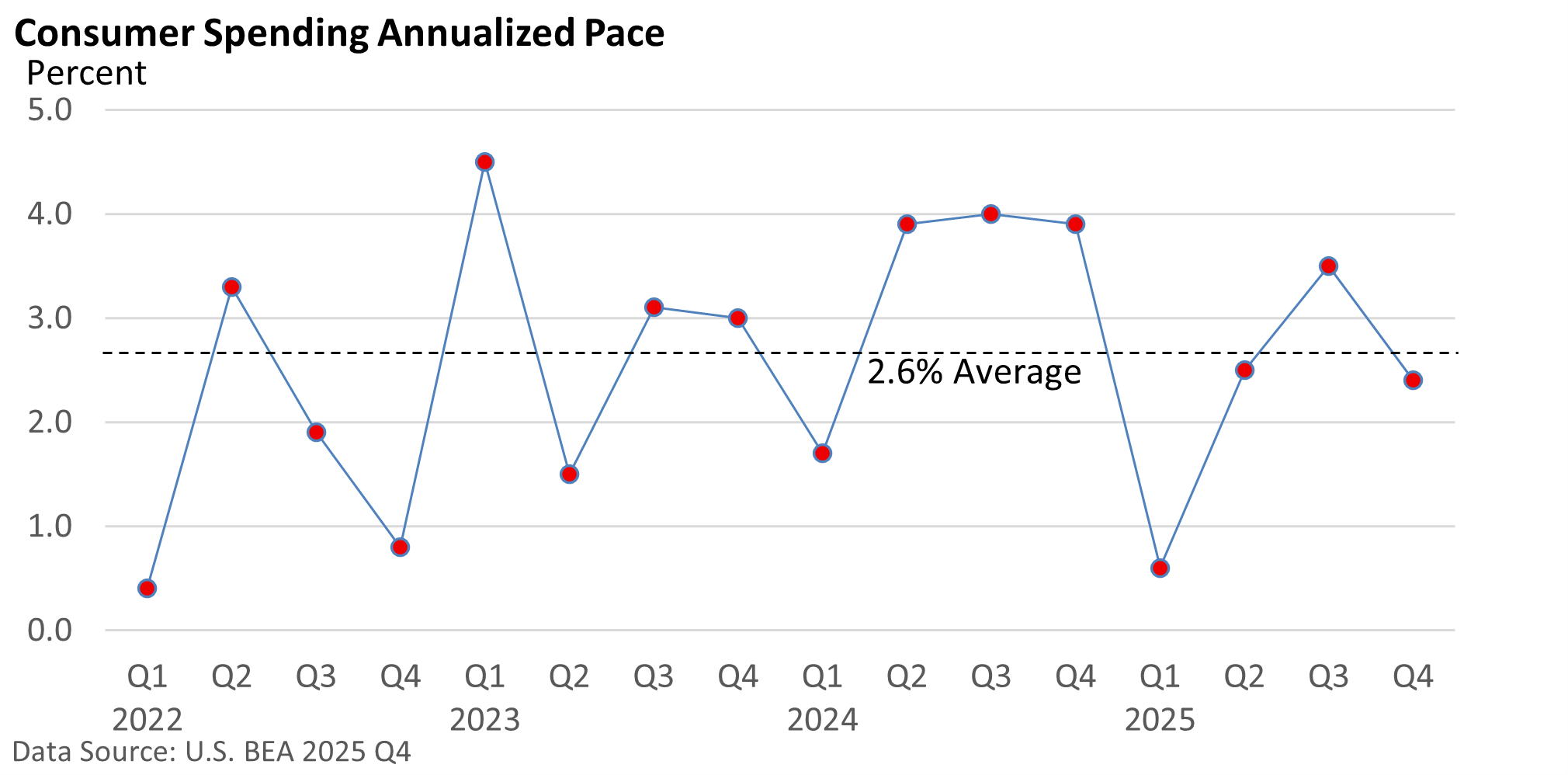
Consumer spending rose at an annualized rate of 2.4% in Q4 and is near the four-year average of 2.6%, according to US BEA data. In addition, business spending and investment continue to rise, partly driven by massive outlays for AI data centers.
Yet, according to Bloomberg, there are alternatives available to the president. The tools available generally require more time for investigation and offer less sweeping, immediate power than tariffs implemented using the IEEPA.
On Friday afternoon, the president announced his plan to impose a new 10% global tariff under Section 122 of the Trade Act of 1974. It is unclear whether any exceptions might arise, although such carve-outs seem reasonable. Tariffs enacted under this provision can stay in place for only 150 days unless Congress approves an extension.
If Congress declines to act, the administration could, at least in theory, allow the tariffs to lapse, declare a new balance-of-payments emergency, and restart the clock, per the Cato Institute.
From an economic standpoint, one aspect of the law has been clarified, but uncertainty over the next steps and their duration has introduced a new layer of unpredictability.
In summary, the decision wasn’t a big surprise, and the president had already indicated that backup plans were in place if his authority through IEEPA was limited or struck down. Stay tuned.
