





author avatar
Mark Chandik

Jan 26, 2026

It’s Hard to Say Good-bye: What Persistently Low Layoffs Say About the Economy

Much has been made of the sluggish hiring environment, but less attention has been paid to an important counterpoint: the persistently low level of layoffs.

Figure 1 highlights the number of individuals who go online or head to their respective state’s unemployment office and file for benefits following a layoff.

At 200,000 in the week ended January 17, claims are near a historic low.

Not surprisingly, layoffs peak in a recession, and the severity of the recession plays a big role in the level.
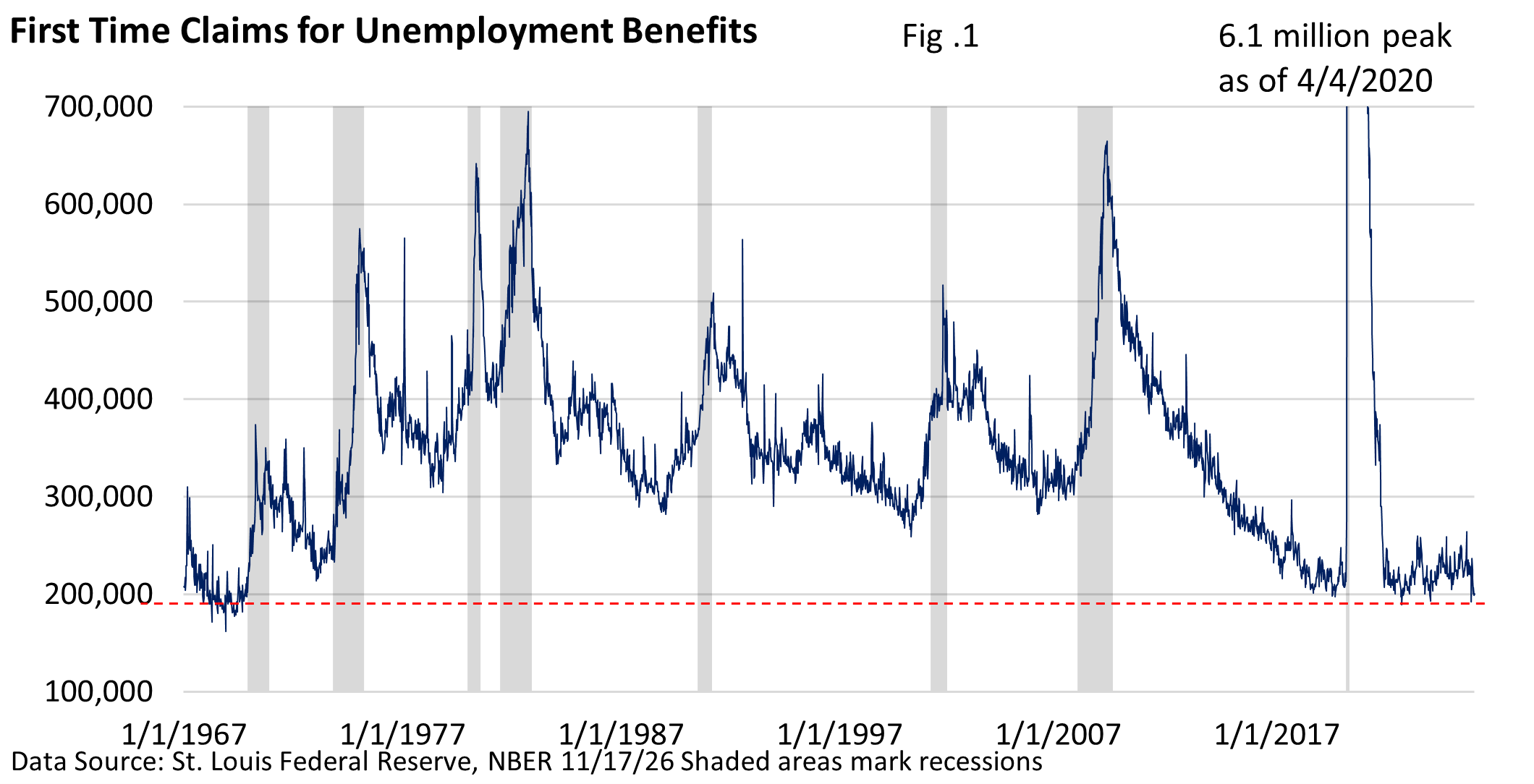
It’s curious that the low reading persists despite high-profile layoff announcements. Perhaps severance packages may delay filings, while others who lose jobs may find refuge in other departments at their company.

Let’s drill down on the last three years—Figure 2.
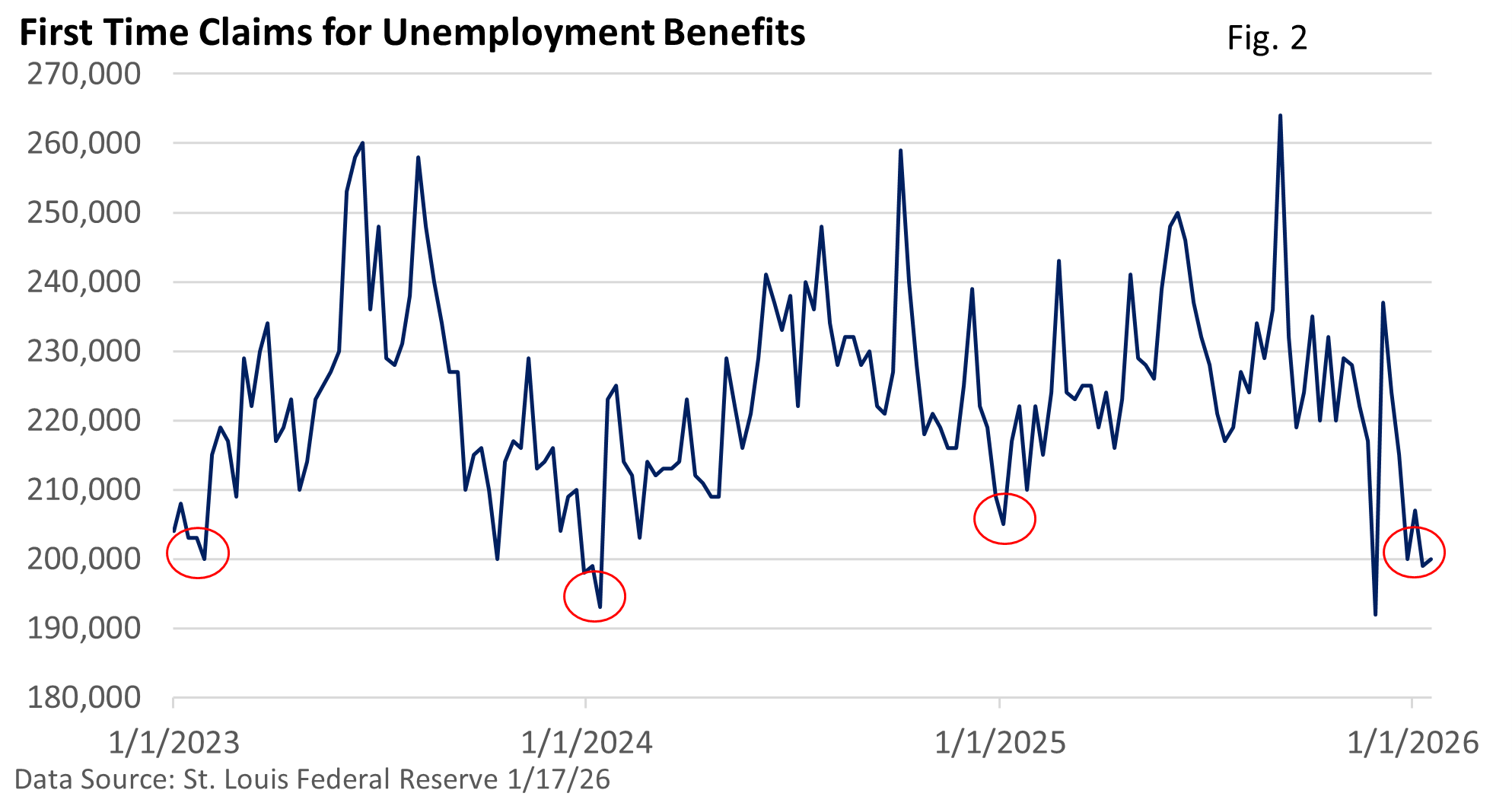
Low layoffs are an important economic gauge as it’s a reliable indicator that companies are reluctant to lose employees due to the demand for the goods and services they offer.

That said, filings tend to decline in January—Figure 2—which may simply reflect seasonal quirks in the data rather than a recent, positive shift in labor‑market dynamics.

If this seasonal pattern persists, filings may edge modestly higher in the weeks ahead. Still, the move back toward the lower end of the annual range is encouraging and, on its own, does not signal underlying economic weakness.

In summary, layoffs never disappear entirely, but workers filing for benefits remains low.

That is a constructive signal for both the labor market and the broader economy. In turn, sustained economic growth provides underlying support for corporate profits.

author avatar
Mark Chandik

Reproduction Prohibited without Express Permission. Copyright FDP Wealth Management. All rights reserved. Advisory Services offered through FDP Wealth Management, LLC, a state Registered Investment Adviser and Valmark Advisers, Inc. a SEC Registered Investment Advisor. Securities offered through ValMark Securities, Inc., Member FINRA/SIPC. 130 Springside Drive, Suite 300, Akron, OH 44333-2431 800.765.5201 Prosperity Partners and FDP Wealth Management, LLC are separate entities from ValMark Securities, Inc. and Valmark Advisers, Inc. Prosperity Partners, FDP Wealth Management, LLC, ValMark Securities, Inc., Valmark Advisers Inc., and their representatives do not offer tax advice. You should consult your tax professional regarding your individual circumstances. Indices are unmanaged and cannot be invested directly in. Past performance is not a guarantee of future results.

Indices are unmanaged and do not incur fees, one cannot directly invest in an index. You should consult your tax professional regarding your individual circumstances. This information is provided by Financial Jumble, LLC. Financial Jumble, LLC is a separate entity from ValMark Securities, Inc. and ValMark Advisers, Inc.

RELATED POSTS

Retail Sales Surge on Higher Gasoline Prices

The Nasdaq hit fresh record highs on Wednesday, Thursday, and Friday, capping off a strong week for tech stocks. On Wednesday, the S&P 500 also made history, closing above 7,000 for the first time. It kept building on those gains through the end of the week.

Stocks Rise to New Highs

The Nasdaq hit fresh record highs on Wednesday, Thursday, and Friday, capping off a strong week for tech stocks. On Wednesday, the S&P 500 also made history, closing above 7,000 for the first time. It kept building on those gains through the end of the week.

Inflation Heats Up as Gasoline Prices Surge

Led by a 10.9% rise in energy, including a 21% rise in gasoline, the US Bureau of Labor Statistics reported that the Consumer Price Index (CPI) rose 0.9% in March, the highest in almost four years. On an annual basis, prices rose 3.3%.

It’s Not Just Oil – Key Commodities That May Soon Be in Short Supply

Oil has captured much of the attention amid the conflict in the Middle East. While a limited number of tankers are transiting the region, the Strait of Hormuz is largely blocked, disrupting nearly one-fifth of the world’s oil supply.

California’s Delicate Energy Situation

How long the war might last is not clear, but its effects are being felt in global energy markets. Oil moves easily across borders, which means supply disruptions quickly lead to higher gasoline prices.