





author avatar
Mark Chandik

Jun 8, 2026

Hiring Ramps Up

Well, that was a pleasant surprise. The US Bureau of Labor Statistics (BLS) reported that nonfarm payrolls rose by 172,000 in May, more than double the 80,000 economists had expected, according to a Wall Street Journal survey.

On top of that, the most recent readings for March and May were revised sharply higher.

As the chart below illustrates, job growth has topped 150,000 in four of the past five months, a stretch we haven’t seen since early 2024.
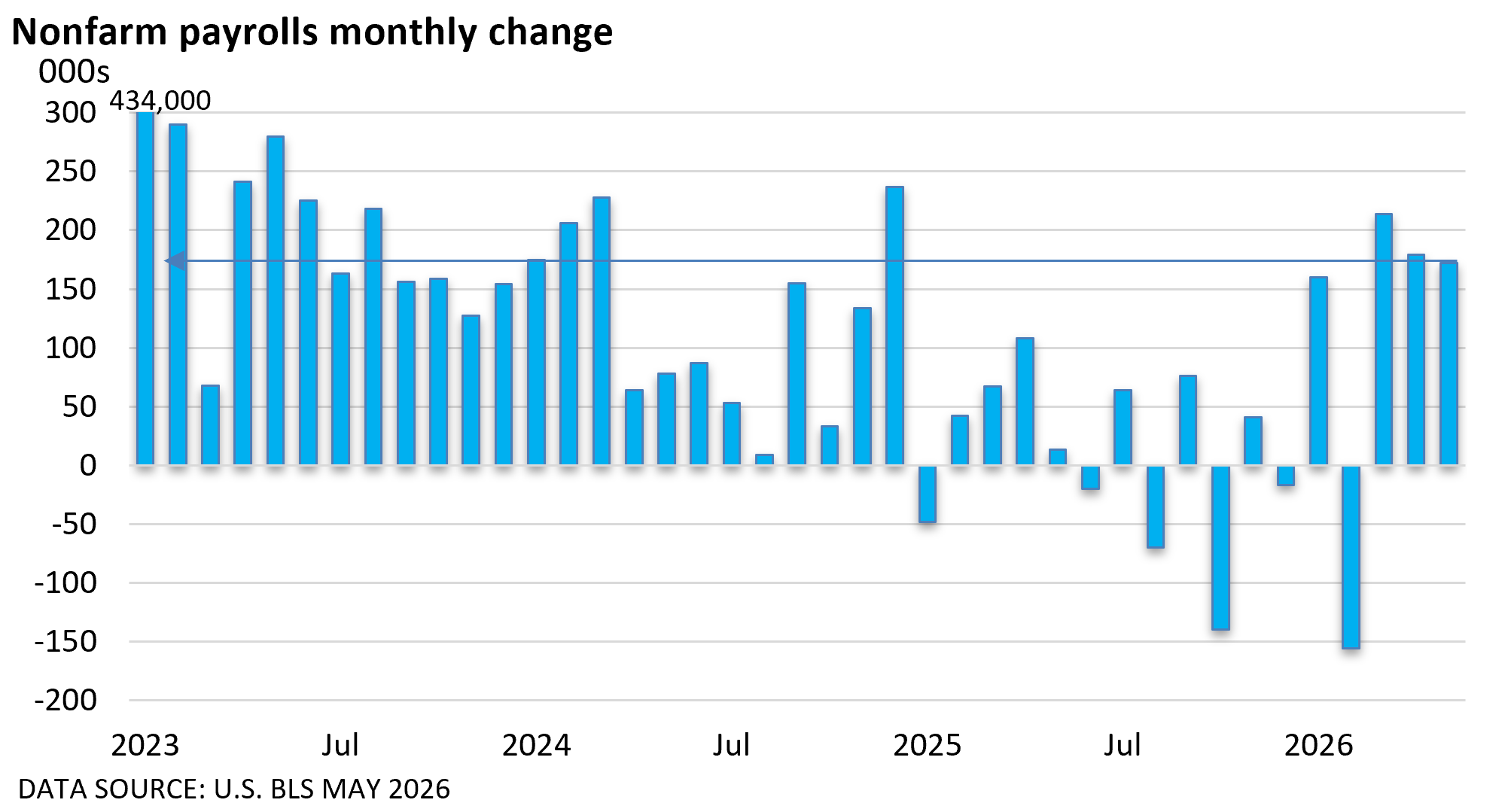
Monthly change in nonfarm payrolls (thousands) by month, 2023–2026; bars fluctuate from about -150k to +434k with a peak near 434,000.
Meanwhile, the unemployment rate held steady at 4.3%, where it’s been for four of the past five months.

While that figure comes from a different survey, job gains above 150,000 suggest that even faster hiring may be needed to push an already low unemployment rate lower.

Nonetheless, in another sign that prospects are improving, the US BLS reported last week that job openings in April rose at the fastest pace since early 2021.

Still, job growth isn’t happening across the board, but after last year’s slowdown, the overall rebound is welcome

And it’s happening even as economic uncertainty has ramped up due to the war in the Middle East, high gas prices, and a fragile ceasefire that, at least for now, has prevented a larger conflict from breaking out.

Economic growth has historically led to job growth. Sales rise and companies look for staff to support improving business conditions.

For reasons that aren’t fully understood, we didn’t see that last year in private-sector jobs outside of health care, but it appears the historic trend is beginning to reassert itself.

For investors, a firmer job market, coupled with still-high inflation, raises the odds that the Federal Reserve’s next move could be a rate hike.

author avatar
Mark Chandik

Reproduction Prohibited without Express Permission. Copyright FDP Wealth Management. All rights reserved. Advisory Services offered through FDP Wealth Management, LLC, a state Registered Investment Adviser and Valmark Advisers, Inc. a SEC Registered Investment Advisor. Securities offered through ValMark Securities, Inc., Member FINRA/SIPC. 130 Springside Drive, Suite 300, Akron, OH 44333-2431 800.765.5201 Prosperity Partners and FDP Wealth Management, LLC are separate entities from ValMark Securities, Inc. and Valmark Advisers, Inc. Prosperity Partners, FDP Wealth Management, LLC, ValMark Securities, Inc., Valmark Advisers Inc., and their representatives do not offer tax advice. You should consult your tax professional regarding your individual circumstances. Indices are unmanaged and cannot be invested directly in. Past performance is not a guarantee of future results.

Indices are unmanaged and do not incur fees, one cannot directly invest in an index. You should consult your tax professional regarding your individual circumstances. This information is provided by Financial Jumble, LLC. Financial Jumble, LLC is a separate entity from ValMark Securities, Inc. and ValMark Advisers, Inc.

RELATED POSTS

Chips in Flux

Since the most recent market low at the end of March, semiconductors (microchips, commonly called chip stocks) have been a very popular trade. In less than three months, the PHLX Semiconductor Index has more than doubled—see Figure 1.

Oil Has Given Back Gains, but Gasoline—Not So Much

Just before the start of the war, WTI crude oil traded at about $67 per barrel, according to MarketWatch. By last week, the price of oil had fallen to within about $1 of its pre-war price.

A Muddy Jobs Report

The recent pickup in job growth is welcome news for job seekers. But June’s jobs report left more questions than answers. Here’s why.

1776 to Today: Reflections on the Fourth of July

As the United States approaches the 250th anniversary of its founding—a milestone known as the Semiquincentennial—the Declaration of Independence remains as important as ever.

There’s a New Sheriff in Town

The Federal Reserve surprised no one by holding its key rate, the fed funds rate, at 3.50–3.75%.