





author avatar
Mark Chandik

Sep 30, 2024

A Fed Rate Cut and Your Mortgage Rate

A recent online advertisement from a major bank read, “The Fed just lowered interest rates. Could refinancing save you money?”

There is an implicit assumption in the ad that the Fed’s half-percentage point rate reduction brought about a significant drop in mortgage rates shortly following the decision.

It didn’t. Why not? Changes in the fed funds rate indirectly influence but don’t mirror fixed mortgage rates. Last Thursday, Freddie Mac’s weekly survey pegged the 30-year fixed rate mortgage at 6.08%, down from 6.09% the prior week and 6.20% two weeks ago.

Instead, the yield on the 10-year Treasury bond has the greatest influence. It’s not a one-to-one lockstep relationship, but changes in the 10-year Treasury yield directly impact fixed mortgage rates, as shown below.
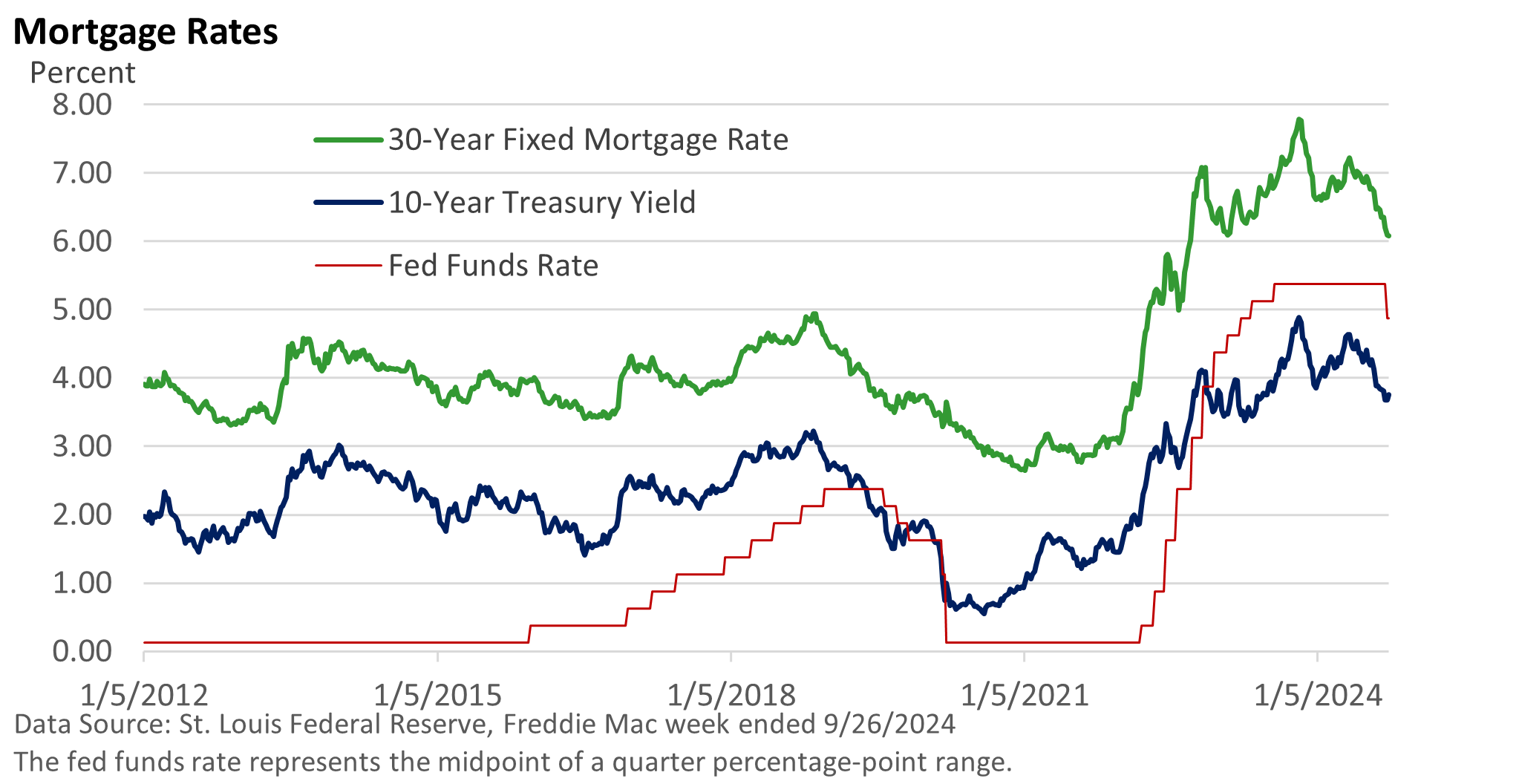
While homebuyers and those that may want to refinance may have been disappointed that a big drop in mortgage rates wasn’t forthcoming, rates are down sharply from the 2024 high of 7.22% in early May.

And they are down significantly from August 1, when the 30-year stood at 6.73%.

What else influenced the summer’s decline in mortgage rates?

In addition to the 10-year Treasury, there was increased speculation about a rate cut by the Fed during the summer, which contributed to the decrease in Treasury yields. The softer labor market and the slowdown in the rate of inflation also influenced the decline in yields.

Plus, demand for mortgage-backed securities, which are bundled by lenders and sold on the secondary market, can affect rates.

If demand for these securities is high, rates may come down slightly. When demand falls off, rates may tick higher to attract buyers.

author avatar
Mark Chandik

Reproduction Prohibited without Express Permission. Copyright FDP Wealth Management. All rights reserved. Advisory Services offered through FDP Wealth Management, LLC, a state Registered Investment Adviser and Valmark Advisers, Inc. a SEC Registered Investment Advisor. Securities offered through ValMark Securities, Inc., Member FINRA/SIPC. 130 Springside Drive, Suite 300, Akron, OH 44333-2431 800.765.5201 Prosperity Partners and FDP Wealth Management, LLC are separate entities from ValMark Securities, Inc. and Valmark Advisers, Inc. Prosperity Partners, FDP Wealth Management, LLC, ValMark Securities, Inc., Valmark Advisers Inc., and their representatives do not offer tax advice. You should consult your tax professional regarding your individual circumstances. Indices are unmanaged and cannot be invested directly in. Past performance is not a guarantee of future results.

Indices are unmanaged and do not incur fees, one cannot directly invest in an index. You should consult your tax professional regarding your individual circumstances. This information is provided by Financial Jumble, LLC. Financial Jumble, LLC is a separate entity from ValMark Securities, Inc. and ValMark Advisers, Inc.

RELATED POSTS

It’s Not Just Oil – Key Commodities That May Soon Be in Short Supply

Oil has captured much of the attention amid the conflict in the Middle East. While a limited number of tankers are transiting the region, the Strait of Hormuz is largely blocked, disrupting nearly one-fifth of the world’s oil supply.

California’s Delicate Energy Situation

How long the war might last is not clear, but its effects are being felt in global energy markets. Oil moves easily across borders, which means supply disruptions quickly lead to higher gasoline prices.

Decoding the Fed: Impact on Investors

Against the backdrop of the war, the Federal Reserve met last week and decided to hold its key rate—the fed funds rate—unchanged at 3.50–3.75%. The decision was completely expected.

Looking Past the Pump: A Granular Look at Gasoline Prices

There are fears that higher prices will exacerbate inflation and hurt the economy, as cash that might have gone to other items will be diverted to the gas tank.

The War and Its Impact – So Far

What is the efficient market theory? Textbooks have been written to fully explain the theory. But if we can sum it up in one sentence: Assets, such as stocks, reflect all publicly available information. It is a foundational principle of finance.