





author avatar
Mark Chandik

Mar 30, 2026

California’s Delicate Energy Situation

How long the war might last is not clear, but its effects are being felt in global energy markets. Oil moves easily across borders, which means supply disruptions quickly lead to higher gasoline prices.

However, it is harder to ship natural gas around the world. That limited mobility has helped shield US natural gas prices. The US is a net exporter of natural gas.

California, however, is in a more delicate situation. It’s what you might call an energy island. It is not connected to major oil pipelines, California oil production and shipments from Alaska are down sharply over the last 30 years, and imports account for about 60% of its needs today—Fig 1.
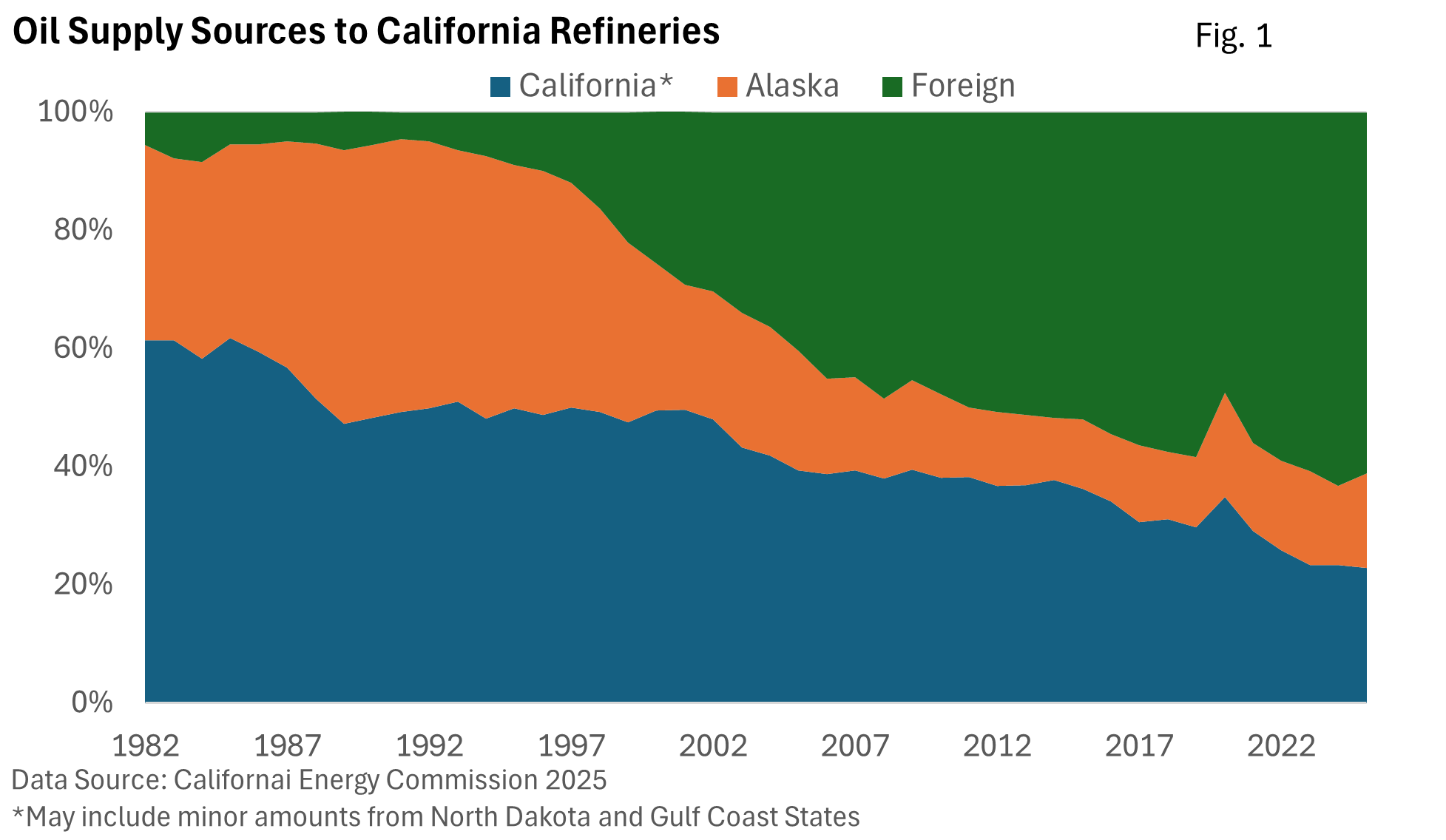
In addition, about 30% of its imports are derived from the Middle East (Iraq: 18%, Saudi Arabia: 8%, and the United Arab Emirates: 3%), according to the California Energy Commission.

In other words, about 18% of all California’s oil is imported from the unstable Persian Gulf.

In total, the US imports about 500,000 barrels per day from the Persian Gulf, according to the International Energy Agency. Almost half lands in California.

In contrast, the US produces almost 14 million barrels of oil per day, according to the US Energy Information Administration—Figure 2. As a whole, the country is not very dependent on Middle Eastern crude.
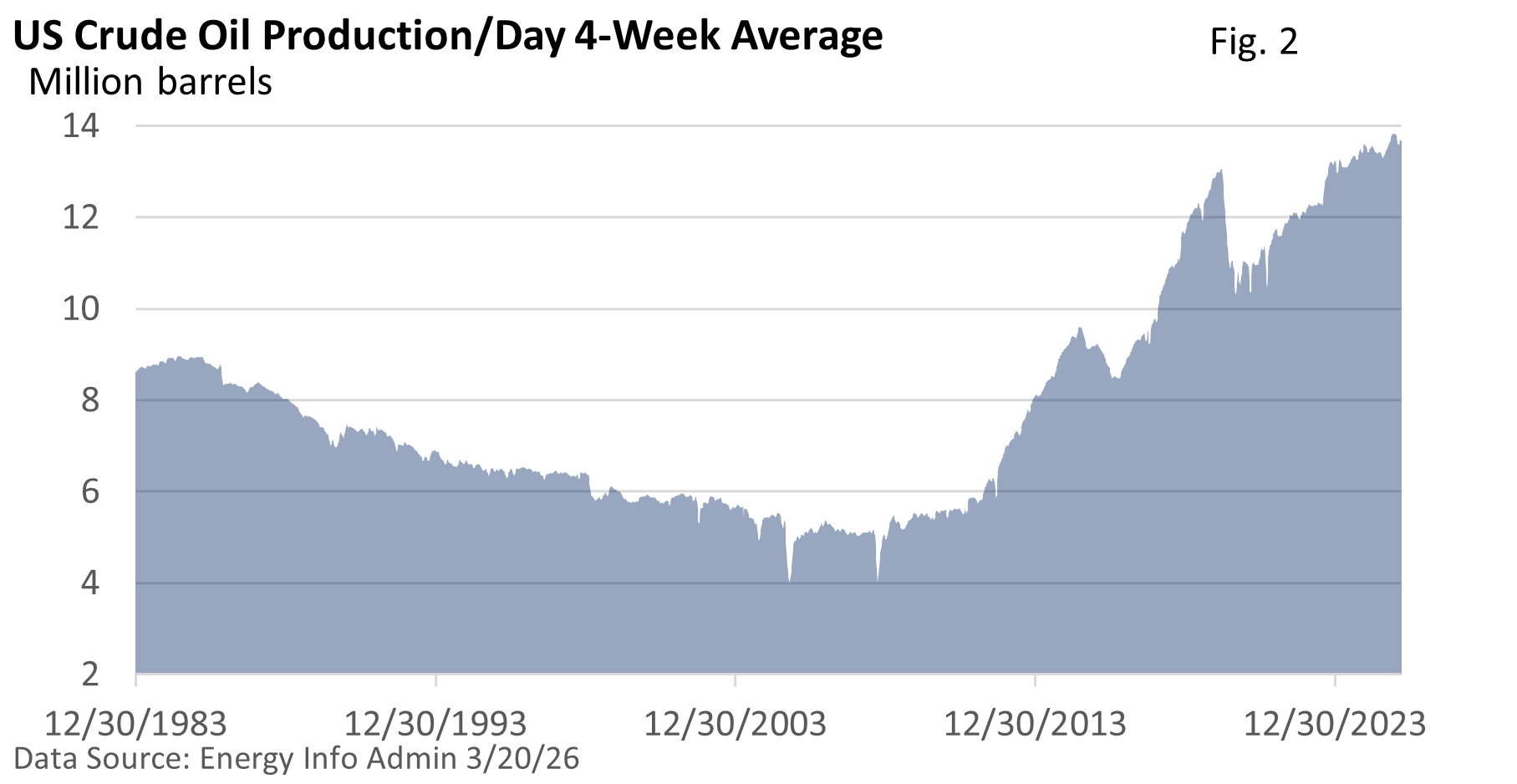
In fact, oil imported from OPEC has declined by about 75% since 2006. Imports mostly originate from the Western Hemisphere.

Although Strategic Petroleum Reserve releases could help mitigate near-term strains, a shift by Asian refineries toward domestic markets (CA imports some of its gasoline) and reduced Middle East oil imports could expose California to greater price volatility and supply risks.

Bottom line

  • Yes, gasoline lines and shortages are plausible in California.
  • The risk is higher than in most US states due to imports and isolation.
  • Shortages in the state—if they occur—would most likely be regional and temporary.
  • Any refinery outages in California could exacerbate the situation.
  • Price spikes are the most likely outward sign; lines follow only if supply interruptions persist.
author avatar
Mark Chandik

Reproduction Prohibited without Express Permission. Copyright FDP Wealth Management. All rights reserved. Advisory Services offered through FDP Wealth Management, LLC, a state Registered Investment Adviser and Valmark Advisers, Inc. a SEC Registered Investment Advisor. Securities offered through ValMark Securities, Inc., Member FINRA/SIPC. 130 Springside Drive, Suite 300, Akron, OH 44333-2431 800.765.5201 Prosperity Partners and FDP Wealth Management, LLC are separate entities from ValMark Securities, Inc. and Valmark Advisers, Inc. Prosperity Partners, FDP Wealth Management, LLC, ValMark Securities, Inc., Valmark Advisers Inc., and their representatives do not offer tax advice. You should consult your tax professional regarding your individual circumstances. Indices are unmanaged and cannot be invested directly in. Past performance is not a guarantee of future results.

Indices are unmanaged and do not incur fees, one cannot directly invest in an index. You should consult your tax professional regarding your individual circumstances. This information is provided by Financial Jumble, LLC. Financial Jumble, LLC is a separate entity from ValMark Securities, Inc. and ValMark Advisers, Inc.

RELATED POSTS

Decoding the Fed: Impact on Investors

Against the backdrop of the war, the Federal Reserve met last week and decided to hold its key rate—the fed funds rate—unchanged at 3.50–3.75%. The decision was completely expected.

Looking Past the Pump: A Granular Look at Gasoline Prices

There are fears that higher prices will exacerbate inflation and hurt the economy, as cash that might have gone to other items will be diverted to the gas tank.

The War and Its Impact – So Far

What is the efficient market theory? Textbooks have been written to fully explain the theory. But if we can sum it up in one sentence: Assets, such as stocks, reflect all publicly available information. It is a foundational principle of finance.

Navigating Volatility

Over the weekend, global markets were shaken by significant geopolitical developments, as the US and Israel carried out coordinated strikes on Iran that resulted in the death of Iran’s Supreme Leader. Iran responded with missile strikes, which escalated tensions and heightened uncertainty in global markets.

Q4 Government Shutdown Drafs on GDP Supreme Court Blocks Tariff Plan

The government shutdown proved to be a far greater drag on the economy than earlier estimates indicated. On Friday, the U.S. BEA reported that fourth-quarter Gross Domestic Product (GDP), the largest measure of economic output, grew at a 1.4% annualized pace. This compares with a 4.4% annualized pace in Q3.