





author avatar
Mark Chandik

Feb 24, 2026

Q4 Government Shutdown Drafs on GDP Supreme Court Blocks Tariff Plan

The government shutdown proved to be a far greater drag on the economy than earlier estimates indicated. On Friday, the U.S. BEA reported that fourth-quarter Gross Domestic Product (GDP), the largest measure of economic output, grew at a 1.4% annualized pace. This compares with a 4.4% annualized pace in Q3.

The sharp contraction in government outlays shaved 1.2 percentage points off overall Q4 GDP growth. Removing the impact of federal spending, GDP would have expanded by 2.6%.

Still, the most important driver of economic growth—consumer spending— remains positive.

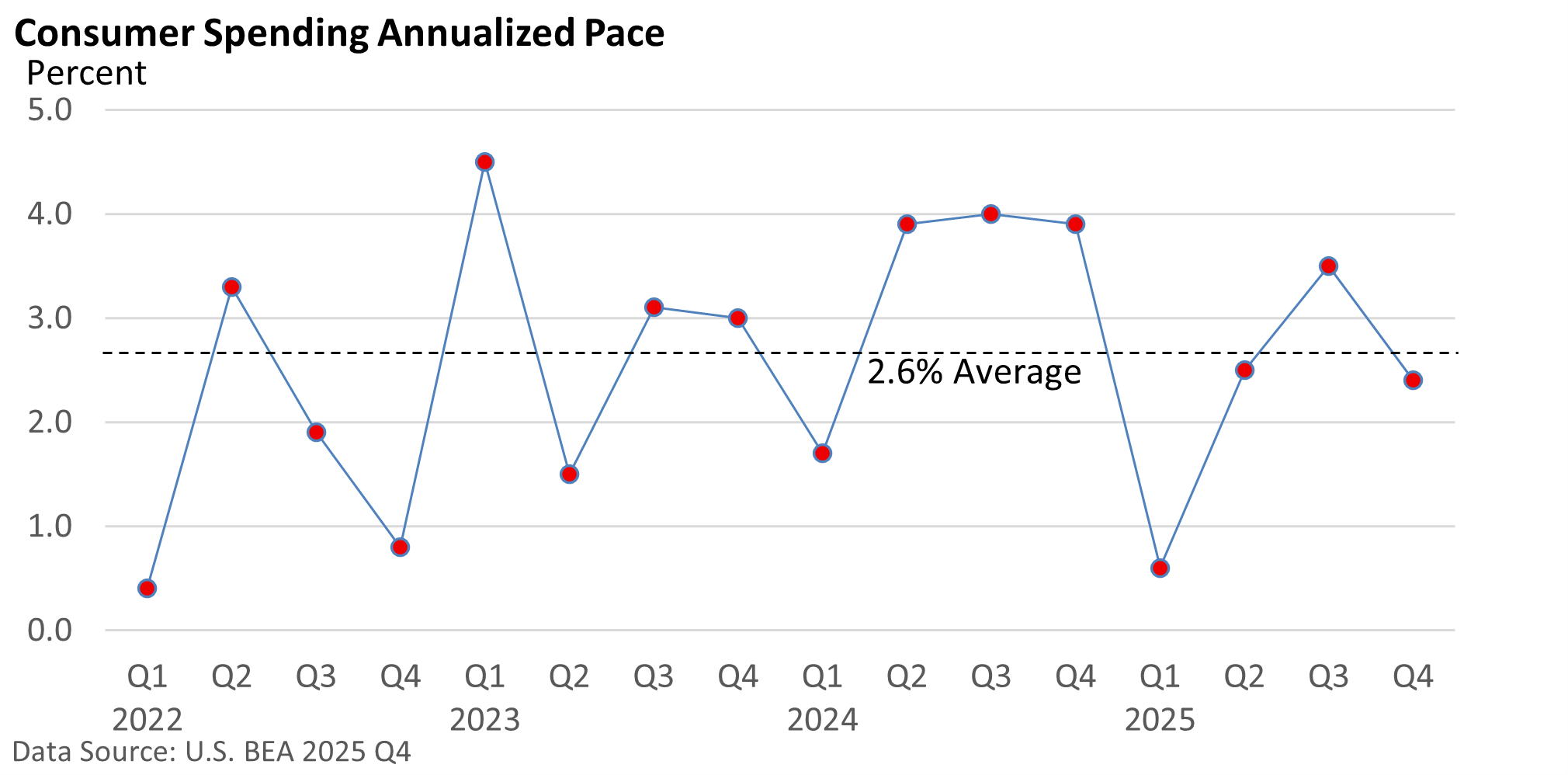
Consumer spending rose at an annualized rate of 2.4% in Q4 and is near the four-year average of 2.6%, according to US BEA data. In addition, business spending and investment continue to rise, partly driven by massive outlays for AI data centers.
Separately, the Supreme Court struck down key portions of the president’s global tariff initiative, ruling that his reliance on the International Emergency Economic Powers Act (IEEPA) to advance his aggressive trade agenda exceeded the statute’s authority.

Yet, according to Bloomberg, there are alternatives available to the president. The tools available generally require more time for investigation and offer less sweeping, immediate power than tariffs implemented using the IEEPA.

On Friday afternoon, the president announced his plan to impose a new 10% global tariff under Section 122 of the Trade Act of 1974. It is unclear whether any exceptions might arise, although such carve-outs seem reasonable. Tariffs enacted under this provision can stay in place for only 150 days unless Congress approves an extension.

If Congress declines to act, the administration could, at least in theory, allow the tariffs to lapse, declare a new balance-of-payments emergency, and restart the clock, per the Cato Institute.

From an economic standpoint, one aspect of the law has been clarified, but uncertainty over the next steps and their duration has introduced a new layer of unpredictability.

In summary, the decision wasn’t a big surprise, and the president had already indicated that backup plans were in place if his authority through IEEPA was limited or struck down. Stay tuned.

author avatar
Mark Chandik

Reproduction Prohibited without Express Permission. Copyright FDP Wealth Management. All rights reserved. Advisory Services offered through FDP Wealth Management, LLC, a state Registered Investment Adviser and Valmark Advisers, Inc. a SEC Registered Investment Advisor. Securities offered through ValMark Securities, Inc., Member FINRA/SIPC. 130 Springside Drive, Suite 300, Akron, OH 44333-2431 800.765.5201 Prosperity Partners and FDP Wealth Management, LLC are separate entities from ValMark Securities, Inc. and Valmark Advisers, Inc. Prosperity Partners, FDP Wealth Management, LLC, ValMark Securities, Inc., Valmark Advisers Inc., and their representatives do not offer tax advice. You should consult your tax professional regarding your individual circumstances. Indices are unmanaged and cannot be invested directly in. Past performance is not a guarantee of future results.

Indices are unmanaged and do not incur fees, one cannot directly invest in an index. You should consult your tax professional regarding your individual circumstances. This information is provided by Financial Jumble, LLC. Financial Jumble, LLC is a separate entity from ValMark Securities, Inc. and ValMark Advisers, Inc.

RELATED POSTS

A Hotter August CPI Builds Rate Hike Momentum

First, let’s clarify that any attempt to predict the Federal Reserve’s actions this week is, at best, an educated guess. Fed Chair Kevin Warsh has struck a hawkish tone, and the odds of a quarter-point increase in the fed funds rate are 87%, according to the CME Group. It was 59% on September 4.

Behind the Jobs Report

On Friday, the US Bureau of Labor Statistics (BLS) reported that nonfarm payrolls rose by a much greater-than-expected 162,000 jobs in August. The unemployment rate held steady at 4.1%.

Location Location Location

The graphic below compares the change in home prices, adjusted for inflation, for various US cities. For example, the average USA home price has topped inflation by 238% since 1948. Why has there been such a wide trajectory in prices, and why have they proven so persistent?

Rising Yields Faily to Derail Stocks

This year, the stock market has risen significantly. Lingering worries about oil prices, inflation, the war with Iran, and the possibility of an AI bubble haven’t subsided. But the economy is expanding, corporate profits have been strong, and the S&P 500 Index set a new high last week, according to the Wall Street Journal.

All Gas, No Brakes: Profits Soar in Q2

In a solid earnings season, we’d generally expect S&P 500 companies to deliver double-digit profit growth, meaning earnings growth of at least 10% versus a year ago (20% tops). That’s not a hard-and-fast rule, but it provides a useful benchmark for evaluating the strength of a quarter.