





Sep 25, 2023

Higher for Longer and Longer… and Maybe Longer

Weekly Market Commentary

The Federal Reserve surprised virtually no one when Fed officials unanimously voted to keep the fed funds rate unchanged at 5.25 – 5.50% on Wednesday.

While it is the second time the Fed has punted on a rate hike this year (the last time was June), official Federal Reserve Economic Projections (released quarterly and updated last week) still suggest we may get one more increase this year, possibly in early November or in December.

The Fed also upgraded its assessment of the economy, noting in its press release that the economy is expanding at a “solid pace,” up from “moderate” in July.

Fed Chief Jerome Powell mentioned the Fed’s 2 percent annual inflation goal eight times in his opening statement that preceded the Q&A at the press conference.

So, if inflation is still well above the 2 percent target, AND Powell emphasized that the Fed is fully committed to getting inflation back to 2 percent, AND economic growth has recently accelerated, why did the Fed forgo a rate increase?

Since the start of the current cycle of rate hikes, they quickly covered a lot of ground. And there is a concern that too many increases might needlessly tip the economy into a recession.

Though the Fed always denies that politics plays a role in formulating policy, cynics might suggest that next year’s election is also creating a more cautious mood among policymakers.
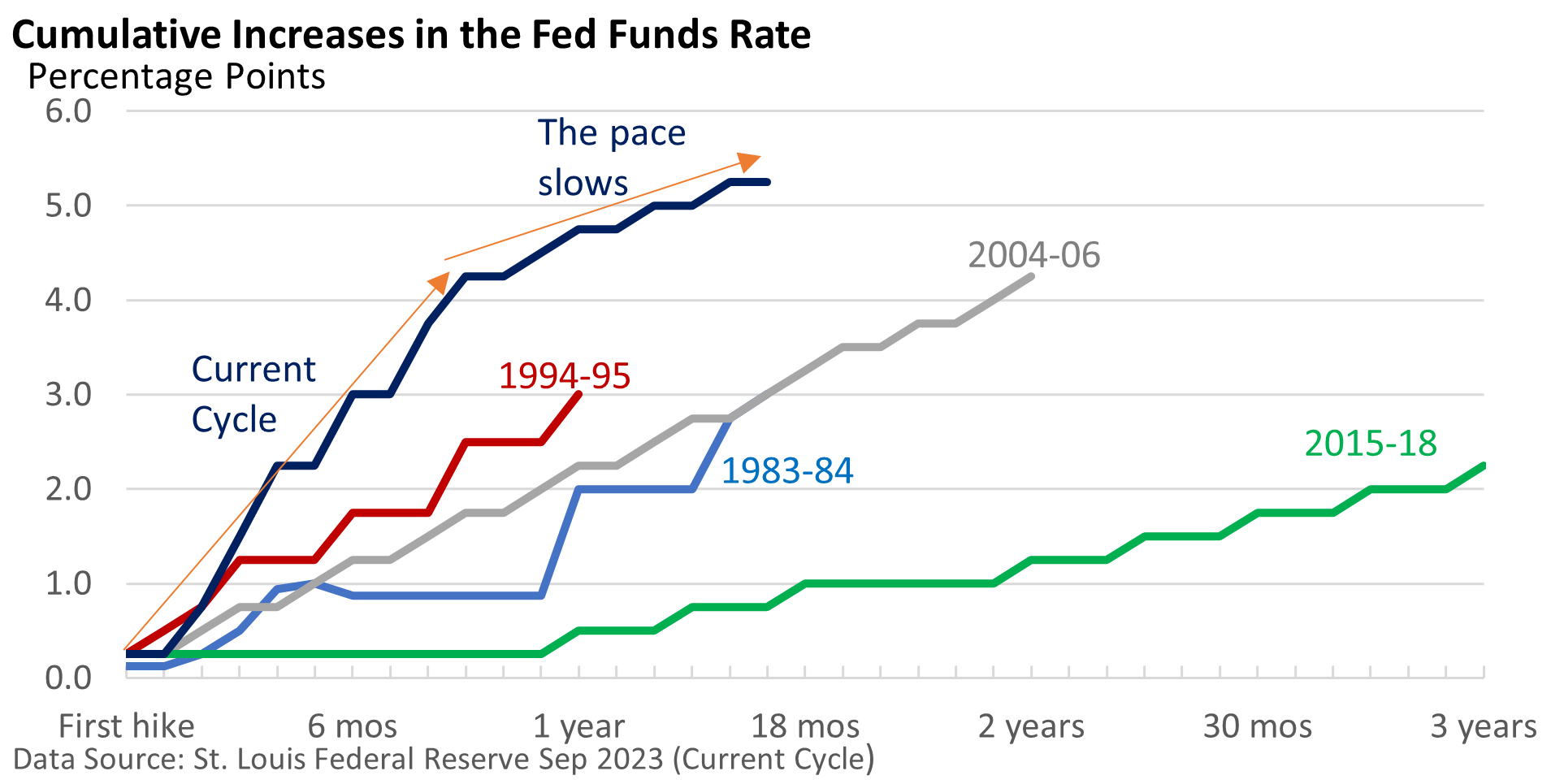
As the graphic illustrates, this is the most aggressive series of rate hikes in over 40 years. Why aren’t we already in a recession, as many forecasters had projected early in the year?

Maybe rates haven’t been high enough for long enough. Or consumers and businesses were in a much stronger position than was fully understood. Or maybe there are other factors in play.

When asked about ever-changing Fed economic forecasts, Powell was blunt. “Forecasting is very difficult. Forecasters are a humble lot with much to be humble about.”

The Fed reminded the public that it still expects one more rate increase this year, and it reduced the projected size of rate cuts in 2024 from a full percentage point to a half-percentage point.

Bottom line: investors have continually underestimated the Fed’s commitment to maintaining higher interest rates. It’s why “higher for longer” is now a part of the vocabulary for investors.

Reproduction Prohibited without Express Permission. Copyright FDP Wealth Management. All rights reserved. Advisory Services offered through FDP Wealth Management, LLC, a state Registered Investment Adviser and Valmark Advisers, Inc. a SEC Registered Investment Advisor. Securities offered through ValMark Securities, Inc., Member FINRA/SIPC. 130 Springside Drive, Suite 300, Akron, OH 44333-2431 800.765.5201 Prosperity Partners and FDP Wealth Management, LLC are separate entities from ValMark Securities, Inc. and Valmark Advisers, Inc. Prosperity Partners, FDP Wealth Management, LLC, ValMark Securities, Inc., Valmark Advisers Inc., and their representatives do not offer tax advice. You should consult your tax professional regarding your individual circumstances. Indices are unmanaged and cannot be invested directly in. Past performance is not a guarantee of future results.

Indices are unmanaged and do not incur fees, one cannot directly invest in an index. You should consult your tax professional regarding your individual circumstances. This information is provided by Financial Jumble, LLC. Financial Jumble, LLC is a separate entity from ValMark Securities, Inc. and ValMark Advisers, Inc.

RELATED POSTS

Data Disconnect

Retailers are ringing up solid earnings, but consumer confidence surveys tell a different story, suggesting the mood is far from upbeat. This disconnect raises a big question: if shoppers are still buying, as we will highlight in a moment, why do they feel so uneasy about the economy?

Buyer’s Market – With Strings Attached

Redfin reported last week that sellers are grappling with the strongest buyer’s market since the real estate brokerage firm began compiling records back in 2013. Sellers now outnumber buyers by 37%.

Investors Unfazed by Shutdown

The government shutdown lasted from October 1 to November 12. It was the longest on record. During that period, the S&P 500 rose from 6,688.46 (September 30) to 6,850.92 (November 12), or an advance of 2.4%. As we’ve noted in prior shutdowns, investors typically ignore political drama.

The Job Market’s Missing Pulse

The government shutdown has been and will always be prominently featured in the 24-hour news cycle. Travelers are feeling it, furloughed federal employees wonder when they will receive their next paycheck, and even the housing market is affected as some buyers are left in limbo.

One Cut, Two Cut: The Fed’s Delicate Balancing Act

The Federal Reserve delivered a widely expected 25-basis-point rate cut (bp, 1 bp = 0.01%), but Fed Chief Jay Powell tempered market enthusiasm by signaling that a December cut is far from certain.