





May 6, 2024

Rate Cuts Still on the Table, Timing Less Certain

Weekly Market Commentary

We often discuss the Federal Reserve and interest rates because both greatly impact investors. For starters, changes in interest rates have a significant impact on stock prices and income earned on savings.

Sharply higher rates in 2022 pushed equities into a bear market. The pause in rate hikes in 2023, coupled with continued economic growth and the craze surrounding AI, led to a new bull market.

Wednesday’s Fed meeting left rates unchanged—no surprise. How Fed Chief Jay Powell might frame the meeting was uppermost on the minds of investors.

Given stubbornly high inflation, would Powell shift gears and take on a more hawkish tone, even signaling the possibility of another rate hike this year? Or would he emphasize that current interest rates are high enough to bring the rate of inflation back down?
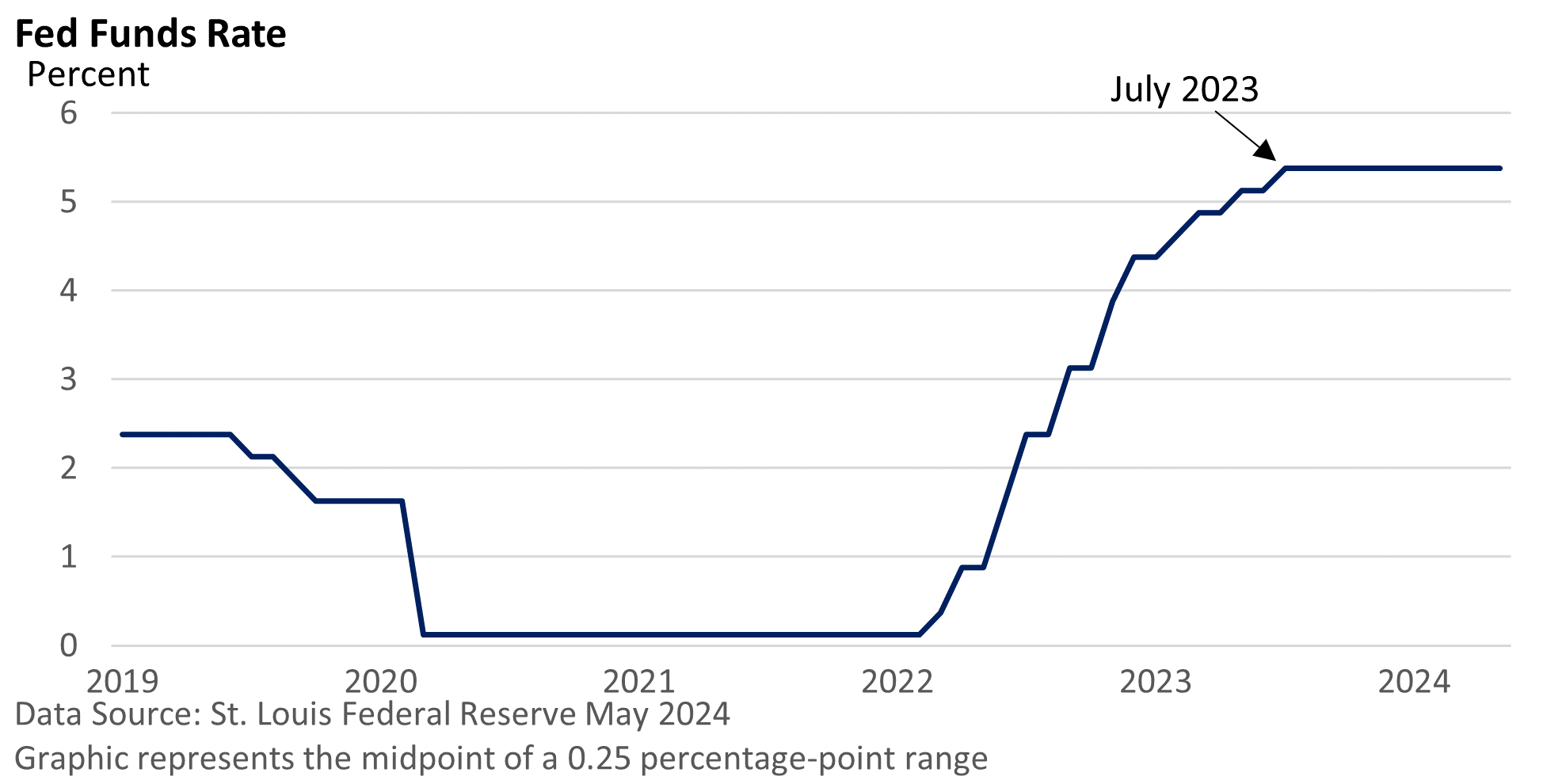
Despite the recent uptick in the rate of inflation, Powell said, “It’s unlikely that the next policy rate move will be a hike.” The Fed, he said, would require “persuasive evidence” before hiking rates again, setting a high bar for another rate increase.

He made no mention of:

  • Inflation becoming entrenched,
  • The need to be vigilant against inflation, or
  • The lessons and mistakes of the 1960s/70s.

And he sidestepped a question about whether Fed officials discussed a rate hike at the meeting.

But he said the Fed is in no hurry to reduce interest rates, though he did not rule out the possibility of a rate cut this year.

Overall, the Fed’s approach was less aggressive than some had feared.

Taking a 2024 rate hike off the table encouraged bullish sentiment, and he left the door open to an easier policy. But the Fed’s next move will largely be dependent on the economic outlook and inflation.

Reproduction Prohibited without Express Permission. Copyright FDP Wealth Management. All rights reserved. Advisory Services offered through FDP Wealth Management, LLC, a state Registered Investment Adviser and Valmark Advisers, Inc. a SEC Registered Investment Advisor. Securities offered through ValMark Securities, Inc., Member FINRA/SIPC. 130 Springside Drive, Suite 300, Akron, OH 44333-2431 800.765.5201 Prosperity Partners and FDP Wealth Management, LLC are separate entities from ValMark Securities, Inc. and Valmark Advisers, Inc. Prosperity Partners, FDP Wealth Management, LLC, ValMark Securities, Inc., Valmark Advisers Inc., and their representatives do not offer tax advice. You should consult your tax professional regarding your individual circumstances. Indices are unmanaged and cannot be invested directly in. Past performance is not a guarantee of future results.

Indices are unmanaged and do not incur fees, one cannot directly invest in an index. You should consult your tax professional regarding your individual circumstances. This information is provided by Financial Jumble, LLC. Financial Jumble, LLC is a separate entity from ValMark Securities, Inc. and ValMark Advisers, Inc.

RELATED POSTS

Q4 Government Shutdown Drags on GDP; Supreme Court Blocks Tariff Plan

The government shutdown proved to be a far greater drag on the economy than earlier estimates indicated. On Friday, the U.S. BEA reported that fourth-quarter Gross Domestic Product (GDP), the largest measure of economic output, grew at a 1.4% annualized pace. This compares with a 4.4% annualized pace in Q3.

Revisiting 2025 Employment

The US Bureau of Labor Statistics published its final benchmark revisions covering employment during the 12‑month period between April 2024 and March 2025. The revisions showed that payrolls were revised lower by 898,000 jobs compared with the originally reported figures.

Markets Rotate: What’s Driving the Shift; Plus, the Dow Crosses a Milestone

After leading markets for much of the past two years, AI, tech stocks, and software specifically, are losing leadership in early 2026, as investors rotate capital toward other sectors, including energy, industrials, and defensive sectors.

January Barometer Flashes Green, a Sleepy Fed Gathering

The so-called January Barometer holds that the market’s performance in January—measured by the S&P 500 Index—tends to foreshadow how stocks will perform during the year. Since 1970, January finished higher 33 times and fell 23 times, excluding this month’s increase of 1.37% (MarketWatch data, excludes reinvested dividends).

It’s Hard to Say Good-bye: What Persistently Low Layoffs Say About the Economy

Much has been made of the sluggish hiring environment, but less attention has been paid to an important counterpoint: the persistently low level of layoffs. Figure 1 highlights the number of individuals who go online or head to their respective state’s unemployment office and file for benefits following a layoff.