




Dec 5, 2022

Too Much Hiring

Weekly Market Commentary

Can there be too much hiring? Can job growth be too fast? It seems like an odd question. But following a better-than-expected jobs report on Friday and the initial negative reaction (shares pared losses and finished mixed), the question is worth exploring.

The U.S. Bureau of Labor Statistics reported nonfarm payrolls rose 263,000 in November, beating the CNBC consensus estimate of 200,000. The unemployment rate remained at 3.7%.
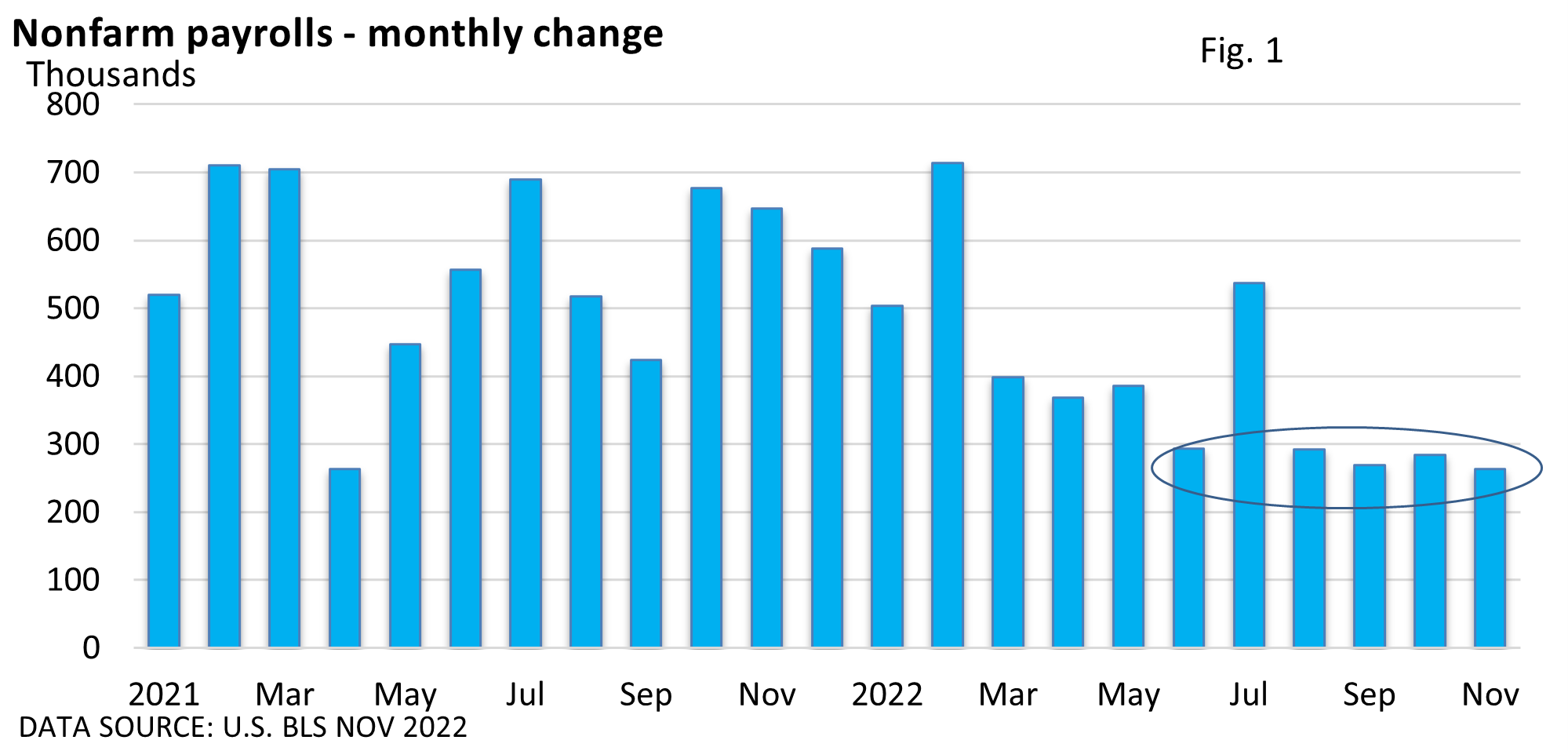
The trend in Figure 1 illustrates a moderation in job growth, but nothing concerning.

Five of the last six months have held in a narrow but historically solid range of 263,000 to 293,000. Investors initially reacted negatively to the report, and it seems fair to inquire why analysts had expected a big slowdown in November. Layoffs aren’t up, and job openings remain high.

So, why the sour mood? Sometimes the interest of Wall Street (investors) lines up with those of Main Street, but not always.

Main Street is benefiting from the labor shortage and upbeat job growth, as both are helping to support wages.

But Wall Street contends that robust hiring and fast wage gains add to inflation. You see, interest rates have skyrocketed this year in response to high inflation.

Wage growth that is too fast usually forces businesses to raise prices since labor costs are among the biggest expenses for most firms.

And, if inflation remains sticky, we’re likely to see rates continue to rise and remain at a higher level for a longer period. That creates added headwinds for stocks.

There will come a time when job growth slows. Several economic indicators suggest that a recession may be unavoidable next year. Historically, economic weakness sends the jobless rate higher and slows wage hikes.

The Fed’s goal, however, is to gently slow the economy and bring down the rate of inflation. It’s a very narrow path and may not be achievable. Next year, we may be having a different conversation, but today’s prevailing themes continue to be interest rates and inflation.

Reproduction Prohibited without Express Permission. Copyright FDP Wealth Management. All rights reserved. Advisory Services offered through FDP Wealth Management, LLC, a state Registered Investment Adviser and Valmark Advisers, Inc. a SEC Registered Investment Advisor. Securities offered through ValMark Securities, Inc., Member FINRA/SIPC. 130 Springside Drive, Suite 300, Akron, OH 44333-2431 800.765.5201 Prosperity Partners and FDP Wealth Management, LLC are separate entities from ValMark Securities, Inc. and Valmark Advisers, Inc. Prosperity Partners, FDP Wealth Management, LLC, ValMark Securities, Inc., Valmark Advisers Inc., and their representatives do not offer tax advice. You should consult your tax professional regarding your individual circumstances. Indices are unmanaged and cannot be invested directly in. Past performance is not a guarantee of future results.

Indices are unmanaged and do not incur fees, one cannot directly invest in an index. You should consult your tax professional regarding your individual circumstances. This information is provided by Financial Jumble, LLC. Financial Jumble, LLC is a separate entity from ValMark Securities, Inc. and ValMark Advisers, Inc.

RELATED POSTS

Soft December Hiring Underscores Tepid Year

On Friday, the U.S. Bureau of Labor Statistics reported that nonfarm payrolls increased by 50,000 in December, underscoring a year of persistently sluggish job growth.

A Stock Market Three-Peat

The bull market that began in late 2022 continued through last year. The S&P 500 Index, which posted gains that topped 20% in both 2023 and 2024, recorded an advance of 16.39% last year.

An Uptick in the Unemployment Rate

The unemployment rate rose from 4.4% in September to 4.6% in November—see Figure 1. The US Bureau of Labor Statistics did not conduct its household survey in October due to the government shutdown. The household survey includes the unemployment rate

Fed Cuts Rates Again, Signals a Possible Pause

The Federal Reserve followed through on what was a widely expected rate cut, reducing the fed funds rate a quarter-percentage point (1 basis point = 0.01%) to a range of 3.50 – 3.75%.

Black Friday’s Spending Spree

A December 1 headline from Reuters sums up the start of the Christmas shopping season: US Holiday Shoppers Shake Off Economic Blues for Online Spending Spree.