





Dec 9, 2024

Job Growth and Economic Growth

On Friday, the U.S. Bureau of Labor Statistics (BLS) reported that nonfarm payrolls rose by 227,000 in November, which came in just above the consensus forecast of 214,000 (CNBC).

The unemployment rate, measured by a different BLS survey, ticked up to 4.2% from 4.1%.

November’s increase was a recovery from just 36,000 in October, when hurricanes and Boeing’s (BA $154) strike negatively affected the data.

In part, November represented a catch-up.

Job growth last month was concentrated in health care, which rose by 72,000, and the leisure and hospitality sector, which grew by 53,000. All levels of government increased by 33,000.

Strictly speaking, gains were narrowly concentrated in November, which is something we’ve seen recently.

However, there appears to be a disconnect between solid economic growth and a slowdown in job creation.

Over the medium and longer term, economic growth supports job growth.

If sales are expanding at most companies, these same firms would be expected, on average, to add workers to support their growing businesses.

In addition, new businesses would be expected to hire.

The graphic below highlights the average change in nonfarm payrolls per quarter (left side) and compares the change with quarterly Gross Domestic Product ((GDP), right side).

Robust GDP in 2021 coincided with robust employment growth, as the re-opening of the economy boosted both economic output and rehiring.

But look what’s happened since the 3rd quarter of 2022. GDP has been steady and solid, averaging an increase of 2.9% per quarter.

Soft economic landing? Hardly. But job growth has slowed.
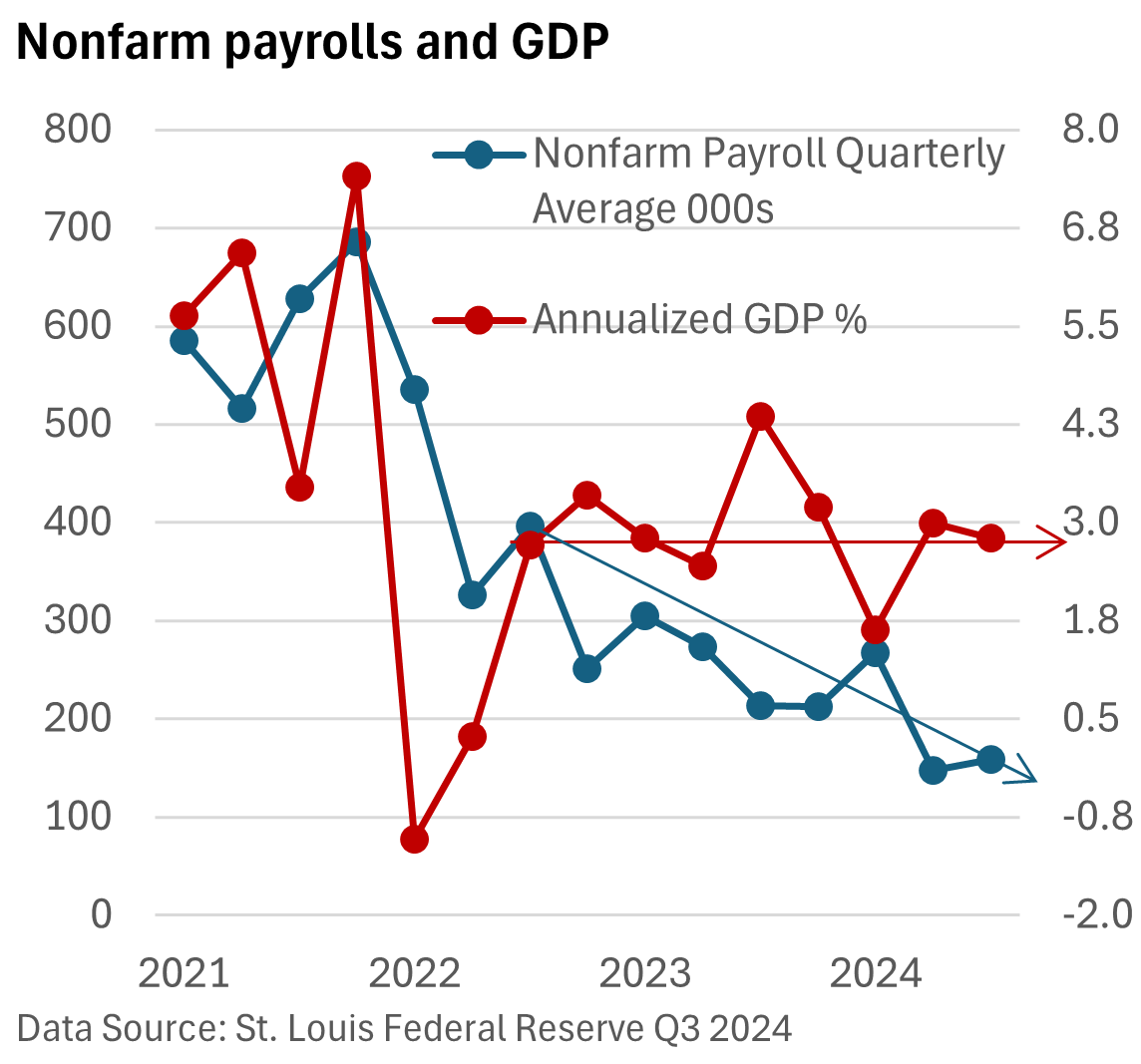
Perhaps it can be explained by quirks in one or both surveys. But it’s a conundrum.

With inflation above the Fed’s target of 2% per year, GDP argues against rate cuts. However, the moderation in job growth has encouraged the Federal Reserve to reduce interest rates, even as GDP expands.

Reproduction Prohibited without Express Permission. Copyright FDP Wealth Management. All rights reserved. Advisory Services offered through FDP Wealth Management, LLC, a state Registered Investment Adviser and Valmark Advisers, Inc. a SEC Registered Investment Advisor. Securities offered through ValMark Securities, Inc., Member FINRA/SIPC. 130 Springside Drive, Suite 300, Akron, OH 44333-2431 800.765.5201 Prosperity Partners and FDP Wealth Management, LLC are separate entities from ValMark Securities, Inc. and Valmark Advisers, Inc. Prosperity Partners, FDP Wealth Management, LLC, ValMark Securities, Inc., Valmark Advisers Inc., and their representatives do not offer tax advice. You should consult your tax professional regarding your individual circumstances. Indices are unmanaged and cannot be invested directly in. Past performance is not a guarantee of future results.

Indices are unmanaged and do not incur fees, one cannot directly invest in an index. You should consult your tax professional regarding your individual circumstances. This information is provided by Financial Jumble, LLC. Financial Jumble, LLC is a separate entity from ValMark Securities, Inc. and ValMark Advisers, Inc.

RELATED POSTS

An Uptick in the Unemployment Rate

The unemployment rate rose from 4.4% in September to 4.6% in November—see Figure 1. The US Bureau of Labor Statistics did not conduct its household survey in October due to the government shutdown. The household survey includes the unemployment rate

Fed Cuts Rates Again, Signals a Possible Pause

The Federal Reserve followed through on what was a widely expected rate cut, reducing the fed funds rate a quarter-percentage point (1 basis point = 0.01%) to a range of 3.50 – 3.75%.

Black Friday’s Spending Spree

A December 1 headline from Reuters sums up the start of the Christmas shopping season: US Holiday Shoppers Shake Off Economic Blues for Online Spending Spree.

Data Disconnect

Retailers are ringing up solid earnings, but consumer confidence surveys tell a different story, suggesting the mood is far from upbeat. This disconnect raises a big question: if shoppers are still buying, as we will highlight in a moment, why do they feel so uneasy about the economy?

Buyer’s Market – With Strings Attached

Redfin reported last week that sellers are grappling with the strongest buyer’s market since the real estate brokerage firm began compiling records back in 2013. Sellers now outnumber buyers by 37%.