




Oct 27, 2025

All That Glitters is Gold

Among various assets, one unexpected outperformer has been gold. Since the start of the year, the shiny metal has increased by over 50%, easily surpassing the major stock market indexes.
The Dollar Index (DXY) is an index (or measure) of the value of the US dollar relative to a basket of foreign currencies, often referred to as a basket of US trade partners’ currencies.  The Index rises when the US dollar gains value when compared to other currencies.  The index is designed, maintained, and published by ICE (Intercontinental Exchange, Inc.). You cannot buy into the index directly. ​Commodity-related products, including gold, carry a high level of risk and are not suitable for all investors. Commodity-related investments can be highly volatile and may lack liquidity. Their performance is significantly influenced by fluctuations in underlying commodity prices, global events, import restrictions, international competition, government regulations, and broader economic conditions. Past performance is no guarantee of future results.

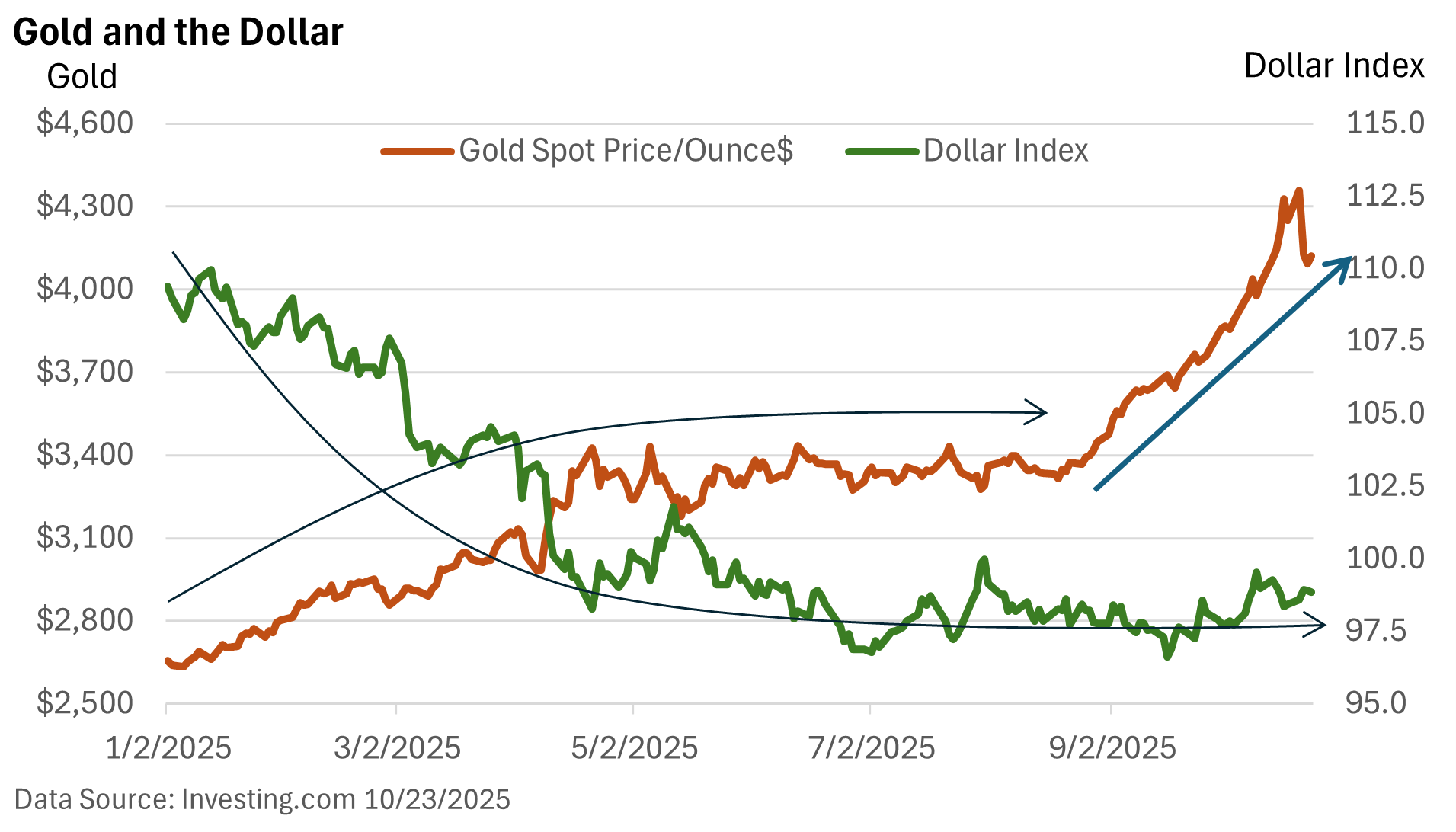
Globally, gold is priced in dollars. A rising dollar has historically provided a stiff headwind for gold. And the opposite is true. A weak dollar has historically been supportive of gold.

That pattern played out during the first eight months of the year. As the dollar slipped during the first four months, gold rallied.

But the dollar’s stabilization put a lid on gold, at least through the end of August.

A meteoric rise 

Despite a stable dollar, gold has soared over the past couple of months, surpassing $4,000 per ounce for the first time.

Why has the price of gold surged? There are several reasons, including—

  • Purchases of the metal by global central banks, as they gradually diversify away from the dollar.
  • Tariffs and trade uncertainty may also be encouraging some investors to look at gold. Economic uncertainty has historically aided gold.
  • The large federal deficit is viewed as unsustainable. It contributes to economic uncertainty, currency debasement, and investor distrust in traditional financial instruments.
  • Expected rate cuts by the Federal Reserve support gold. In part, gold does not pay a dividend (obviously), and falling rates may make it more appealing.
  • Higher inflation is seen as supporting gold; however, as we’ve observed before, other factors can outweigh changes in inflation. Gold was weak in 2022 despite high inflation. It has surged in 2025, even as the inflation rate has remained relatively steady.
  • Lastly, success begets success. Let’s call it momentum. The run-up in price, especially over the last two months, has encouraged speculators to add to their positions. In other words, it’s FOMO—the Fear of Missing Out.

But gold is very speculative and can be volatile. Last week, gold saw its biggest one-day selloff in more than a decade, according to the Wall Street Journal.

Such a decline probably wasn’t surprising, at least in hindsight. But timing a move like that is all but impossible.

Reproduction Prohibited without Express Permission. Copyright FDP Wealth Management. All rights reserved. Advisory Services offered through FDP Wealth Management, LLC, a state Registered Investment Adviser and Valmark Advisers, Inc. a SEC Registered Investment Advisor. Securities offered through ValMark Securities, Inc., Member FINRA/SIPC. 130 Springside Drive, Suite 300, Akron, OH 44333-2431 800.765.5201 Prosperity Partners and FDP Wealth Management, LLC are separate entities from ValMark Securities, Inc. and Valmark Advisers, Inc. Prosperity Partners, FDP Wealth Management, LLC, ValMark Securities, Inc., Valmark Advisers Inc., and their representatives do not offer tax advice. You should consult your tax professional regarding your individual circumstances. Indices are unmanaged and cannot be invested directly in. Past performance is not a guarantee of future results.

Indices are unmanaged and do not incur fees, one cannot directly invest in an index. You should consult your tax professional regarding your individual circumstances. This information is provided by Financial Jumble, LLC. Financial Jumble, LLC is a separate entity from ValMark Securities, Inc. and ValMark Advisers, Inc.

RELATED POSTS

Q4 Government Shutdown Drags on GDP; Supreme Court Blocks Tariff Plan

The government shutdown proved to be a far greater drag on the economy than earlier estimates indicated. On Friday, the U.S. BEA reported that fourth-quarter Gross Domestic Product (GDP), the largest measure of economic output, grew at a 1.4% annualized pace. This compares with a 4.4% annualized pace in Q3.

Revisiting 2025 Employment

The US Bureau of Labor Statistics published its final benchmark revisions covering employment during the 12‑month period between April 2024 and March 2025. The revisions showed that payrolls were revised lower by 898,000 jobs compared with the originally reported figures.

Markets Rotate: What’s Driving the Shift; Plus, the Dow Crosses a Milestone

After leading markets for much of the past two years, AI, tech stocks, and software specifically, are losing leadership in early 2026, as investors rotate capital toward other sectors, including energy, industrials, and defensive sectors.

January Barometer Flashes Green, a Sleepy Fed Gathering

The so-called January Barometer holds that the market’s performance in January—measured by the S&P 500 Index—tends to foreshadow how stocks will perform during the year. Since 1970, January finished higher 33 times and fell 23 times, excluding this month’s increase of 1.37% (MarketWatch data, excludes reinvested dividends).

It’s Hard to Say Good-bye: What Persistently Low Layoffs Say About the Economy

Much has been made of the sluggish hiring environment, but less attention has been paid to an important counterpoint: the persistently low level of layoffs. Figure 1 highlights the number of individuals who go online or head to their respective state’s unemployment office and file for benefits following a layoff.