





author avatar
Mark Chandik

Apr 20, 2026

Stocks Rise to New Highs

The Nasdaq hit fresh record highs on Wednesday, Thursday, and Friday, capping off a strong week for tech stocks. On Wednesday, the S&P 500 also made history, closing above 7,000 for the first time. It kept building on those gains through the end of the week.

Recent action stands in stark contrast from just a few weeks ago, and the new highs come despite the war with Iran. Why?

Largely, that’s because the stock market reflects what investors expect will happen down the road, not how things look right now. Economists and market analysts often point out that stocks move based on predictions about the future—where the economy, profits, and interest rates are headed—rather than a simple snapshot of today’s conditions.

In essence, with a ceasefire in effect, investors collectively believe that the war will end soon and oil and other commodities will gradually exit the Strait, limiting any economic impact at home.

On Friday morning Iran said it would fully open shipping through the Strait of Hormuz, a critical chokepoint that handles roughly one‑fifth of the world’s oil supply. Oil tumbled by $10 per barrel, stocks added to recent gains, but the president said the blockade of Iran will continue.

Note in the graphic below that stocks have closely tracked the price of oil since the war began. The vertical dashed lines highlight investor reaction to changing oil prices.

Between March 30 and April 7, however, stocks began to break free of oil’s tight grip. Rising crude prices didn’t prevent investors from snapping up equities during that short period.
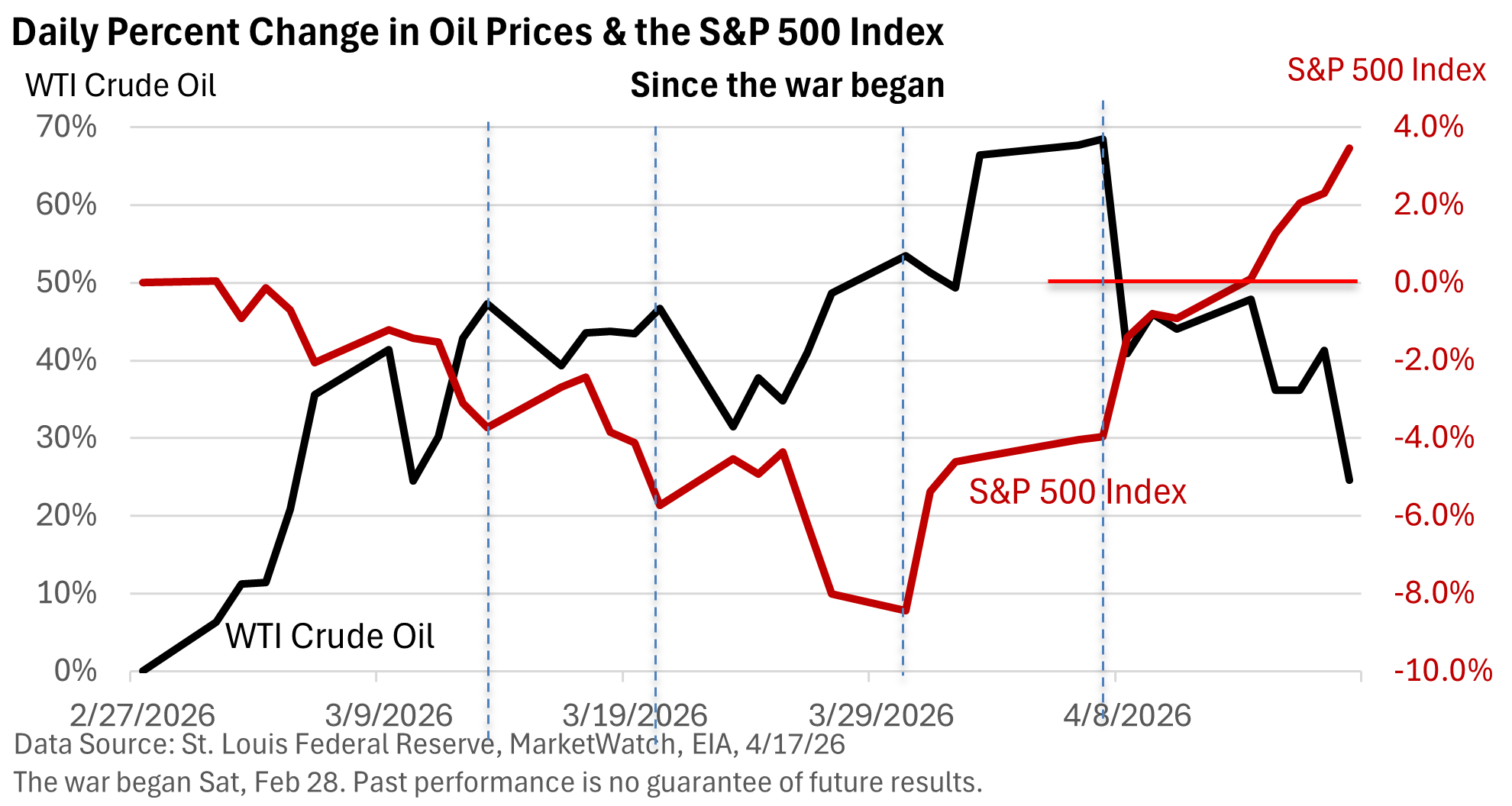
Line chart of daily percent change: WTI Crude Oil (black) and S&P 500 Index (red) from Feb to Apr 2026, with event markers and data sources noted.
On April 13, the S&P 500 Index had completely erased losses incurred since the start of the war. But the price of oil remained nearly 50% above its pre-war price.

Although the decline in crude last week helped fuel recent gains in stocks, investors are collectively betting that a new round of hostilities won’t reignite.

The expanding US economy, expectations of a very strong Q1 profit season, stable interest rates, and rising profit estimates for the remainder of the year, according to LSEG, are also fueling recent optimism. In short, the selloff in March was relatively restrained given the gravity of events in the Middle East. Continued economic and profit growth, coupled with the prospect the conflict will be resolved, has underpinned stocks.

author avatar
Mark Chandik

Reproduction Prohibited without Express Permission. Copyright FDP Wealth Management. All rights reserved. Advisory Services offered through FDP Wealth Management, LLC, a state Registered Investment Adviser and Valmark Advisers, Inc. a SEC Registered Investment Advisor. Securities offered through ValMark Securities, Inc., Member FINRA/SIPC. 130 Springside Drive, Suite 300, Akron, OH 44333-2431 800.765.5201 Prosperity Partners and FDP Wealth Management, LLC are separate entities from ValMark Securities, Inc. and Valmark Advisers, Inc. Prosperity Partners, FDP Wealth Management, LLC, ValMark Securities, Inc., Valmark Advisers Inc., and their representatives do not offer tax advice. You should consult your tax professional regarding your individual circumstances. Indices are unmanaged and cannot be invested directly in. Past performance is not a guarantee of future results.

Indices are unmanaged and do not incur fees, one cannot directly invest in an index. You should consult your tax professional regarding your individual circumstances. This information is provided by Financial Jumble, LLC. Financial Jumble, LLC is a separate entity from ValMark Securities, Inc. and ValMark Advisers, Inc.

RELATED POSTS

Inflation Heats Up as Gasoline Prices Surge

Led by a 10.9% rise in energy, including a 21% rise in gasoline, the US Bureau of Labor Statistics reported that the Consumer Price Index (CPI) rose 0.9% in March, the highest in almost four years. On an annual basis, prices rose 3.3%.

It’s Not Just Oil – Key Commodities That May Soon Be in Short Supply

Oil has captured much of the attention amid the conflict in the Middle East. While a limited number of tankers are transiting the region, the Strait of Hormuz is largely blocked, disrupting nearly one-fifth of the world’s oil supply.

California’s Delicate Energy Situation

How long the war might last is not clear, but its effects are being felt in global energy markets. Oil moves easily across borders, which means supply disruptions quickly lead to higher gasoline prices.

Decoding the Fed: Impact on Investors

Against the backdrop of the war, the Federal Reserve met last week and decided to hold its key rate—the fed funds rate—unchanged at 3.50–3.75%. The decision was completely expected.

Looking Past the Pump: A Granular Look at Gasoline Prices

There are fears that higher prices will exacerbate inflation and hurt the economy, as cash that might have gone to other items will be diverted to the gas tank.