





author avatar
Mark Chandik

Apr 27, 2026

Retail Sales Surge on Higher Gasoline Prices

It is no surprise that retail sales surged last month—but not for the reason investors typically want to see.

The U.S. Census Bureau reported a 1.7% increase in March retail sales, driven largely by a 15.5% jump at gasoline stations. The overall strength reflects higher prices at the pump, not strong underlying consumer demand.

Retail sales are goods purchased online or at the store.

Put plainly, if you drive a gasoline-powered vehicle, higher gasoline prices translate into higher spending for gasoline, and that was reflected in the March data.

But there was good news in the data, too. The higher price of gasoline didn’t eat into other categories. In other words, the shock of higher gasoline prices didn’t force most folks to cut back in other areas.

You see, if spending at gas stations is excluded, spending rose a healthy 0.6% in March. And that’s not a big surprise either.

Retail sales spending is ‘lumpy’ and can be affected by everything from weather to statistical quirks in the data.

That said, a spike in gasoline prices wouldn’t be expected to immediately force a reallocation in the family budget. Initially, most folks simply dip into their savings or add to their credit card balances, and spending holds up in other categories.

But as onerous as higher gas prices might be, if prices were to hold at today’s levels over an extended period of time, would they dampen economic growth as consumers are forced to choose between gasoline and other items or services?

As the graphic illustrates, family budgets have weathered worse. In part, autos are more efficient today, and more people are driving EVs.
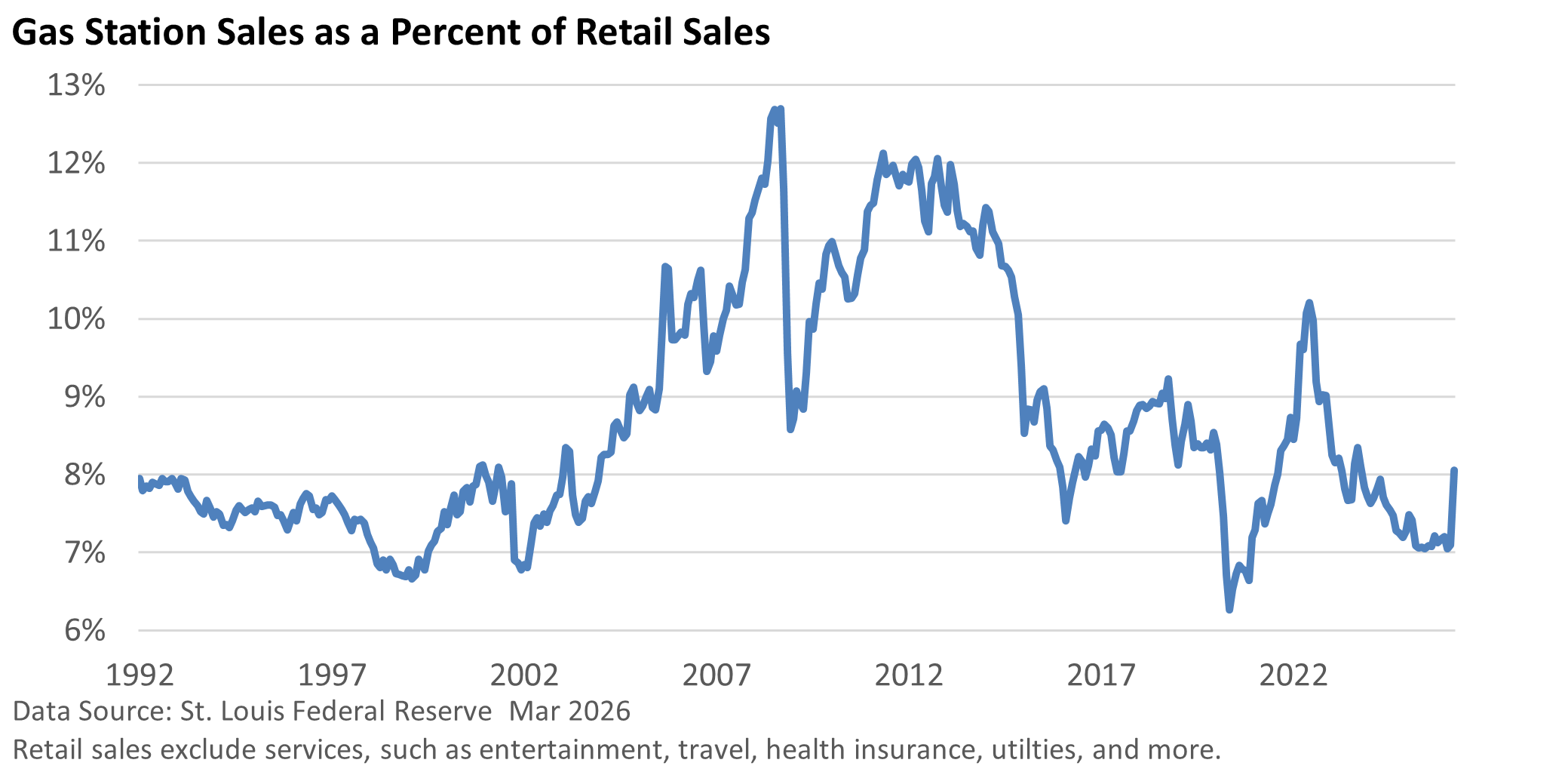
Line chart showing gas station sales as a percent of retail sales from 1992 to 2022, fluctuating between about 6% and 13% with peaks around 2007–2008 and 2010s; data from St. Louis Fed.
Paying high prices for gasoline is never welcome. Still, higher gas prices alone, viewed through the narrow lens that is laser-focused on the overall economic impact, don’t appear to be sufficient to destabilize the economy, particularly given the consumers’ ability to absorb higher gasoline costs in the past.
author avatar
Mark Chandik

Reproduction Prohibited without Express Permission. Copyright FDP Wealth Management. All rights reserved. Advisory Services offered through FDP Wealth Management, LLC, a state Registered Investment Adviser and Valmark Advisers, Inc. a SEC Registered Investment Advisor. Securities offered through ValMark Securities, Inc., Member FINRA/SIPC. 130 Springside Drive, Suite 300, Akron, OH 44333-2431 800.765.5201 Prosperity Partners and FDP Wealth Management, LLC are separate entities from ValMark Securities, Inc. and Valmark Advisers, Inc. Prosperity Partners, FDP Wealth Management, LLC, ValMark Securities, Inc., Valmark Advisers Inc., and their representatives do not offer tax advice. You should consult your tax professional regarding your individual circumstances. Indices are unmanaged and cannot be invested directly in. Past performance is not a guarantee of future results.

Indices are unmanaged and do not incur fees, one cannot directly invest in an index. You should consult your tax professional regarding your individual circumstances. This information is provided by Financial Jumble, LLC. Financial Jumble, LLC is a separate entity from ValMark Securities, Inc. and ValMark Advisers, Inc.

RELATED POSTS

Stocks Rise to New Highs

The Nasdaq hit fresh record highs on Wednesday, Thursday, and Friday, capping off a strong week for tech stocks. On Wednesday, the S&P 500 also made history, closing above 7,000 for the first time. It kept building on those gains through the end of the week.

Inflation Heats Up as Gasoline Prices Surge

Led by a 10.9% rise in energy, including a 21% rise in gasoline, the US Bureau of Labor Statistics reported that the Consumer Price Index (CPI) rose 0.9% in March, the highest in almost four years. On an annual basis, prices rose 3.3%.

It’s Not Just Oil – Key Commodities That May Soon Be in Short Supply

Oil has captured much of the attention amid the conflict in the Middle East. While a limited number of tankers are transiting the region, the Strait of Hormuz is largely blocked, disrupting nearly one-fifth of the world’s oil supply.

California’s Delicate Energy Situation

How long the war might last is not clear, but its effects are being felt in global energy markets. Oil moves easily across borders, which means supply disruptions quickly lead to higher gasoline prices.

Decoding the Fed: Impact on Investors

Against the backdrop of the war, the Federal Reserve met last week and decided to hold its key rate—the fed funds rate—unchanged at 3.50–3.75%. The decision was completely expected.