




author avatar
Mark Chandik

Jun 16, 2026

The Latest on Inflation

The latest Consumer Price Index (CPI) report from the U.S. Bureau of Labor Statistics (BLS) provided investors with a modest sense of relief when it was released last Wednesday.

According to the BLS, headline CPI rose 0.5% in May and is up 4.2% compared to a year ago, accelerating from April’s 3.8% annual increase. The more encouraging news came from core CPI, which excludes the more volatile food and energy categories.

Core prices rose just 0.2% in May, helping to ease some inflation concerns. On an annual basis, core CPI increased 2.9%, ticking up slightly from 2.8% in April.

Rising energy and gasoline prices are the primary culprits behind the significant rise in the CPI. Let’s review Figure 1. Energy prices have surged. Outside of energy, price increases are somewhat elevated, but we aren’t seeing significant pressures in food or core inflation—all items except food and energy.
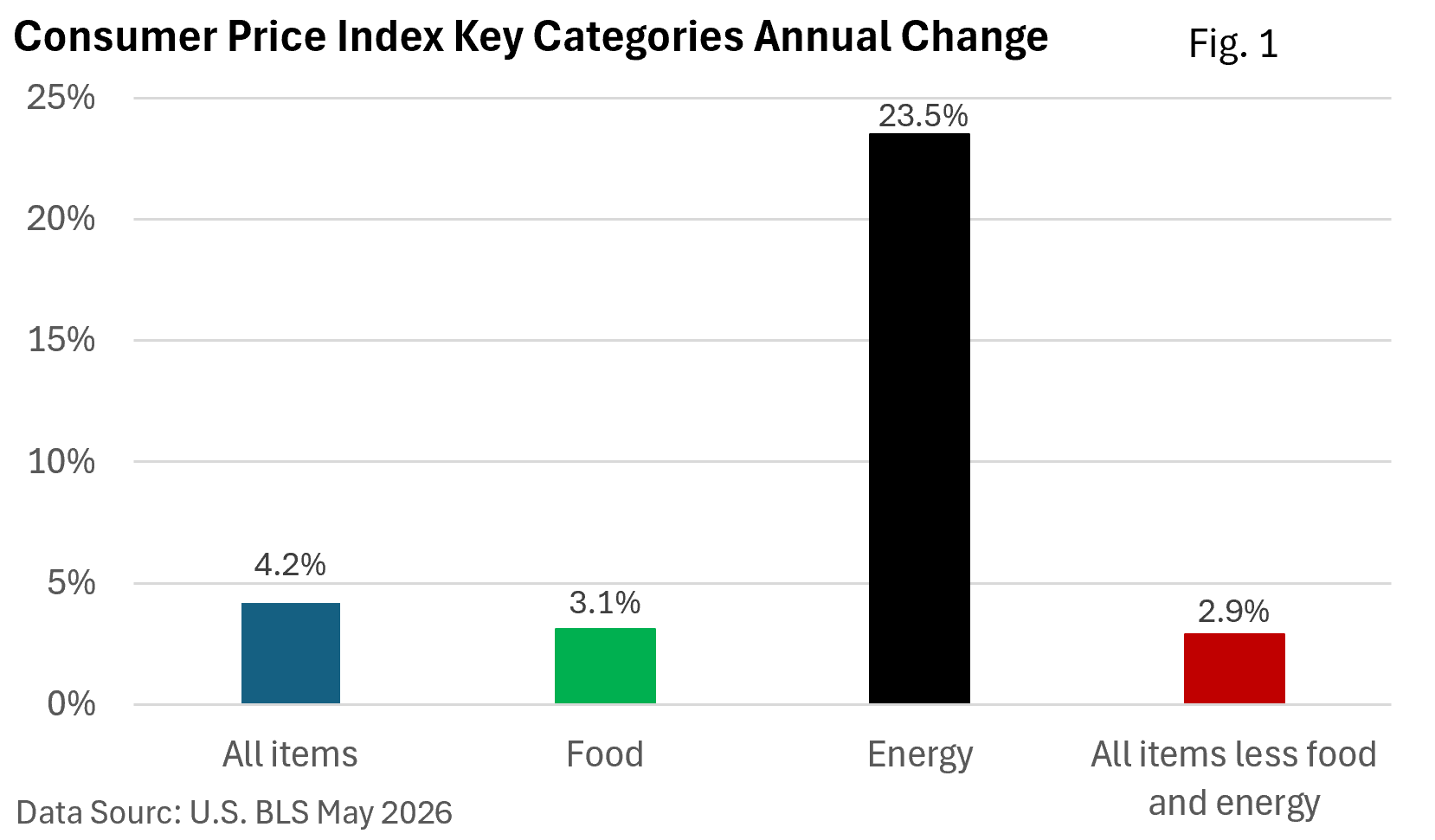
Bar chart of CPI annual change by category: All items 4.2%, Food 3.1%, Energy 23.5%, All items less food and energy 2.9%. Data source: U.S. BLS May 2026.
It’s not ideal, but for the most part, what’s happened to gasoline has yet to bleed into most everyday items.

Meanwhile, here’s one more look at two broad categories in the CPI. Shelter (housing, rent) is rising at about the rate it was in the late 2010s. But that’s not the case for core consumer goods—excluding food and energy—and services (excluding housing). They remain somewhat elevated.
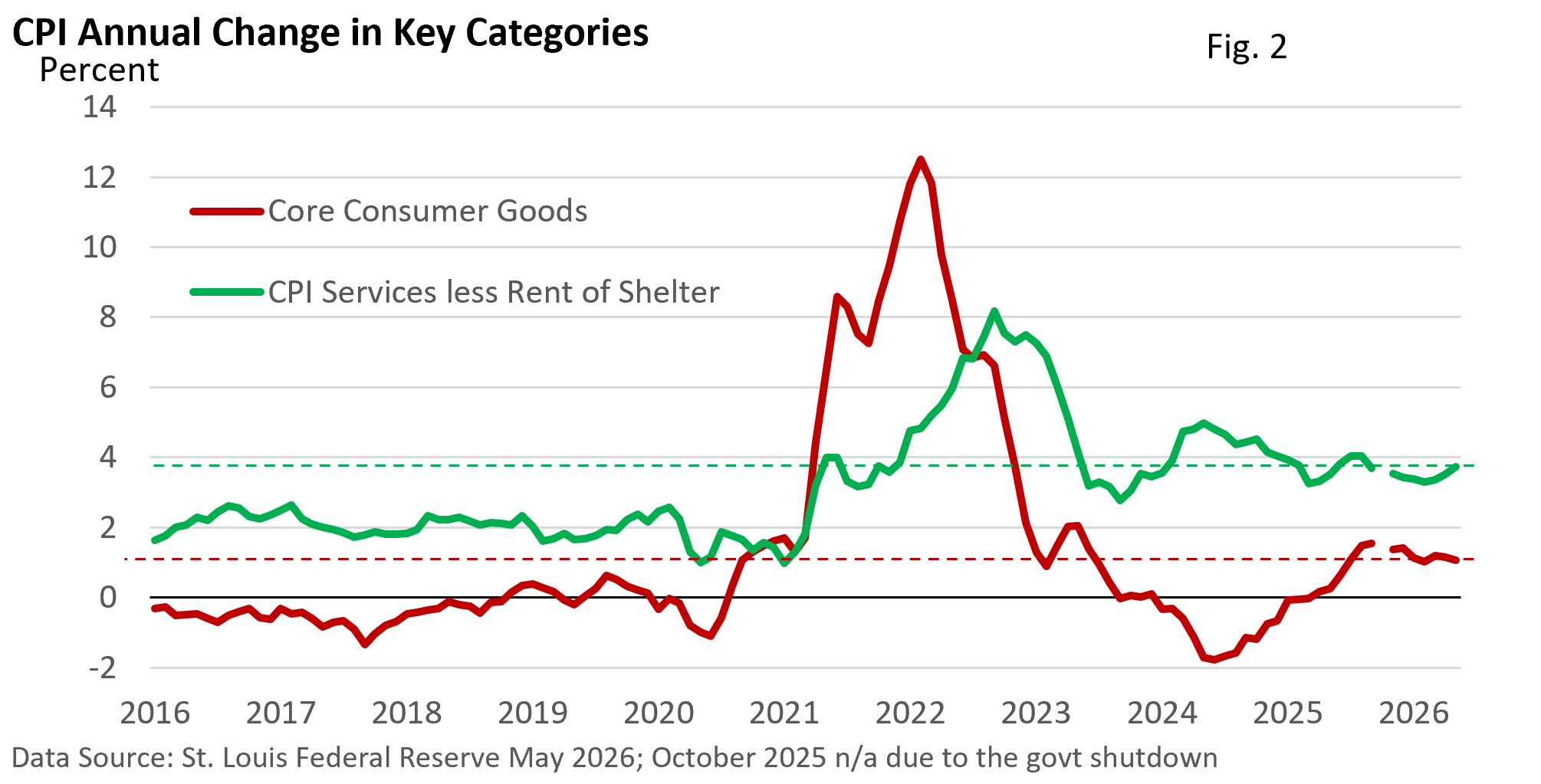
Fig. 2: CPI annual changes 2016–2026 for Core Consumer Goods (red) and Services less Rent of Shelter (green). Red peaks ~12% in 2022 then drops to near 0% by 2024; green fluctuates around 2–6%, with a peak near 8% in 2023–2024; data note at bottom.
author avatar
Mark Chandik

Reproduction Prohibited without Express Permission. Copyright FDP Wealth Management. All rights reserved. Advisory Services offered through FDP Wealth Management, LLC, a state Registered Investment Adviser and Valmark Advisers, Inc. a SEC Registered Investment Advisor. Securities offered through ValMark Securities, Inc., Member FINRA/SIPC. 130 Springside Drive, Suite 300, Akron, OH 44333-2431 800.765.5201 Prosperity Partners and FDP Wealth Management, LLC are separate entities from ValMark Securities, Inc. and Valmark Advisers, Inc. Prosperity Partners, FDP Wealth Management, LLC, ValMark Securities, Inc., Valmark Advisers Inc., and their representatives do not offer tax advice. You should consult your tax professional regarding your individual circumstances. Indices are unmanaged and cannot be invested directly in. Past performance is not a guarantee of future results.

Indices are unmanaged and do not incur fees, one cannot directly invest in an index. You should consult your tax professional regarding your individual circumstances. This information is provided by Financial Jumble, LLC. Financial Jumble, LLC is a separate entity from ValMark Securities, Inc. and ValMark Advisers, Inc.

RELATED POSTS

Hiring Ramps Up

Well, that was a pleasant surprise. The US Bureau of Labor Statistics (BLS) reported that nonfarm payrolls rose by 172,000 in May, more than double the 80,000 economists had expected, according to a Wall Street Journal survey.

An AI Boost to Jobs

What’s driving bond yields higher? Since the recent low, the 10-year Treasury yield has climbed nearly three-quarters of a percentage point. The 10-year is a key benchmark because many borrowing rates, including mortgage rates, closely track its movements.

Bond Yields on the Rise

What’s driving bond yields higher? Since the recent low, the 10-year Treasury yield has climbed nearly three-quarters of a percentage point. The 10-year is a key benchmark because many borrowing rates, including mortgage rates, closely track its movements.

A Profits Gusher

S&P 500 corporate profits are surging in the first quarter, helping to push both the S&P 500 Index and the tech-heavy Nasdaq Composite to new highs this month.

April Flowers: A Brighter Jobs Picture

On Thursday, the US Bureau of Economic Analysis reported that Gross Domestic Product (GDP), the largest measure of goods and services, expanded at an annual rate of 2.0% in the first quarter.