





author avatar
Mark Chandik

Jul 6, 2026

A Muddy Jobs Report

The recent pickup in job growth is welcome news for job seekers. But June’s jobs report left more questions than answers. Here’s why.

Nonfarm payrolls rose by a smaller-than-expected 57,000 in June, according to the U.S. Bureau of Labor Statistics. In addition, April and May were revised lower by a combined 74,000.

Overall, it was not a particularly impressive month for payroll growth. However, employment data can be volatile from month to month. An uneven pattern is not unusual in the labor market.

As we’ve seen for some time, health care continues to be the engine of growth, generating 47,000 new jobs in June.

What really raised eyebrows, however, was the loss of 61,000 jobs in leisure and hospitality, the sector’s largest decline since late 2020.

Even more surprising, the drop occurred during a month when foreign visitors were flocking to the U.S. for the FIFA Club World Cup.

You’d expect hiring as companies staff up restaurants, bars, and maybe even hotels. But, at least according to the government’s survey, that didn’t happen. All that said, something seems amiss.  But if that’s the case, these anomalies tend to wash out over time.

Still, there was some good news. The unemployment rate fell to 4.2% in June from May’s 4.3%.

Notably, the jobless rate has remained within a fairly narrow range for two years, averaging 4.24% over that period.
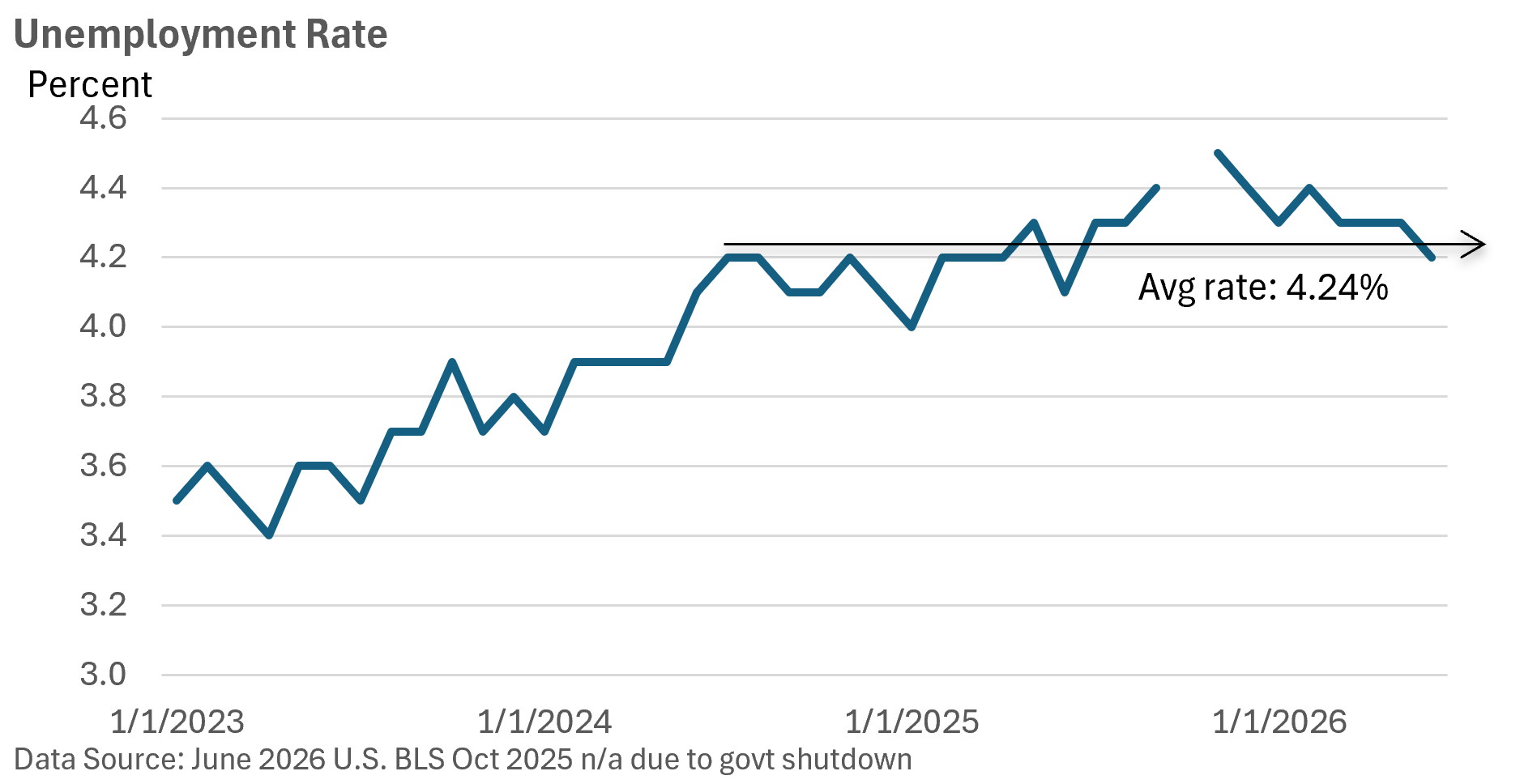
Line chart of unemployment rate from 2023 to 2026, ending near 4.2%, with an average line shown as 4.24%. Data source noted at bottom.
What does the unemployment rate tell us? At its core, it helps answer whether job growth is strong enough to keep the jobless rate from rising, or better yet, strong enough to push it lower.

During that two-year period, the average monthly increase in nonfarm payrolls was 54,000.

Historically, that’s soft, but slow labor force growth has prevented the jobless rate from rising. Slow job growth offers little comfort to those seeking new jobs, but the number of unemployed remains reasonably low, according to government data.

author avatar
Mark Chandik

Reproduction Prohibited without Express Permission. Copyright FDP Wealth Management. All rights reserved. Advisory Services offered through FDP Wealth Management, LLC, a state Registered Investment Adviser and Valmark Advisers, Inc. a SEC Registered Investment Advisor. Securities offered through ValMark Securities, Inc., Member FINRA/SIPC. 130 Springside Drive, Suite 300, Akron, OH 44333-2431 800.765.5201 Prosperity Partners and FDP Wealth Management, LLC are separate entities from ValMark Securities, Inc. and Valmark Advisers, Inc. Prosperity Partners, FDP Wealth Management, LLC, ValMark Securities, Inc., Valmark Advisers Inc., and their representatives do not offer tax advice. You should consult your tax professional regarding your individual circumstances. Indices are unmanaged and cannot be invested directly in. Past performance is not a guarantee of future results.

Indices are unmanaged and do not incur fees, one cannot directly invest in an index. You should consult your tax professional regarding your individual circumstances. This information is provided by Financial Jumble, LLC. Financial Jumble, LLC is a separate entity from ValMark Securities, Inc. and ValMark Advisers, Inc.

RELATED POSTS

1776 to Today: Reflections on the Fourth of July

As the United States approaches the 250th anniversary of its founding—a milestone known as the Semiquincentennial—the Declaration of Independence remains as important as ever.

There’s a New Sheriff in Town

The Federal Reserve surprised no one by holding its key rate, the fed funds rate, at 3.50–3.75%.

The Latest on Inflation

The latest Consumer Price Index (CPI) report from the U.S. Bureau of Labor Statistics (BLS) provided investors with a modest sense of relief when it was released last Wednesday.

Hiring Ramps Up

Well, that was a pleasant surprise. The US Bureau of Labor Statistics (BLS) reported that nonfarm payrolls rose by 172,000 in May, more than double the 80,000 economists had expected, according to a Wall Street Journal survey.

An AI Boost to Jobs

What’s driving bond yields higher? Since the recent low, the 10-year Treasury yield has climbed nearly three-quarters of a percentage point. The 10-year is a key benchmark because many borrowing rates, including mortgage rates, closely track its movements.