





author avatar
Mark Chandik

Jun 16, 2026

The Latest on Inflation

The latest Consumer Price Index (CPI) report from the U.S. Bureau of Labor Statistics (BLS) provided investors with a modest sense of relief when it was released last Wednesday.

According to the BLS, headline CPI rose 0.5% in May and is up 4.2% compared to a year ago, accelerating from April’s 3.8% annual increase. The more encouraging news came from core CPI, which excludes the more volatile food and energy categories.

Core prices rose just 0.2% in May, helping to ease some inflation concerns. On an annual basis, core CPI increased 2.9%, ticking up slightly from 2.8% in April.

Rising energy and gasoline prices are the primary culprits behind the significant rise in the CPI. Let’s review Figure 1. Energy prices have surged. Outside of energy, price increases are somewhat elevated, but we aren’t seeing significant pressures in food or core inflation—all items except food and energy.
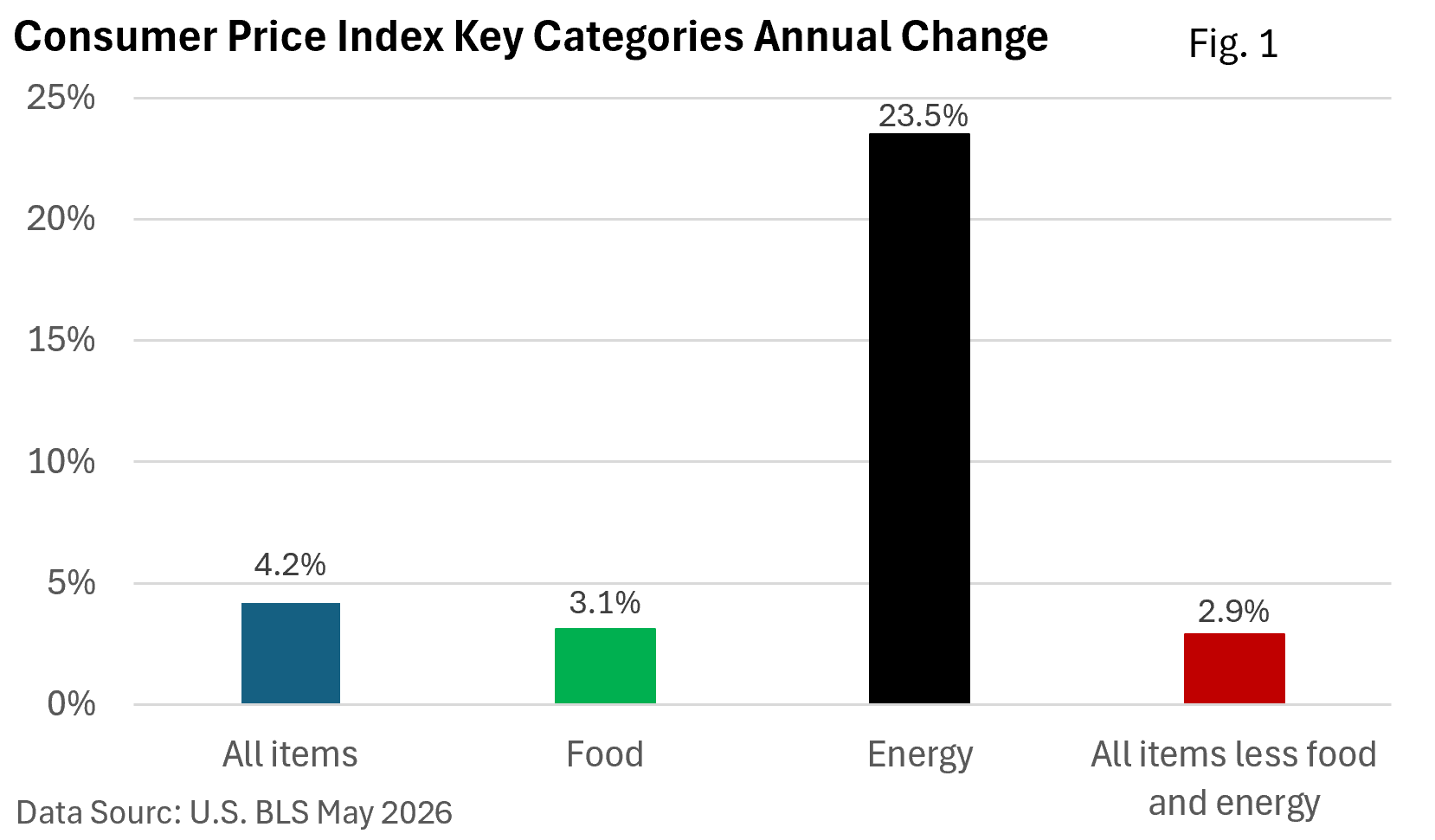
Bar chart of CPI annual change by category: All items 4.2%, Food 3.1%, Energy 23.5%, All items less food and energy 2.9%. Data source: U.S. BLS May 2026.
It’s not ideal, but for the most part, what’s happened to gasoline has yet to bleed into most everyday items.

Meanwhile, here’s one more look at two broad categories in the CPI. Shelter (housing, rent) is rising at about the rate it was in the late 2010s. But that’s not the case for core consumer goods—excluding food and energy—and services (excluding housing). They remain somewhat elevated.
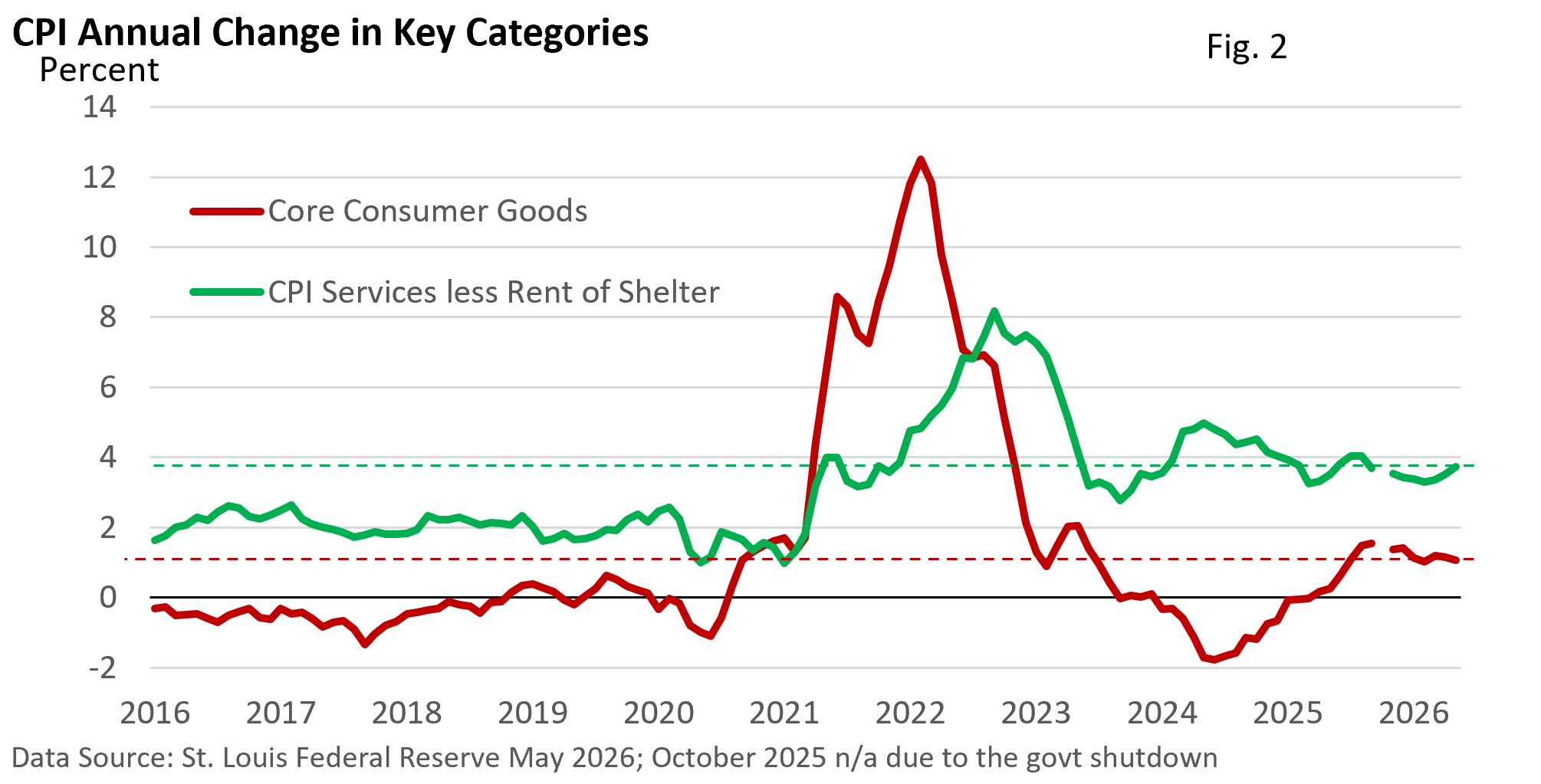
Fig. 2: CPI annual changes 2016–2026 for Core Consumer Goods (red) and Services less Rent of Shelter (green). Red peaks ~12% in 2022 then drops to near 0% by 2024; green fluctuates around 2–6%, with a peak near 8% in 2023–2024; data note at bottom.
author avatar
Mark Chandik

Reproduction Prohibited without Express Permission. Copyright FDP Wealth Management. All rights reserved. Advisory Services offered through FDP Wealth Management, LLC, a state Registered Investment Adviser and Valmark Advisers, Inc. a SEC Registered Investment Advisor. Securities offered through ValMark Securities, Inc., Member FINRA/SIPC. 130 Springside Drive, Suite 300, Akron, OH 44333-2431 800.765.5201 Prosperity Partners and FDP Wealth Management, LLC are separate entities from ValMark Securities, Inc. and Valmark Advisers, Inc. Prosperity Partners, FDP Wealth Management, LLC, ValMark Securities, Inc., Valmark Advisers Inc., and their representatives do not offer tax advice. You should consult your tax professional regarding your individual circumstances. Indices are unmanaged and cannot be invested directly in. Past performance is not a guarantee of future results.

Indices are unmanaged and do not incur fees, one cannot directly invest in an index. You should consult your tax professional regarding your individual circumstances. This information is provided by Financial Jumble, LLC. Financial Jumble, LLC is a separate entity from ValMark Securities, Inc. and ValMark Advisers, Inc.

RELATED POSTS

Rising Yields Faily to Derail Stocks

This year, the stock market has risen significantly. Lingering worries about oil prices, inflation, the war with Iran, and the possibility of an AI bubble haven’t subsided. But the economy is expanding, corporate profits have been strong, and the S&P 500 Index set a new high last week, according to the Wall Street Journal.

All Gas, No Brakes: Profits Soar in Q2

In a solid earnings season, we’d generally expect S&P 500 companies to deliver double-digit profit growth, meaning earnings growth of at least 10% versus a year ago (20% tops). That’s not a hard-and-fast rule, but it provides a useful benchmark for evaluating the strength of a quarter.

A Murky Fed Message

“All hat and no cattle” is a traditional cowboy phrase—especially popular in Texas—describing someone who is basically a poser: plenty of talk, lots of sparkle, but little to back it up. It’s all talk and no action, and that’s the takeaway from Federal Reserve Chair Kevin Warsh’s second Fed meeting and subsequent press conference.

Social Security and You

The trust fund that supports Social Security retirement benefits is projected to be depleted in the fourth quarter of 2032. At that point, ongoing revenue from Social Security payroll taxes is expected to cover approximately 78% of scheduled retirement benefits.

Chips in Flux

Since the most recent market low at the end of March, semiconductors (microchips, commonly called chip stocks) have been a very popular trade. In less than three months, the PHLX Semiconductor Index has more than doubled—see Figure 1.