





Aug 4, 2025

Heavy Data Week Offers Mixed Picture

Last week was packed with economic developments, as reports poured in from all directions.

We saw the release of second-quarter Gross Domestic Product (GDP) figures, the broadest measure of goods and services produced, alongside the July jobs report. As if that weren’t enough, the Federal Reserve held its policy meeting, and strong corporate earnings continued to roll in.

Yes, there was a flurry of activity, and the overall picture was mixed at best.

Trade flows continue to whipsaw the data. While the headline showed a solid 3.0% gain, it overstated actual growth—essentially the reverse of Q1, when a 0.5% decline understated underlying activity. As the Wall Street Journal noted, it was the “Weirdest GDP Report Ever.”

Bottom line—growth has moderated in 2025, and consumer spending has slowed.

Meanwhile, the Federal Reserve kept the fed funds rate at 4.25–4.50%. Despite ongoing economic concerns, the Fed remains focused on any inflationary pressures stemming from tariffs.

The Fed kept its September rate cards close to the vest, even as Fed Chief Powell repeatedly emphasized “downside risks to the labor market”—a phrase he repeated six times during his press conference.

Elsewhere, S&P 500 Q2 earnings continue to impress and are up over 11% versus one year ago, according to LSEG (as of Aug 1). That’s nearly double the estimate as of July 1. In part, the AI story is driving earnings for big tech companies, and that spills over into S&P 500 profits.

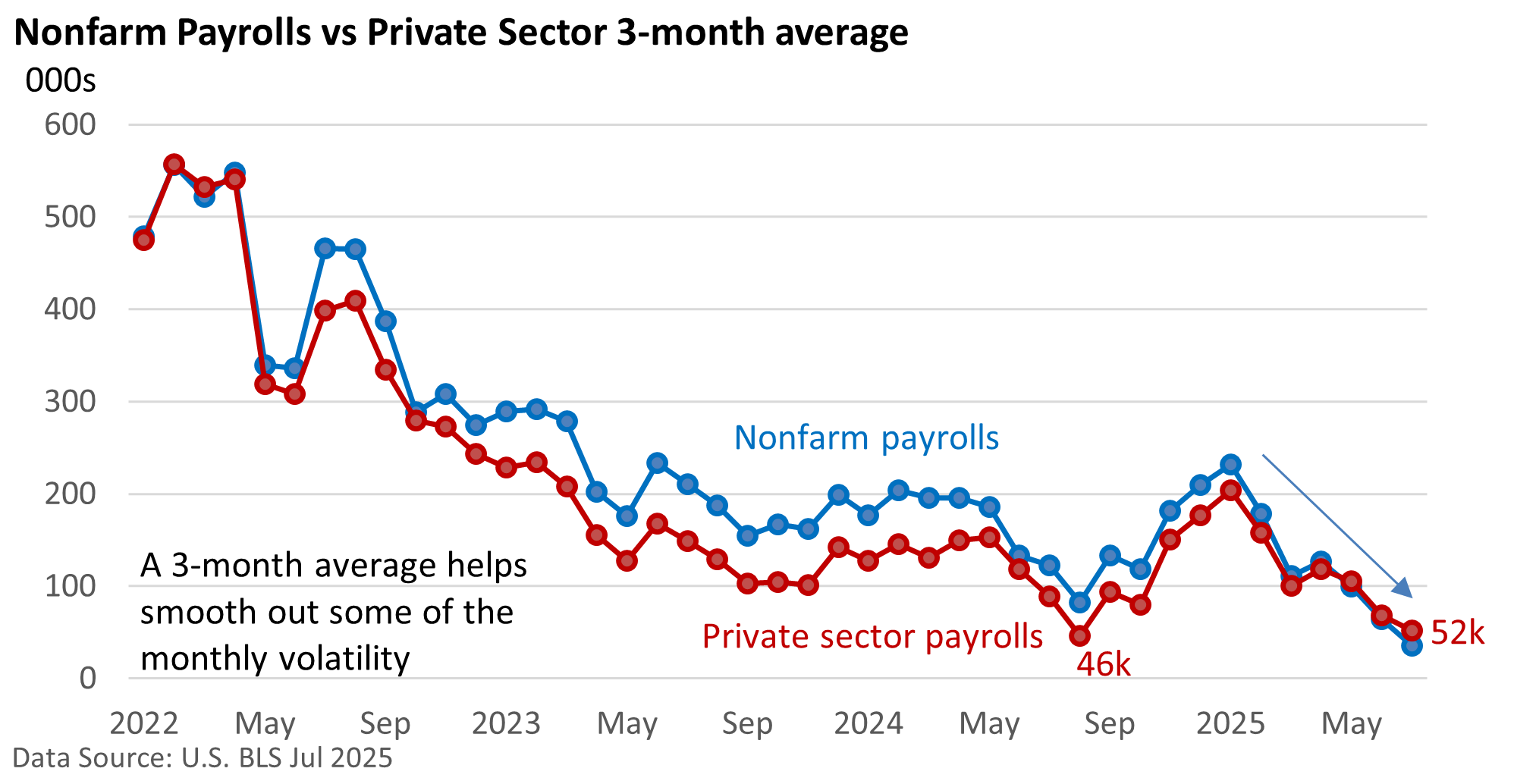
But July’s jobs report fell short of expectations. According to the US Bureau of Labor Statistics, nonfarm payrolls (includes all govt. jobs) rose a subdued 73,000 in July, with private sector gains totaling 83,000. On its own, that’s not terrible—certainly not impressive but not alarming either.

However, downward revisions to May and June—amounting to a combined 258,000—paint a more unsettling picture. Revisions are normal. The size of the revisions, however, was not. Even more striking, nearly all of July’s job growth came from a single sector: healthcare, which added 73,000 jobs. So far this year, 470,000 of the 588,000 private-sector jobs created have been in healthcare and social assistance, per to US BLS data.
Reproduction Prohibited without Express Permission. Copyright FDP Wealth Management. All rights reserved. Advisory Services offered through FDP Wealth Management, LLC, a state Registered Investment Adviser and Valmark Advisers, Inc. a SEC Registered Investment Advisor. Securities offered through ValMark Securities, Inc., Member FINRA/SIPC. 130 Springside Drive, Suite 300, Akron, OH 44333-2431 800.765.5201 Prosperity Partners and FDP Wealth Management, LLC are separate entities from ValMark Securities, Inc. and Valmark Advisers, Inc. Prosperity Partners, FDP Wealth Management, LLC, ValMark Securities, Inc., Valmark Advisers Inc., and their representatives do not offer tax advice. You should consult your tax professional regarding your individual circumstances. Indices are unmanaged and cannot be invested directly in. Past performance is not a guarantee of future results.

Indices are unmanaged and do not incur fees, one cannot directly invest in an index. You should consult your tax professional regarding your individual circumstances. This information is provided by Financial Jumble, LLC. Financial Jumble, LLC is a separate entity from ValMark Securities, Inc. and ValMark Advisers, Inc.

RELATED POSTS

Data Disconnect

Retailers are ringing up solid earnings, but consumer confidence surveys tell a different story, suggesting the mood is far from upbeat. This disconnect raises a big question: if shoppers are still buying, as we will highlight in a moment, why do they feel so uneasy about the economy?

Buyer’s Market – With Strings Attached

Redfin reported last week that sellers are grappling with the strongest buyer’s market since the real estate brokerage firm began compiling records back in 2013. Sellers now outnumber buyers by 37%.

Investors Unfazed by Shutdown

The government shutdown lasted from October 1 to November 12. It was the longest on record. During that period, the S&P 500 rose from 6,688.46 (September 30) to 6,850.92 (November 12), or an advance of 2.4%. As we’ve noted in prior shutdowns, investors typically ignore political drama.

The Job Market’s Missing Pulse

The government shutdown has been and will always be prominently featured in the 24-hour news cycle. Travelers are feeling it, furloughed federal employees wonder when they will receive their next paycheck, and even the housing market is affected as some buyers are left in limbo.

One Cut, Two Cut: The Fed’s Delicate Balancing Act

The Federal Reserve delivered a widely expected 25-basis-point rate cut (bp, 1 bp = 0.01%), but Fed Chief Jay Powell tempered market enthusiasm by signaling that a December cut is far from certain.