





Oct 3, 2022

The Dollar vs The World

Weekly Market Commentary

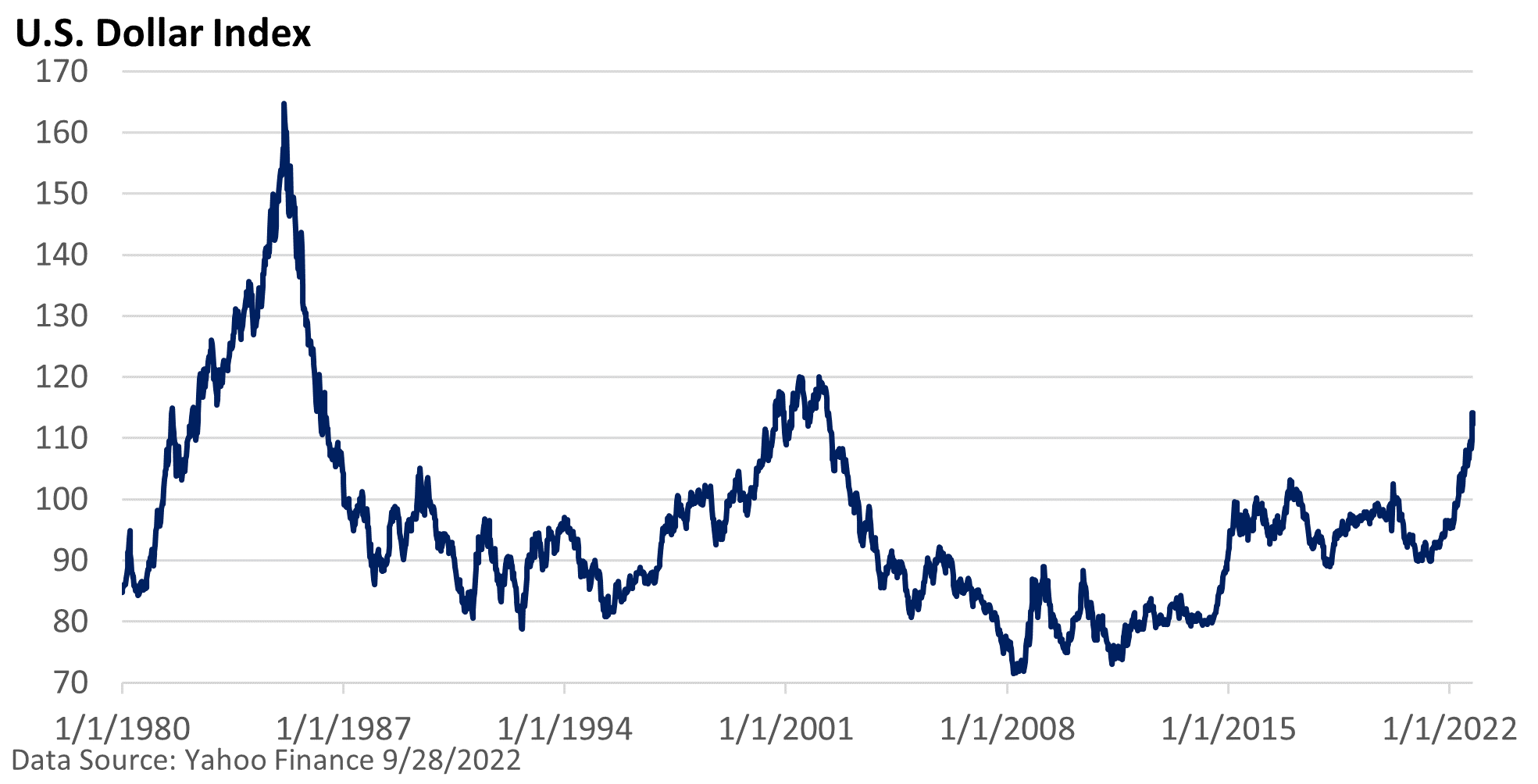
The dollar has soared to its highest level against the euro in 20 years. It has risen to its highest level against the Japanese yen in 30 years and recently hit a record high against the British pound, according to CNBC.

The U.S. Dollar Index is an index (or measure) of the value of the U.S. dollar relative to a basket of foreign currencies. As the graphic illustrates, the index is at a 20-year high.
What’s behind the surging greenback?

Interest rates in the U.S. have soared. Higher rates and talk of more rate hikes have attracted foreign cash that seeks a higher return.

Global uncertainty has also aided the dollar, as the dollar is the world’s reserve currency. The size and strength of the U.S. economy is unparalleled. The U.S. is still one of the safest places to park cash, and the dollar makes up a big share of foreign-exchange reserves.

Dollar strength advantages:

  • A stronger dollar lowers the cost of imports.
  • Global trade in commodities is usually priced in dollars. A strong dollar creates a headwind for commodity prices.
  • It’s a great time for U.S. tourists traveling overseas.

Dollar strength drawbacks:

  • A stronger dollar raises the price of exported goods, reducing competitiveness.
  • Overseas sales of U.S. companies must be translated back into a more expensive dollar, which pressures revenues and earnings.
  • A fast-appreciating dollar forces global central banks to react, which may create unwanted tensions in global finance. Emerging market economies may get hurt, too.

In the near term, the stronger dollar is probably being viewed favorably by Fed officials, at least privately, as fighting inflation is today’s aim.

Recently, investors are viewing the soaring greenback with apprehension, as some fret over tensions in global markets and added headwinds for earnings of firms that conduct a significant share of business overseas.

Reproduction Prohibited without Express Permission. Copyright FDP Wealth Management. All rights reserved. Advisory Services offered through FDP Wealth Management, LLC, a state Registered Investment Adviser and Valmark Advisers, Inc. a SEC Registered Investment Advisor. Securities offered through ValMark Securities, Inc., Member FINRA/SIPC. 130 Springside Drive, Suite 300, Akron, OH 44333-2431 800.765.5201 Prosperity Partners and FDP Wealth Management, LLC are separate entities from ValMark Securities, Inc. and Valmark Advisers, Inc. Prosperity Partners, FDP Wealth Management, LLC, ValMark Securities, Inc., Valmark Advisers Inc., and their representatives do not offer tax advice. You should consult your tax professional regarding your individual circumstances. Indices are unmanaged and cannot be invested directly in. Past performance is not a guarantee of future results.

Indices are unmanaged and do not incur fees, one cannot directly invest in an index. You should consult your tax professional regarding your individual circumstances. This information is provided by Financial Jumble, LLC. Financial Jumble, LLC is a separate entity from ValMark Securities, Inc. and ValMark Advisers, Inc.

RELATED POSTS

Soft December Hiring Underscores Tepid Year

On Friday, the U.S. Bureau of Labor Statistics reported that nonfarm payrolls increased by 50,000 in December, underscoring a year of persistently sluggish job growth.

A Stock Market Three-Peat

The bull market that began in late 2022 continued through last year. The S&P 500 Index, which posted gains that topped 20% in both 2023 and 2024, recorded an advance of 16.39% last year.

An Uptick in the Unemployment Rate

The unemployment rate rose from 4.4% in September to 4.6% in November—see Figure 1. The US Bureau of Labor Statistics did not conduct its household survey in October due to the government shutdown. The household survey includes the unemployment rate

Fed Cuts Rates Again, Signals a Possible Pause

The Federal Reserve followed through on what was a widely expected rate cut, reducing the fed funds rate a quarter-percentage point (1 basis point = 0.01%) to a range of 3.50 – 3.75%.

Black Friday’s Spending Spree

A December 1 headline from Reuters sums up the start of the Christmas shopping season: US Holiday Shoppers Shake Off Economic Blues for Online Spending Spree.