




May 4, 2026

AI Boom Lifts GDP, Stocks Reach New Highs

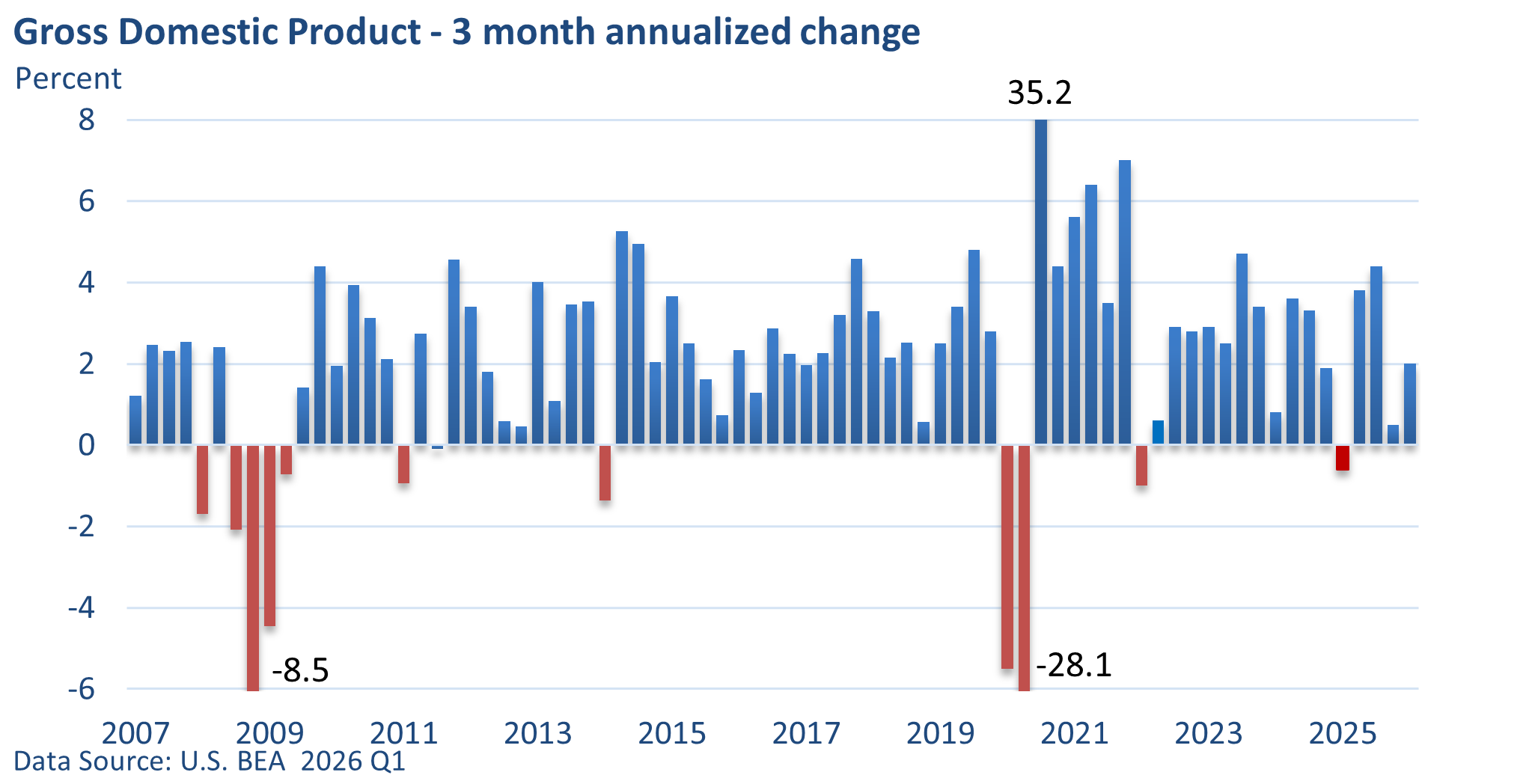
On Thursday, the US Bureau of Economic Analysis reported that Gross Domestic Product (GDP), the largest measure of goods and services, expanded at an annual rate of 2.0% in the first quarter.
Bar chart of quarterly GDP growth (3-month annualized) from 2007 to 2025, blue bars positive and red bars negative; notable declines around 2009 (-8.5%) and 2020 (-28.1%). Data from BEA, Q1 2026.
It was a respectable showing, underscoring the economy’s continued resilience despite ongoing uncertainty.

Although consumer spending, which accounts for nearly 70% of GDP (U.S. BEA), moderated, the AI boom and seemingly insatiable demand for data center–related equipment provided a critical pillar of support for the economy in the first quarter.

In fact, business spending on AI accounted for nearly half of GDP’s rise in Q1. A rebound in government spending and a return of workers (public and private-sector contractors) following the government shutdown in Q4 also aided output. That’s unlikely to repeat in the current quarter.

Separately, Federal Reserve Chief Jay Powell delivered his final press conference on Wednesday. As expected, the Fed held its key rate steady at 3.50–3.75%. Powell’s term concludes this month, with his successor, Kevin Warsh, expected to be confirmed in the coming days.

Yet, Powell’s final meeting as Fed chair wasn’t devoid of drama. He plans to remain at the Fed, as his concurrent term as a Fed governor ends in early 2028. He didn’t indicate how long he intends to serve.

Meanwhile, three Fed officials who voted in favor of holding rates steady favored shifting the Fed’s rate-cut bias to neutral amid worries about inflation.

Even so, the slightly more hawkish tone didn’t rattle investors. With Powell on his way out as Fed chief, focus has shifted to what comes next at the Fed. Instead, investors stayed focused on solid growth and strong Q1 earnings.

Last week, the S&P 500 and the tech-heavy Nasdaq touched new highs on Thursday and added to gains on Friday.

author avatar
Mark Chandik

Reproduction Prohibited without Express Permission. Copyright FDP Wealth Management. All rights reserved. Advisory Services offered through FDP Wealth Management, LLC, a state Registered Investment Adviser and Valmark Advisers, Inc. a SEC Registered Investment Advisor. Securities offered through ValMark Securities, Inc., Member FINRA/SIPC. 130 Springside Drive, Suite 300, Akron, OH 44333-2431 800.765.5201 Prosperity Partners and FDP Wealth Management, LLC are separate entities from ValMark Securities, Inc. and Valmark Advisers, Inc. Prosperity Partners, FDP Wealth Management, LLC, ValMark Securities, Inc., Valmark Advisers Inc., and their representatives do not offer tax advice. You should consult your tax professional regarding your individual circumstances. Indices are unmanaged and cannot be invested directly in. Past performance is not a guarantee of future results.

Indices are unmanaged and do not incur fees, one cannot directly invest in an index. You should consult your tax professional regarding your individual circumstances. This information is provided by Financial Jumble, LLC. Financial Jumble, LLC is a separate entity from ValMark Securities, Inc. and ValMark Advisers, Inc.

RELATED POSTS

The New Railroads: Deconding the AI Boom

The AI boom has introduced an entirely new vocabulary. Just a few years ago, terms like OpenAI, Anthropic, hyperscalers, GPUs, and compute were mostly confined to niche tech circles. Today, they dominate headlines and boardroom conversations.

Stocks and Elections

Stocks surged in a broad-based rally on Wednesday. But sentiment shifted abruptly on Thursday as investors assessed the outcome and its potential implications for the dominant technology and AI trade. That reassessment triggered a sharp pullback, sending shares much lower.

The American Economic Boom

You’d never know it from sluggish job growth or consumer surveys showing confidence near rock bottom levels, but economic indicators that measure actual activity tell a much different story, with many indicators reflecting a surprising degree of strength.

The End of an Era – The Disappearance of Cheap Stuff

To better understand what’s been happening to inflation, let’s take a long-term look at two major inflation categories: the price of services and consumer goods.

Is Inflation Becoming Entrenched in the Economic Fabric?

Congress has long tasked the Federal Reserve with pursuing two core objectives: price stability and maximum employment, commonly known as the Fed’s dual mandate.