

author avatar
Mark Chandik

Aug 5, 2026

A Murky Fed Message

“All hat and no cattle” is a traditional cowboy phrase—especially popular in Texas—describing someone who is basically a poser: plenty of talk, lots of sparkle, but little to back it up.

It’s all talk and no action, and that’s the takeaway from Federal Reserve Chair Kevin Warsh’s second Fed meeting and subsequent press conference.

In a 9-3 split decision, the Federal Reserve left its key rate, the fed funds rate, unchanged at 3.50–3.75%. While it wasn’t entirely unexpected, Warsh’s tough talk in June raised the possibility that the Fed might raise its key rate last week.

The three dissenters favored a quarter-point hike.

Once again, Warsh came out swinging against inflation, insisting that the Fed will deliver on its goal to bring down inflation. He pointed out that inflation has been above the Fed’s target of 2% for over five years. His rhetoric and posture were unwavering and resolute.

But achieving the Fed’s goal of price stability hasn’t been easy. The Fed’s tools aren’t perfect. It’s not like a recipe. You know, mix several pre-measured ingredients and bake at a set temperature for a set amount of time.

Historically, the preferred tool in its toolkit has been interest rates.

But the lack of a rate hike on Wednesday, no hint of a rate hike in September, and a vague explanation as to why the Fed isn’t backing up its tough talk with action left investors, especially bond investors, with a feeling that the Fed’s bark is louder than its bite.

Warsh’s comments seemed to suggest the bond market was doing the heavy lifting for the Fed. He pointed out that the intra-meeting rise in bond yields was “among the most significant in the last two decades.”

The graphic below illustrates the rise in longer-term bond yields between the two meetings. And yields have edged higher since the Wednesday meeting.

Notably, the 30-year Treasury yield, a bond primarily purchased by institutional investors such as pension funds, is at its highest level since 2007, per Bloomberg.
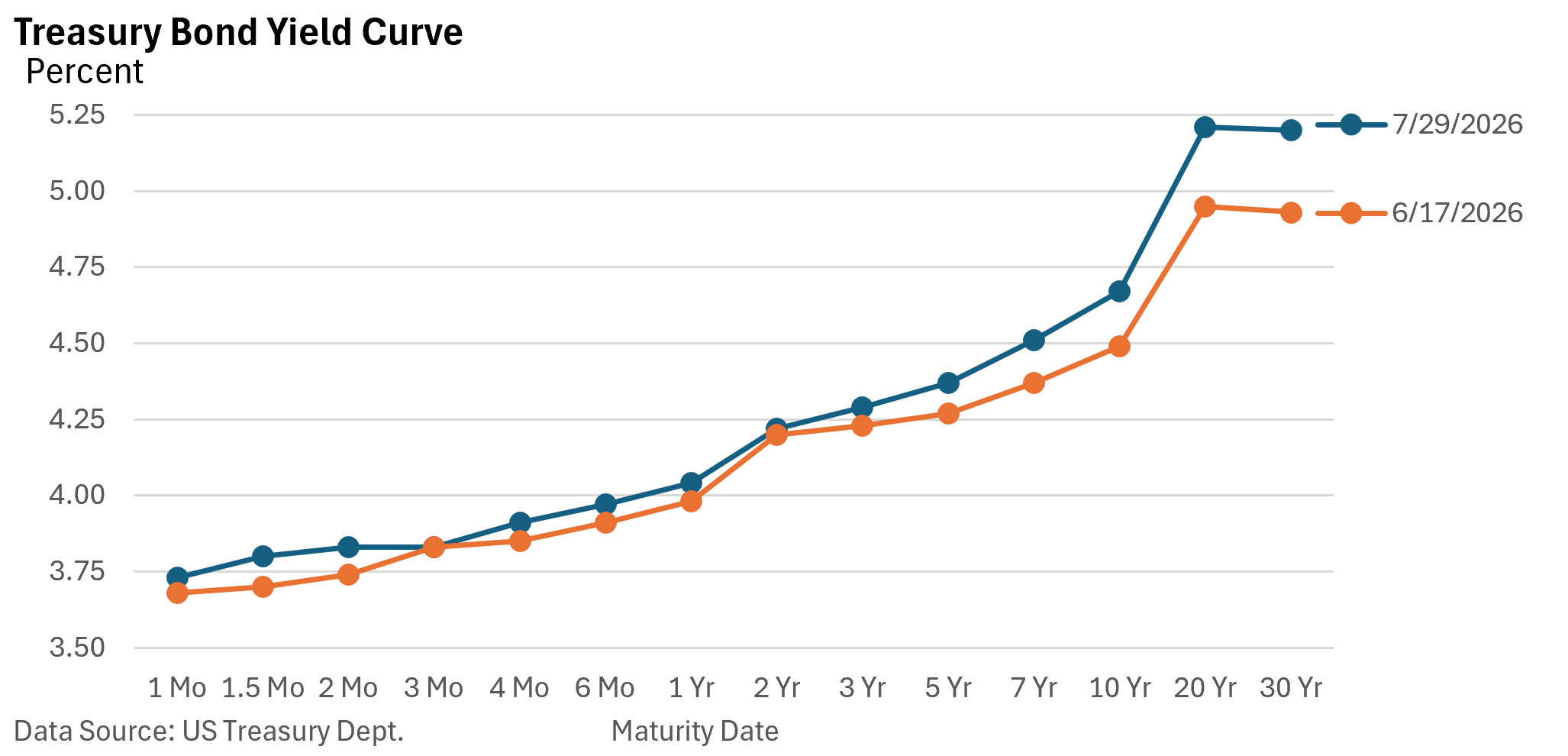
Treasury yield curve showing yields rising from short to long maturities with blue and orange lines representing two data series; data source: U.S. Treasury Department.
In other words, bond investors have gradually backed away from bonds (bond prices and bond yields move in opposite directions) amid worries about inflation and the Fed’s credibility in its fight against inflation.

Additionally, the large federal deficit and enormous need for capital for the AI buildout may also be playing a role.

Perhaps investors simply need to adjust to his style. Over the last two decades, investors have grown accustomed to guidance, signaling, and plain talk about the Fed’s intentions.

That’s not Warsh’s style.

Maybe the Fed chairman simply didn’t have the votes to raise rates.  But I can’t stress enough how unusual it would be for a Fed chairman to side with the minority. It’s never happened.

There are those who believe inflation has peaked, and rate hikes aren’t needed. And Fed policy can’t produce one drop of oil.

Even so, the lack of congruence between tough talk and inaction left investors questioning the Fed’s commitment to its message.

author avatar
Mark Chandik

Reproduction Prohibited without Express Permission. Copyright FDP Wealth Management. All rights reserved. Advisory Services offered through FDP Wealth Management, LLC, a state Registered Investment Adviser and Valmark Advisers, Inc. a SEC Registered Investment Advisor. Securities offered through ValMark Securities, Inc., Member FINRA/SIPC. 130 Springside Drive, Suite 300, Akron, OH 44333-2431 800.765.5201 Prosperity Partners and FDP Wealth Management, LLC are separate entities from ValMark Securities, Inc. and Valmark Advisers, Inc. Prosperity Partners, FDP Wealth Management, LLC, ValMark Securities, Inc., Valmark Advisers Inc., and their representatives do not offer tax advice. You should consult your tax professional regarding your individual circumstances. Indices are unmanaged and cannot be invested directly in. Past performance is not a guarantee of future results.

Indices are unmanaged and do not incur fees, one cannot directly invest in an index. You should consult your tax professional regarding your individual circumstances. This information is provided by Financial Jumble, LLC. Financial Jumble, LLC is a separate entity from ValMark Securities, Inc. and ValMark Advisers, Inc.

RELATED POSTS

Rising Mortgage Rates: A Consequence of Higher Treasury Yields

Mortgage rates have moved sharply higher in recent months, creating a noticeable headwind for homebuyers and homeowners looking to refinance.

When Bad News Is Good News

Released by the US Bureau of Labor Statistics (BLS), September’s nonfarm payroll report came in lighter than expected, and the unemployment rate unexpectedly inched higher.

Rising Bond Yields and the Stock Market

“Bond Selloff Deepens After 30-Year Yield Hits Highest Level Since 2004,” declared Bloomberg News last week. CNBC echoed the sentiment with “10-Year Treasury Yield Rockets to 19-Year High.”

The Fed Hikes Rates: What Investors Should Know

In his opening remarks in a speech last month at the Federal Reserve Bank of Kansas City’s Economic Symposium, Fed Chief Kevin Warsh said, “(Event) planners have some recreation options lined up for later today.

A Hotter August CPI Builds Rate Hike Momentum

First, let’s clarify that any attempt to predict the Federal Reserve’s actions this week is, at best, an educated guess. Fed Chair Kevin Warsh has struck a hawkish tone, and the odds of a quarter-point increase in the fed funds rate are 87%, according to the CME Group. It was 59% on September 4.