





Nov 23, 2026

Consumers Stay Strong, Investors Lose Their Footing

Throughout the year, higher gasoline prices have been a frequent source of frustration for many people. Every trip to the pump seemingly leaves less money available for dining, entertainment, and other discretionary purchases.

In October, the US Census reported that retail sales rose 0.2%, as a 1.6% decline in the volatile auto sales category slowed overall sales. Outside of autos, sales rose a solid 0.6%. Remove autos and gas station sales, which helps filter out changes in gas prices, sales were up 0.5%.
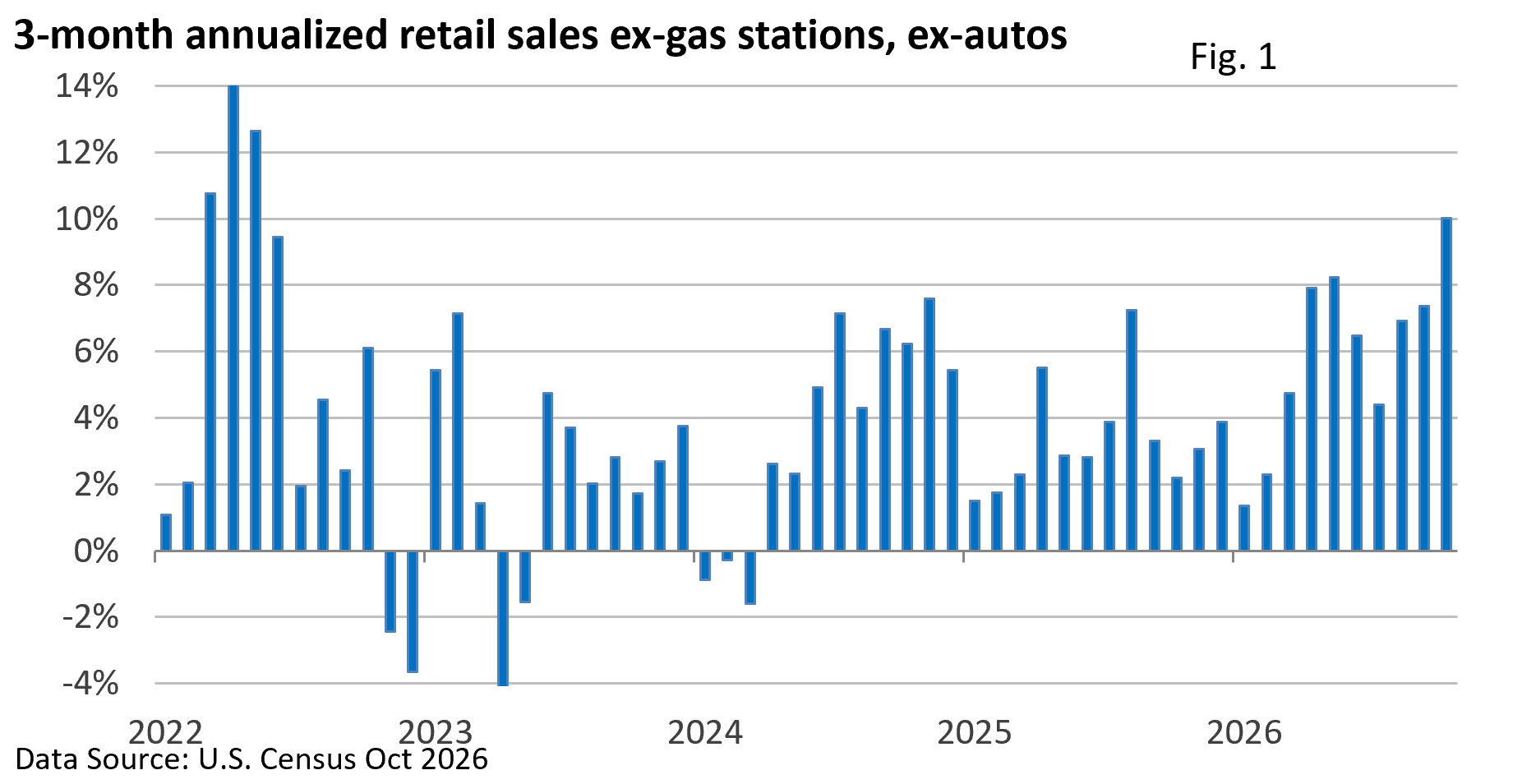
Notably, Figure 1 illustrates that despite the steep rise in gasoline prices, spending continues to outpace inflation. Nonetheless, while there is some resistance to higher prices, spending is rising.

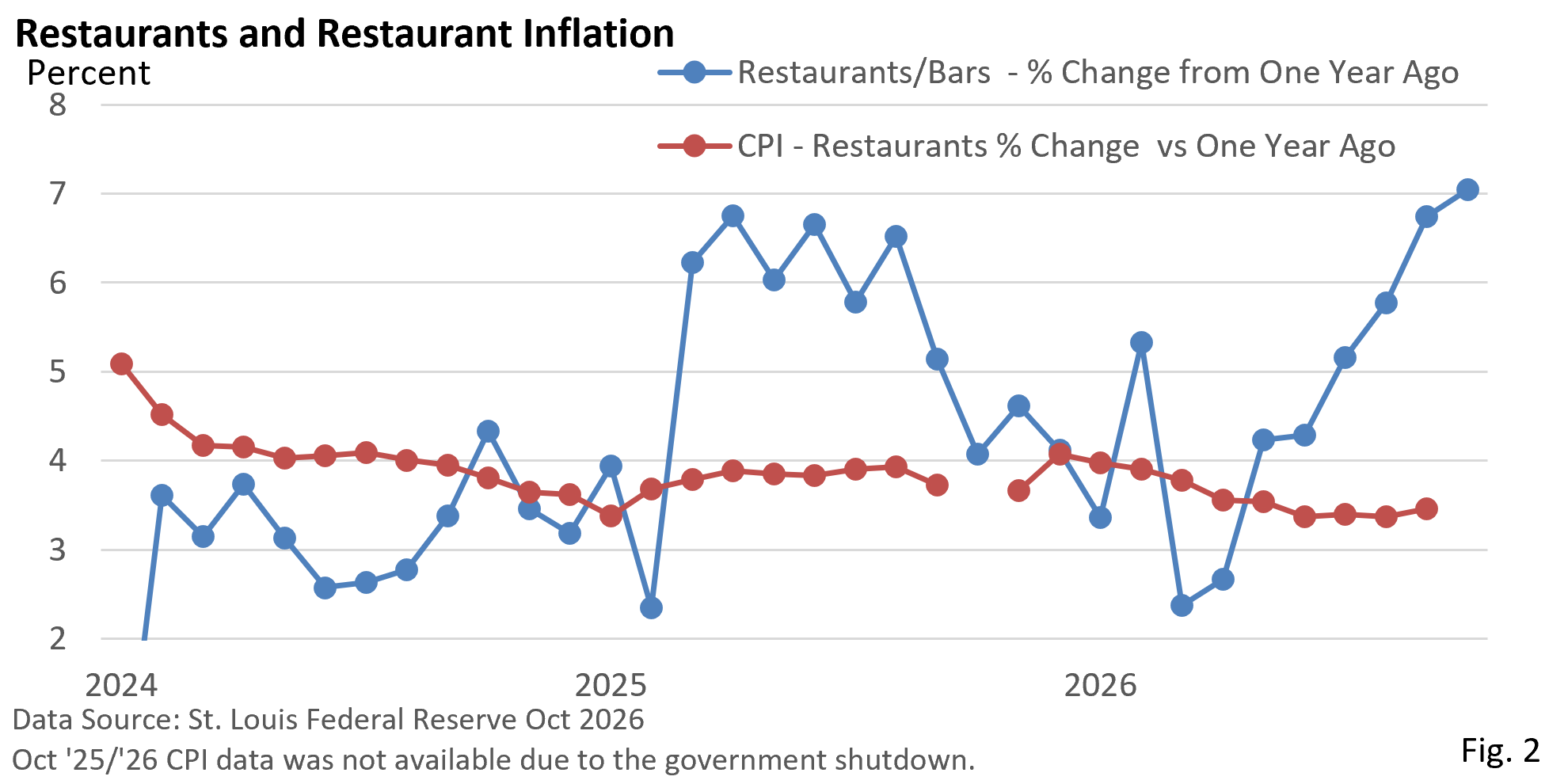
One of the clearest signs that consumers are still spending is restaurant activity, a quintessential form of discretionary spending. Despite widespread complaints about high prices, consumers continue to open their wallets (Figure 2).

The blue line highlights the annual change in spending at restaurants and bars, while the red line highlights the annual rate of inflation at those same locations.
Market pullback

Much of the recent weakness has been concentrated in areas tied to the AI theme. While many technology companies continue to report strong growth, investors are scrutinizing spending plans, competitive pressures, and the profitability of AI-related investments.

Concerns surrounding the broader AI ecosystem have led to a reassessment of valuations across some of the market’s biggest winners.

More broadly, the pullback appears driven by sentiment rather than a sudden deterioration in economic fundamentals. Earnings growth remains positive, consumer spending continues to hold up, and recession fears remain subdued.

However, the departure of CEO and co-founder Jensen Huang from Nvidia (NVDA $126), the prospect of tighter U.S. restrictions on chip exports to Southeast Asian data centers, and uncertainty surrounding the scope of local data center moratoriums have injected a renewed dose of uncertainty into the market.

After a strong run for stocks, investors have become less willing to pay premium valuations.

author avatar
Mark Chandik

Reproduction Prohibited without Express Permission. Copyright FDP Wealth Management. All rights reserved. Advisory Services offered through FDP Wealth Management, LLC, a state Registered Investment Adviser and Valmark Advisers, Inc. a SEC Registered Investment Advisor. Securities offered through ValMark Securities, Inc., Member FINRA/SIPC. 130 Springside Drive, Suite 300, Akron, OH 44333-2431 800.765.5201 Prosperity Partners and FDP Wealth Management, LLC are separate entities from ValMark Securities, Inc. and Valmark Advisers, Inc. Prosperity Partners, FDP Wealth Management, LLC, ValMark Securities, Inc., Valmark Advisers Inc., and their representatives do not offer tax advice. You should consult your tax professional regarding your individual circumstances. Indices are unmanaged and cannot be invested directly in. Past performance is not a guarantee of future results.

Indices are unmanaged and do not incur fees, one cannot directly invest in an index. You should consult your tax professional regarding your individual circumstances. This information is provided by Financial Jumble, LLC. Financial Jumble, LLC is a separate entity from ValMark Securities, Inc. and ValMark Advisers, Inc.

RELATED POSTS

The New Railroads: Deconding the AI Boom

The AI boom has introduced an entirely new vocabulary. Just a few years ago, terms like OpenAI, Anthropic, hyperscalers, GPUs, and compute were mostly confined to niche tech circles. Today, they dominate headlines and boardroom conversations.

Stocks and Elections

Stocks surged in a broad-based rally on Wednesday. But sentiment shifted abruptly on Thursday as investors assessed the outcome and its potential implications for the dominant technology and AI trade. That reassessment triggered a sharp pullback, sending shares much lower.

The American Economic Boom

You’d never know it from sluggish job growth or consumer surveys showing confidence near rock bottom levels, but economic indicators that measure actual activity tell a much different story, with many indicators reflecting a surprising degree of strength.

The End of an Era – The Disappearance of Cheap Stuff

To better understand what’s been happening to inflation, let’s take a long-term look at two major inflation categories: the price of services and consumer goods.

Is Inflation Becoming Entrenched in the Economic Fabric?

Congress has long tasked the Federal Reserve with pursuing two core objectives: price stability and maximum employment, commonly known as the Fed’s dual mandate.