





author avatar
Mark Chandik

Sep 8, 2025

No Hire, No Fire Economy

For starters, the title is a simplified five-word summary of the labor market. Recall that last week, we explored the low level of layoffs. This week, we shift the focus to hiring trends. But first, let’s take a closer look at the numbers from the latest jobs report.

The US BLS reported that nonfarm payrolls rose just 22,000 in August, below the forecast of 75,000, according to the Wall Street Journal. Revisions to the last two months were minor.

The unemployment rate ticked up from 4.2% in July to 4.3% in August, the highest since October 2021.

When it comes to job creation, most of what we see is occurring in health care. Since the beginning of the year, 456,000 net new jobs have been added in health care, which accounts for the lion’s share of private sector jobs. There has been a net gain of 511,000 in private sector jobs, per US BLS data.

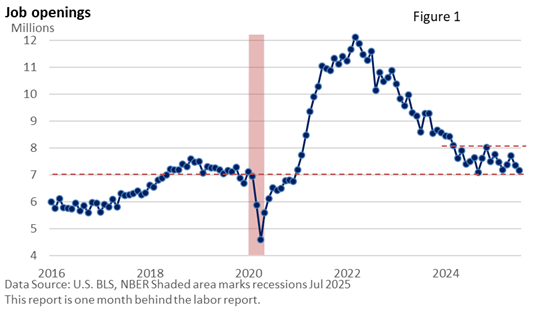
There are jobs that are available, as evidenced by Figure 1, though they have declined.
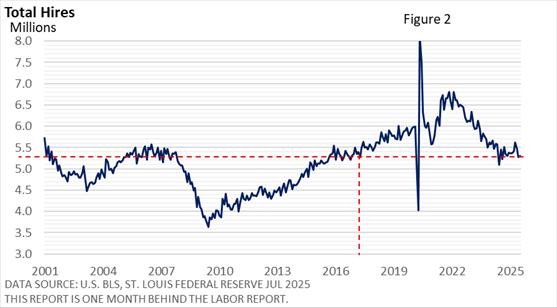
But hiring has slowed—Figure 2. Please note that total hires include all hires, not just net new jobs. It reflects gross (total) hiring activity, which is naturally much larger than net job growth (nonfarm payrolls).
What does last Friday’s jobs report mean for investors?

The data strengthens the case for a rate cut at the Federal Reserve’s upcoming two-day meeting on September 16–17. Signs of a cooling labor market are evident, and the Fed will likely feel compelled to act.

The key question now is how aggressive that action will be. Will the Fed opt for a modest 0.25 percentage-point cut, or will it take a bolder step with a 0.50 percentage-point reduction in the federal funds rate?

Yet, it’s not as though the economy appears to be teetering on the brink of recession.

The Atlanta Fed’s GDPNow model—a real-time estimate of economic growth—is projecting 3.0% annualized GDP growth for Q3 (September 4 is the latest projection).

While it’s still early in the quarter and the model currently reflects mostly July’s data, the current projection suggests that economic momentum hasn’t stalled. But the Fed’s focus is shifting away from still-elevated inflation and toward the risks that appear to be rising in the labor market.

author avatar
Mark Chandik

Reproduction Prohibited without Express Permission. Copyright FDP Wealth Management. All rights reserved. Advisory Services offered through FDP Wealth Management, LLC, a state Registered Investment Adviser and Valmark Advisers, Inc. a SEC Registered Investment Advisor. Securities offered through ValMark Securities, Inc., Member FINRA/SIPC. 130 Springside Drive, Suite 300, Akron, OH 44333-2431 800.765.5201 Prosperity Partners and FDP Wealth Management, LLC are separate entities from ValMark Securities, Inc. and Valmark Advisers, Inc. Prosperity Partners, FDP Wealth Management, LLC, ValMark Securities, Inc., Valmark Advisers Inc., and their representatives do not offer tax advice. You should consult your tax professional regarding your individual circumstances. Indices are unmanaged and cannot be invested directly in. Past performance is not a guarantee of future results.

Indices are unmanaged and do not incur fees, one cannot directly invest in an index. You should consult your tax professional regarding your individual circumstances. This information is provided by Financial Jumble, LLC. Financial Jumble, LLC is a separate entity from ValMark Securities, Inc. and ValMark Advisers, Inc.

RELATED POSTS

A Hotter August CPI Builds Rate Hike Momentum

First, let’s clarify that any attempt to predict the Federal Reserve’s actions this week is, at best, an educated guess. Fed Chair Kevin Warsh has struck a hawkish tone, and the odds of a quarter-point increase in the fed funds rate are 87%, according to the CME Group. It was 59% on September 4.

Behind the Jobs Report

On Friday, the US Bureau of Labor Statistics (BLS) reported that nonfarm payrolls rose by a much greater-than-expected 162,000 jobs in August. The unemployment rate held steady at 4.1%.

Location Location Location

The graphic below compares the change in home prices, adjusted for inflation, for various US cities. For example, the average USA home price has topped inflation by 238% since 1948. Why has there been such a wide trajectory in prices, and why have they proven so persistent?

Rising Yields Faily to Derail Stocks

This year, the stock market has risen significantly. Lingering worries about oil prices, inflation, the war with Iran, and the possibility of an AI bubble haven’t subsided. But the economy is expanding, corporate profits have been strong, and the S&P 500 Index set a new high last week, according to the Wall Street Journal.

All Gas, No Brakes: Profits Soar in Q2

In a solid earnings season, we’d generally expect S&P 500 companies to deliver double-digit profit growth, meaning earnings growth of at least 10% versus a year ago (20% tops). That’s not a hard-and-fast rule, but it provides a useful benchmark for evaluating the strength of a quarter.