





author avatar
Mark Chandik

Aug 17, 2026

Rising Yields Faily to Derail Stocks

This year, the stock market has risen significantly. Lingering worries about oil prices, inflation, the war with Iran, and the possibility of an AI bubble haven’t subsided.

But the economy is expanding, corporate profits have been strong, and the S&P 500 Index set a new high last week, according to the Wall Street Journal.

Nonetheless, while stocks are up this year, we’ve also watched Treasury bond yields rise, as evidenced by the graphic and weekly table of returns below.
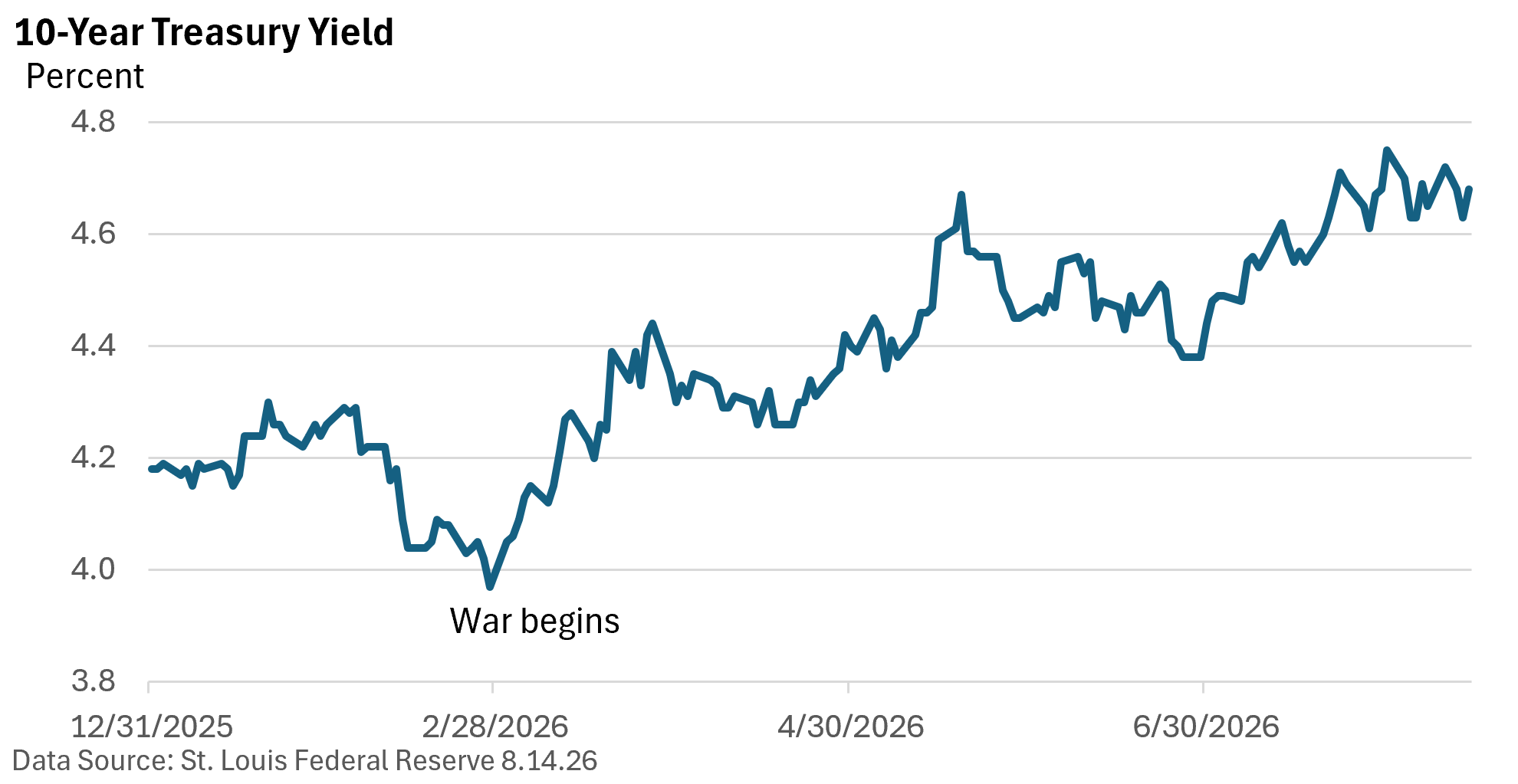
Trend line of 10-year Treasury yield rising from about 4.2% to around 4.8% over six months, with 'War begins' marker at mid-left.
Note that yields briefly snuck under 4% just before the war started. In part, blame rising oil prices and fears that higher oil and other commodities might boost overall inflation at home.

For bondholders, rising yields translate into lower prices, since yields and prices move in opposite directions.

For those looking to buy a home and lock in a mortgage rate, the 30-year mortgage tracks the 10-year yield closely.

Just before the war began, Freddie Mac’s weekly survey recorded an average rate of 5.98%. As of last Thursday, the 30-year mortgage averaged 6.67%, according to the survey.

Yet, despite higher long-term Treasury yields, stocks have had a good run this year, though the market has experienced bouts of volatility, which is normal.

You see, rising bond yields would be expected to create stiffer headwinds for equities.

If an investor can earn a higher return from a Treasury bond, they may choose Treasuries over stocks, as attractive yields could encourage some to reallocate funds within their portfolios.

Higher yields could also slow economic growth, which in turn would likely slow corporate profits.

But the stock market has defied the rise in yields, as booming corporate profits have provided a strong tailwind.

From another perspective, rising bond yields have yet to put downward pressure on stocks and may have simply slowed the market’s rise.

author avatar
Mark Chandik

Reproduction Prohibited without Express Permission. Copyright FDP Wealth Management. All rights reserved. Advisory Services offered through FDP Wealth Management, LLC, a state Registered Investment Adviser and Valmark Advisers, Inc. a SEC Registered Investment Advisor. Securities offered through ValMark Securities, Inc., Member FINRA/SIPC. 130 Springside Drive, Suite 300, Akron, OH 44333-2431 800.765.5201 Prosperity Partners and FDP Wealth Management, LLC are separate entities from ValMark Securities, Inc. and Valmark Advisers, Inc. Prosperity Partners, FDP Wealth Management, LLC, ValMark Securities, Inc., Valmark Advisers Inc., and their representatives do not offer tax advice. You should consult your tax professional regarding your individual circumstances. Indices are unmanaged and cannot be invested directly in. Past performance is not a guarantee of future results.

Indices are unmanaged and do not incur fees, one cannot directly invest in an index. You should consult your tax professional regarding your individual circumstances. This information is provided by Financial Jumble, LLC. Financial Jumble, LLC is a separate entity from ValMark Securities, Inc. and ValMark Advisers, Inc.

RELATED POSTS

All Gas, No Brakes: Profits Soar in Q2

In a solid earnings season, we’d generally expect S&P 500 companies to deliver double-digit profit growth, meaning earnings growth of at least 10% versus a year ago (20% tops). That’s not a hard-and-fast rule, but it provides a useful benchmark for evaluating the strength of a quarter.

A Murky Fed Message

“All hat and no cattle” is a traditional cowboy phrase—especially popular in Texas—describing someone who is basically a poser: plenty of talk, lots of sparkle, but little to back it up. It’s all talk and no action, and that’s the takeaway from Federal Reserve Chair Kevin Warsh’s second Fed meeting and subsequent press conference.

Social Security and You

The trust fund that supports Social Security retirement benefits is projected to be depleted in the fourth quarter of 2032. At that point, ongoing revenue from Social Security payroll taxes is expected to cover approximately 78% of scheduled retirement benefits.

Chips in Flux

Since the most recent market low at the end of March, semiconductors (microchips, commonly called chip stocks) have been a very popular trade. In less than three months, the PHLX Semiconductor Index has more than doubled—see Figure 1.

Oil Has Given Back Gains, but Gasoline—Not So Much

Just before the start of the war, WTI crude oil traded at about $67 per barrel, according to MarketWatch. By last week, the price of oil had fallen to within about $1 of its pre-war price.