





author avatar
Mark Chandik

Jul 14, 2025

Inside the Front Door of the Housing Market

Home sales have fallen sharply over the last three years, with sales near the levels we last saw in 2008, according to the National Association of Realtors. Yet, unlike in 2008, housing prices haven’t collapsed this time around.
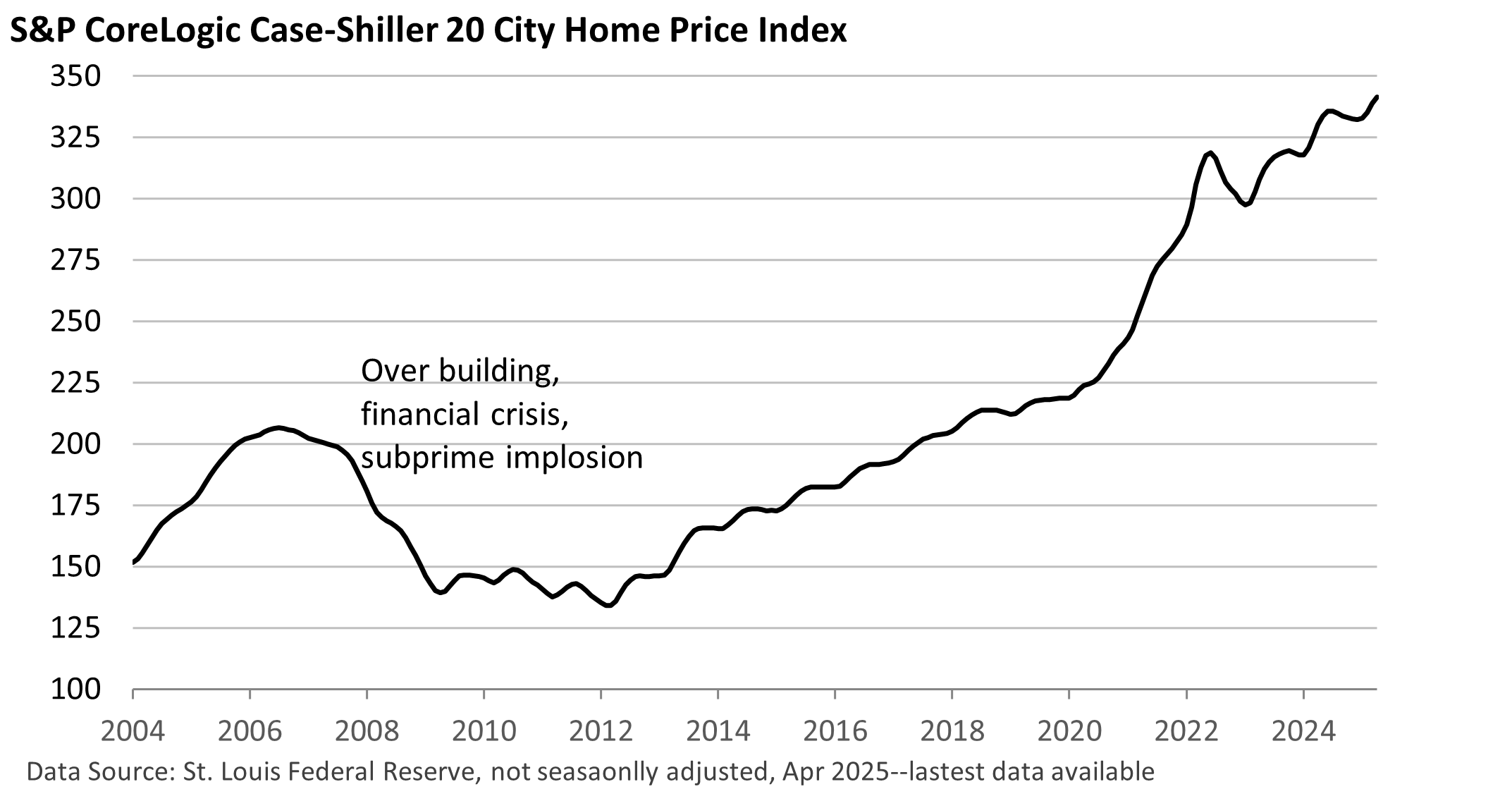
Over the past 15 years, lending standards have improved significantly, and buyers are now making larger down payments, both of which help reduce the risk of homeowners walking away at the first sign of financial stress.

But today’s high prices, coupled with high mortgage rates, have discouraged or simply shut some buyers out of the market.

Further, the rise in mortgage rates brought an unintended—and, in hindsight, unwelcome—side effect: some homeowners who might have listed their properties chose to stay put, reluctant to give up the ultra-low mortgage rates they locked in when borrowing costs were at or below 3%.

Up until now, that has restricted supply and supported prices. That, however, may be changing.

I would like to sell vs I need to sell

As life’s circumstances change, the desire to move is replaced with the necessity to move, and homeowners list their homes and enter the market for a new one.

According to data from Redfin, sellers now outnumber buyers by nearly 500,000, the widest since at least 2013. And the growing imbalance between buyers and sellers could put downward pressure on prices.
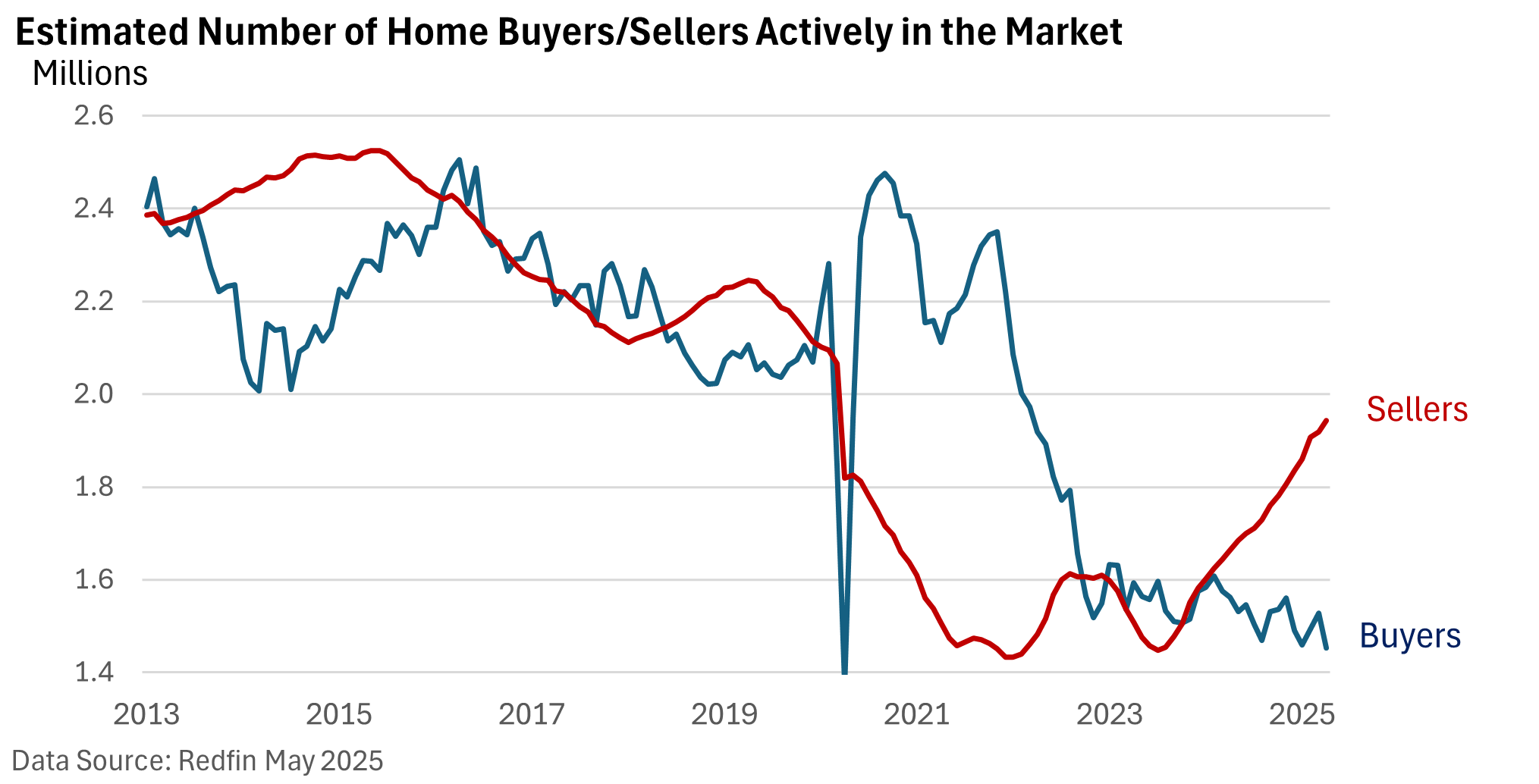
How much pressure? Any forecast is simply an educated guess, but Redfin believes home prices in the US could drop 1% year over year by the end of 2025.

A sharp drop in mortgage rates would likely draw potential buyers that have been on the sidelines.

But it could also prompt hesitant homeowners to list their properties and make long-delayed moves, easing some of the inventory constraints in today’s tight housing market.

author avatar
Mark Chandik

Reproduction Prohibited without Express Permission. Copyright FDP Wealth Management. All rights reserved. Advisory Services offered through FDP Wealth Management, LLC, a state Registered Investment Adviser and Valmark Advisers, Inc. a SEC Registered Investment Advisor. Securities offered through ValMark Securities, Inc., Member FINRA/SIPC. 130 Springside Drive, Suite 300, Akron, OH 44333-2431 800.765.5201 Prosperity Partners and FDP Wealth Management, LLC are separate entities from ValMark Securities, Inc. and Valmark Advisers, Inc. Prosperity Partners, FDP Wealth Management, LLC, ValMark Securities, Inc., Valmark Advisers Inc., and their representatives do not offer tax advice. You should consult your tax professional regarding your individual circumstances. Indices are unmanaged and cannot be invested directly in. Past performance is not a guarantee of future results.

Indices are unmanaged and do not incur fees, one cannot directly invest in an index. You should consult your tax professional regarding your individual circumstances. This information is provided by Financial Jumble, LLC. Financial Jumble, LLC is a separate entity from ValMark Securities, Inc. and ValMark Advisers, Inc.

RELATED POSTS

Looking Past the Pump: A Granular Look at Gasoline Prices

There are fears that higher prices will exacerbate inflation and hurt the economy, as cash that might have gone to other items will be diverted to the gas tank.

The War and Its Impact – So Far

What is the efficient market theory? Textbooks have been written to fully explain the theory. But if we can sum it up in one sentence: Assets, such as stocks, reflect all publicly available information. It is a foundational principle of finance.

Navigating Volatility

Over the weekend, global markets were shaken by significant geopolitical developments, as the US and Israel carried out coordinated strikes on Iran that resulted in the death of Iran’s Supreme Leader. Iran responded with missile strikes, which escalated tensions and heightened uncertainty in global markets.

Q4 Government Shutdown Drafs on GDP Supreme Court Blocks Tariff Plan

The government shutdown proved to be a far greater drag on the economy than earlier estimates indicated. On Friday, the U.S. BEA reported that fourth-quarter Gross Domestic Product (GDP), the largest measure of economic output, grew at a 1.4% annualized pace. This compares with a 4.4% annualized pace in Q3.

Revisiting 2025 Employment

The US Bureau of Labor Statistics published its final benchmark revisions covering employment during the 12‑month period between April 2024 and March 2025. The revisions showed that payrolls were revised lower by 898,000 jobs compared with the originally reported figures.