




author avatar
Mark Chandik

Dec 2, 2025

Data Disconnect

Retailers are ringing up solid earnings, but consumer confidence surveys tell a different story, suggesting the mood is far from upbeat. This disconnect raises a big question: if shoppers are still buying, as we will highlight in a moment, why do they feel so uneasy about the economy?

The graphic below illustrates the conundrum. The University of Michigan’s consumer sentiment survey is near an all-time low.
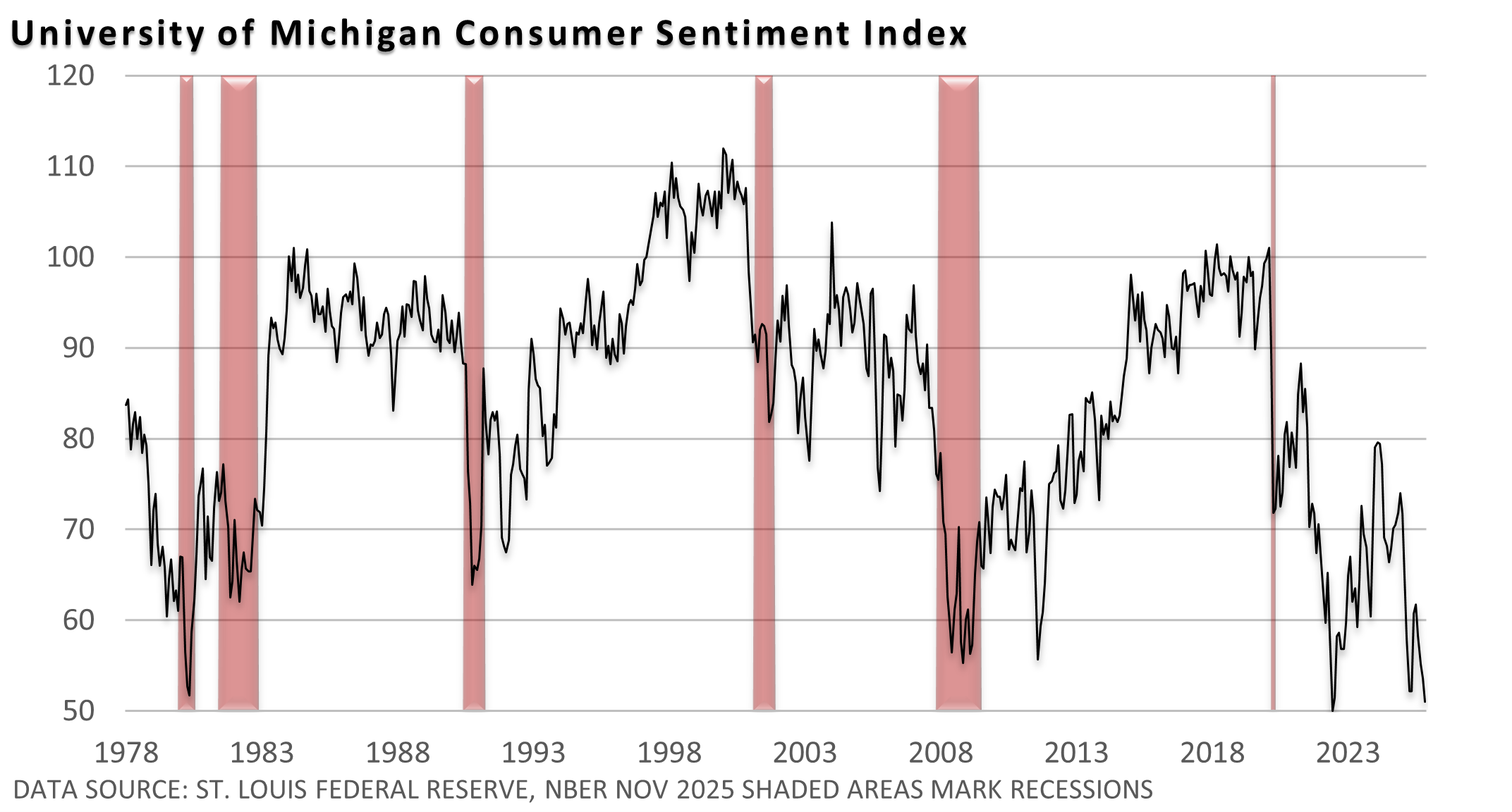
The Conference Board, which also releases a monthly survey, doesn’t reflect such dire conditions, but its results are far from a ringing endorsement of today’s economic environment.

What people say and what they actually do don’t always match up. While a few big retail stores like Target (TGT $91) and Home Depot (HD $357) struggled in the third quarter, most shone.

Lowe’s (LOW $242) said it sees a home-improvement turnaround (Wall Street Journal), retail giant Walmart (WMT $111) hiked its earnings forecast (CNBC), and Urban Outfitters (URBN $74) had a strong quarter (Wall Street Journal).

Best Buy (BBY $79) also raised its sales forecast, Kohl’s reported an unexpected profit in the third quarter, and TJX Cos. (TJX $152) issued a strong outlook (CNBC).

In a strong economy, there will be a few misfires. In a recession, a few firms manage to execute exceedingly well. But the center of gravity for the retailers that have reported has been upbeat.

Possible reason for the disconnect

Consumer confidence surveys capture how people feel about the economy and their financial outlook, not what they’re actually doing with their money right now.

Prices aren’t climbing as fast as they were a few years ago, but they’re still high. And while higher-income households appear to be powering much of the retail strength, lower-income consumers are feeling squeezed.

Bottom line—consumers are still spending, and that supports overall economic activity and the economy as we head into the final month of the year.

author avatar
Mark Chandik

Reproduction Prohibited without Express Permission. Copyright FDP Wealth Management. All rights reserved. Advisory Services offered through FDP Wealth Management, LLC, a state Registered Investment Adviser and Valmark Advisers, Inc. a SEC Registered Investment Advisor. Securities offered through ValMark Securities, Inc., Member FINRA/SIPC. 130 Springside Drive, Suite 300, Akron, OH 44333-2431 800.765.5201 Prosperity Partners and FDP Wealth Management, LLC are separate entities from ValMark Securities, Inc. and Valmark Advisers, Inc. Prosperity Partners, FDP Wealth Management, LLC, ValMark Securities, Inc., Valmark Advisers Inc., and their representatives do not offer tax advice. You should consult your tax professional regarding your individual circumstances. Indices are unmanaged and cannot be invested directly in. Past performance is not a guarantee of future results.

Indices are unmanaged and do not incur fees, one cannot directly invest in an index. You should consult your tax professional regarding your individual circumstances. This information is provided by Financial Jumble, LLC. Financial Jumble, LLC is a separate entity from ValMark Securities, Inc. and ValMark Advisers, Inc.

RELATED POSTS

The Latest on Inflation

The latest Consumer Price Index (CPI) report from the U.S. Bureau of Labor Statistics (BLS) provided investors with a modest sense of relief when it was released last Wednesday.

Hiring Ramps Up

Well, that was a pleasant surprise. The US Bureau of Labor Statistics (BLS) reported that nonfarm payrolls rose by 172,000 in May, more than double the 80,000 economists had expected, according to a Wall Street Journal survey.

An AI Boost to Jobs

What’s driving bond yields higher? Since the recent low, the 10-year Treasury yield has climbed nearly three-quarters of a percentage point. The 10-year is a key benchmark because many borrowing rates, including mortgage rates, closely track its movements.

Bond Yields on the Rise

What’s driving bond yields higher? Since the recent low, the 10-year Treasury yield has climbed nearly three-quarters of a percentage point. The 10-year is a key benchmark because many borrowing rates, including mortgage rates, closely track its movements.

A Profits Gusher

S&P 500 corporate profits are surging in the first quarter, helping to push both the S&P 500 Index and the tech-heavy Nasdaq Composite to new highs this month.